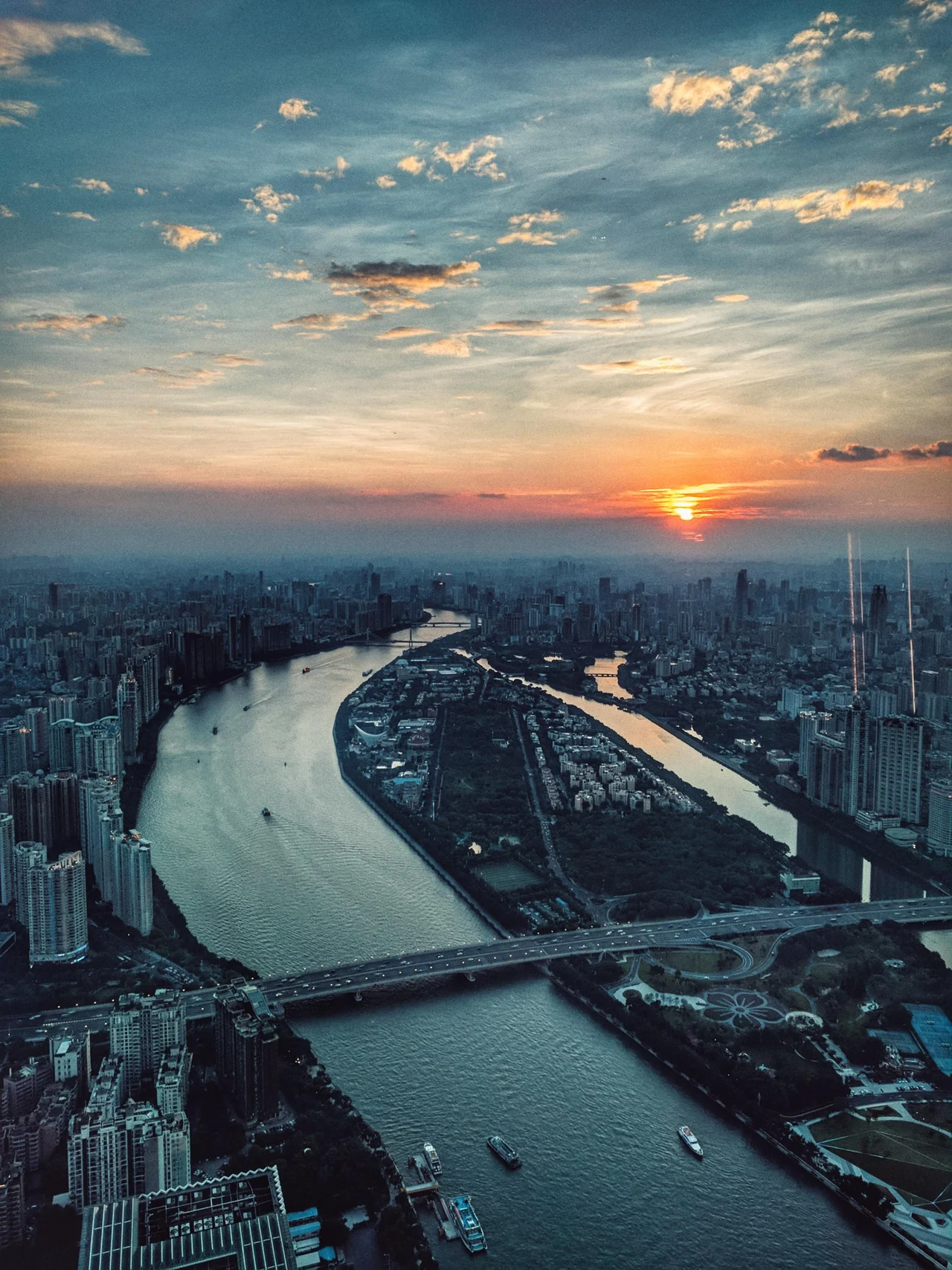

Canton Tower
The city couldn't agree on what to call it. When Guangzhou launched a public naming contest for its new tower, over 10,000 entries arrived and the winning submission — Haixin Tower, an allusion to the Maritime Silk Road — was quietly set aside as too obscure. So the residents named it themselves, multiple times and with some affection: "Slim Waist" for its cinched hyperboloid silhouette; "Twisted Firewood" (which also means "stubborn" in Cantonese); and one name that was a Cantonese homophone of "epilepsy." Eventually, the official name Canton Tower stuck — though the nicknames never quite went away. At 600 meters tall, it is the second-tallest tower in the world, a piece of structural engineering that also functions as an accidental Rorschach test for a city with a personality too large for any single label.
Dutch Architects, Chinese Ambition
The tower was designed by Dutch architects Mark Hemel and Barbara Kuit of Information Based Architecture, working with Arup, the London-headquartered engineering firm. In 2004, their team won an international competition that drew entries from major architectural offices around the world. Construction began in 2005.
The structural concept, developed by Arup's team under structural engineer Professor Dr. Joop Paul, is built on three elements: columns, rings, and braces, combined using parametric design methods to achieve what Joop Paul described as "near mass customization" — a complex geometry assembled from individually customized but systematically produced components. The form it produces is a hyperboloid, a shape that appears to twist as it rises, narrowing dramatically at the waist before flaring outward again toward the top. The same structural logic governs the Adziogol Lighthouse in Ukraine, designed by Vladimir Shukhov in 1910, which the Canton Tower resembles in its underlying geometry.
The tower was topped out in 2009 and became operational on 29 September 2010, opening in time for the 2010 Asian Games in Guangzhou.
A Brief Reign at the Top
When Canton Tower opened, it briefly held the title of the tallest tower in the world, surpassing the CN Tower in Toronto which had held that record for over three decades. The title was short-lived — Tokyo Skytree, completed in 2012, took it back. Canton Tower also held the title of tallest structure in China until the Shanghai Tower was topped out on 3 August 2013.
Today it stands as the fifth-tallest freestanding structure in the world and the second-tallest tower. Rankings in this category shift as new structures are completed, but Canton Tower's position near the top of every list reflects the genuine ambition of the project — this was not a tower designed to merely function. It was designed to announce Guangzhou to the world as a city of the twenty-first century.
The rooftop observatory received its official opening in December 2011. Near the top, sixteen transparent "crystal" passenger cars, each 3.2 meters in diameter and capable of carrying four to six people, travel a track along the rim of the roof, taking 20 to 40 minutes to complete a circuit.
Light as Architecture
At night, the Canton Tower becomes something different. Most tall buildings are uplit from below; the Canton Tower glows from within. Each node of the tower's lighting system is individually controllable, allowing for animations and color changes that can run the full 600-meter height of the structure. Lighting designer Rogier van der Heide, then Global Leader of Arup Lighting, designed the system with LED technology throughout — consuming only 15% of the permitted maximum for facade lighting despite the visual scale of the display.
The effect is visible from across the city. The Pearl River reflects the shifting colors. Photographs of Guangzhou's nighttime skyline almost always include the tower, because it provides a kind of visual anchor that the skyline would otherwise lack — a single structure with a silhouette immediately recognizable from any angle, lit in a way that changes nightly.
The Pearl River at Your Feet
The Canton Tower stands alongside Yuejiang Road West in Haizhu District, on the south bank of the Pearl River. To the north, across the water, lies Zhujiang New Town, Guangzhou's contemporary central business district with its cluster of towers and cultural buildings. The tower's observation levels look out over both banks of the river — the planned geometries of the new city on one side, the older neighborhoods and industrial areas of Haizhu on the other.
From the upper observation deck, the Pearl River Delta spreads toward the horizon in every direction, a delta landscape of rivers, islands, and urban density that produces a significant fraction of the world's manufactured goods. On clear days, the view extends south toward Foshan and Dongguan. It is a view that makes the scale of the delta comprehensible in a way that maps cannot quite match — the distance the Pearl River travels, the number of cities it threads through, the industrial and human geography of one of the most productive regions on earth.
From the Air
Canton Tower stands at approximately 23.11°N, 113.32°E on the south bank of the Pearl River in Guangzhou's Haizhu District. At 600 meters, it is one of the most visible landmarks in the Pearl River Delta from the air — its distinctive hyperboloid silhouette and, at night, its LED lighting make it identifiable from considerable distance. The nearest major airport is ZGGG (Guangzhou Baiyun International), approximately 20 km to the north-northwest. Approaching Guangzhou from the south, the tower marks the center of the city skyline above the Pearl River. Recommended viewing altitude for appreciating both the tower and its urban context: 3,000–6,000 feet in clear conditions.
Nearby Stories
- Shunde 12 km away
- 2015 Shenzhen Landslide 15 km away
- Mount Luofu 23 km away
- Qingyuan Maglev Tourist Line 32 km away
- Kaiping 56 km away
- Heyuan 90 km away
- Chikan, Kaiping 92 km away
- Erlitou Site Museum of the Xia Capital 1257 km away