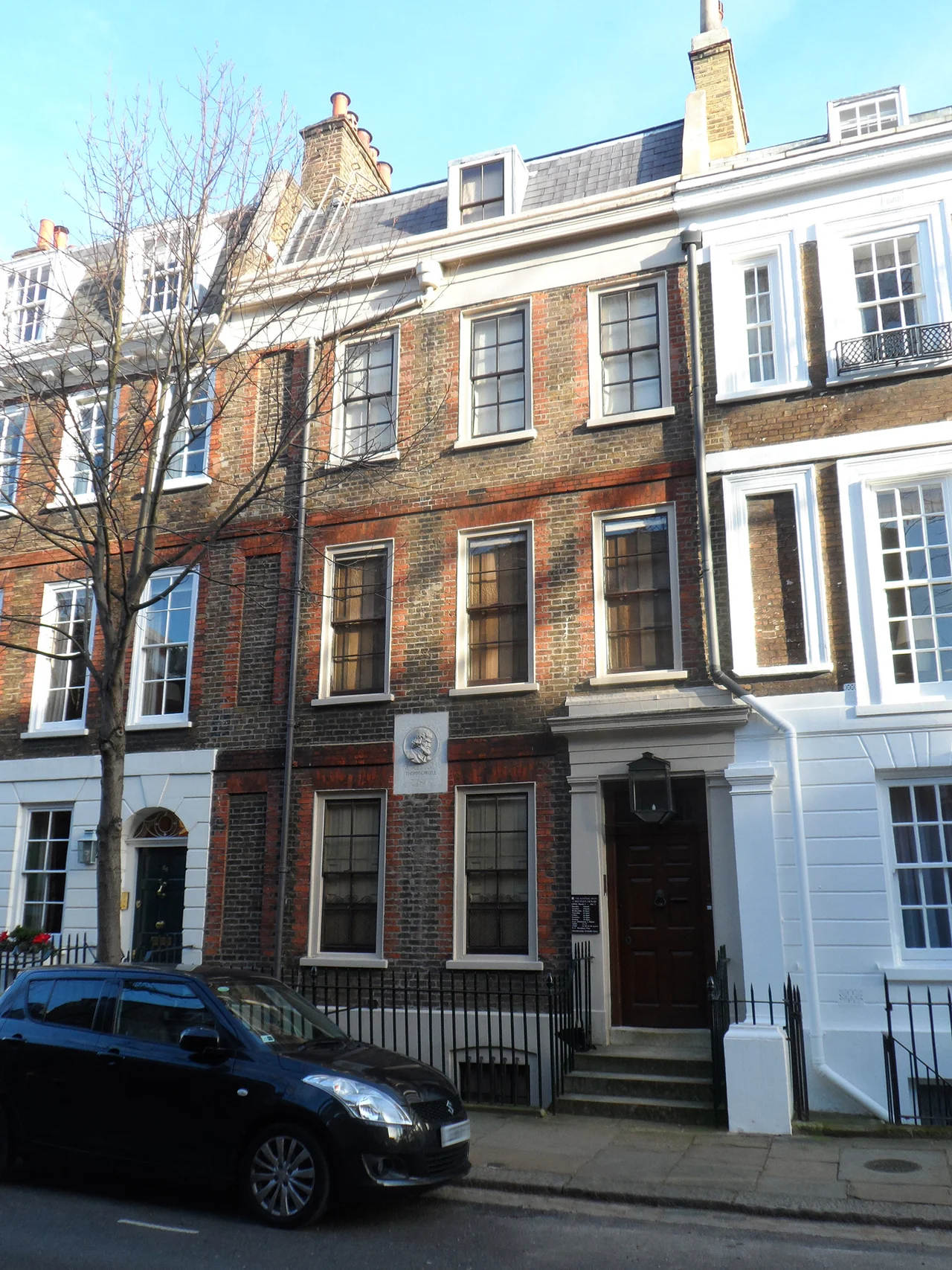

Carlyle's House
Thomas Carlyle moved into 5 Cheyne Row in Chelsea on 10 June 1834, having travelled down from a remote farmhouse in Dumfriesshire with his wife Jane and the conviction that he could only be a writer in London. He had asked his friend Leigh Hunt to find him a house. Hunt, characteristically, had forgotten. Carlyle found one himself, a plain brick terrace from 1708 just off the river, a short walk from where Hunt was already living. He stayed for the rest of his life. So did Jane. For forty-seven years, until Thomas's death in 1881, the house at Cheyne Row became one of the addresses in Victorian intellectual life: a place where the most important essayist and historian of the era worked at his desk upstairs while his wife held court below, conducted a famous correspondence, and slowly went mad.
The Sage of Chelsea
Carlyle had arrived in London just barely solvent. His 1837 history The French Revolution, written in the upstairs study at Cheyne Row, made him famous. The story of its composition is one of the great horror anecdotes of literature: Carlyle lent the only manuscript of Volume One to John Stuart Mill, whose housemaid mistook it for waste paper and used it to light a fire. Carlyle, broken-hearted, sat down and wrote it again from his notes. After The French Revolution came On Heroes, Hero-Worship and the Heroic in History, Past and Present, the monumental Frederick the Great, and a stream of essays that made Carlyle the most influential English-language thinker of the mid-nineteenth century. He believed in Great Men, in moral seriousness, in the dignity of work, and in shouting at people about all three. The Victorians ate it up. Dickens visited. Tennyson came. Robert Browning sat in the kitchen. Emerson made the pilgrimage from Massachusetts.
Jane
Jane Welsh Carlyle has often been described as the wittiest letter-writer in English. She had given up her own literary ambitions to marry Thomas; her correspondence, much of it written from the front parlour at Cheyne Row, runs to thousands of pages and reads like a long, sparkling, mostly miserable novel. The marriage was famous in their lifetime and famous afterwards for being terrible. Samuel Butler wrote later that it was very good of God to let Carlyle and Mrs Carlyle marry one another, and so make only two people miserable instead of four. Jane managed the house, the budget, the servants (whom Thomas drove out of the premises through neighbour complaints about a piano next door), and Thomas's appalling moods. She was a brilliant, frustrated woman trapped in a household that revolved entirely around her husband's genius. She died in 1866. Thomas, in his bereaved Reminiscences, was unsparing in his self-recrimination about how he had treated her. The book did him lasting damage when it was published.
The Soundproof Room
Thomas hated noise. He hated chickens. He hated pianos. He hated his neighbours' chickens and his neighbours' pianos with particular passion. In 1853 he had a sound-proofed study built in the attic of the house, with double walls, double ceilings, and air vents arranged to block external sound. It did not work. The whole house at Cheyne Row preserves this strange domestic archaeology of a Victorian writer's life: Thomas's writing desk, his chair, his books, his pipe; Jane's drawing room with its red wallpaper and the chair where she received guests; the small walled garden out the back, where the fig tree she planted still produces fruit. The Carlyles' kitchen, with its range and its scullery, is the kind of room most museums lose to refurbishment. This one has been kept.
Saved by Public Subscription
Thomas died at home on 5 February 1881. The house went through other tenants. In 1895, fourteen years after his death, admirers raised enough money by public subscription to buy 5 Cheyne Row, by then renumbered 24, and entrust it to the Carlyle's House Memorial Trust. They opened it to the public almost immediately. Octavia Hill, the social reformer who co-founded the National Trust in 1895 (the same year), had pledged the new organisation's support for the house. In 1936 the National Trust formally took over. The house was Grade II listed in 1954. Theatre producer Stanford Holme and his wife Thea, the actress, became curators in 1959, and Thea wrote a book about the Carlyles' marriage called The Carlyles at Home that came out in 1965 and is still the best place to start. Virginia Woolf, who knew Chelsea well, modelled the Hilberrys' house in her 1919 novel Night and Day on Carlyle's House. The fig tree still fruits every September.
From the Air
Cheyne Row sits one street back from the Chelsea Embankment, between Battersea Bridge and Albert Bridge. The house is a modest brown-brick terrace in a row of similar houses. Albert Bridge's pastel ironwork, lit at night, is half a mile east. The Thames curls past the embankment; the Royal Hospital Chelsea is a mile north-east; Battersea Power Station looms across the river. London airspace is restricted, but the area is recognisable on any commercial approach to Heathrow from the east.
From the Air
Located at 51.4843 N, 0.17 W in Chelsea, west London, one block north of the Chelsea Embankment between Battersea Bridge and Albert Bridge. Central London airspace is heavily restricted. Heathrow (EGLL) is approximately ten miles west; helicopter routes follow the Thames. View only during commercial overflights at 4,000 to 6,000 feet on Heathrow approaches.
Nearby Stories
- Battle of Britain, Northfleet 1.1 km away
- Bayham Old Abbey 5.4 km away
- Catharine Macaulay 6.4 km away
- Hatfield rail crash 8.8 km away
- Chequers 8.9 km away
- Chelmsford Cathedral 10 km away
- Queen Victoria Hospital 13 km away
- Fishbourne Roman Palace 36 km away