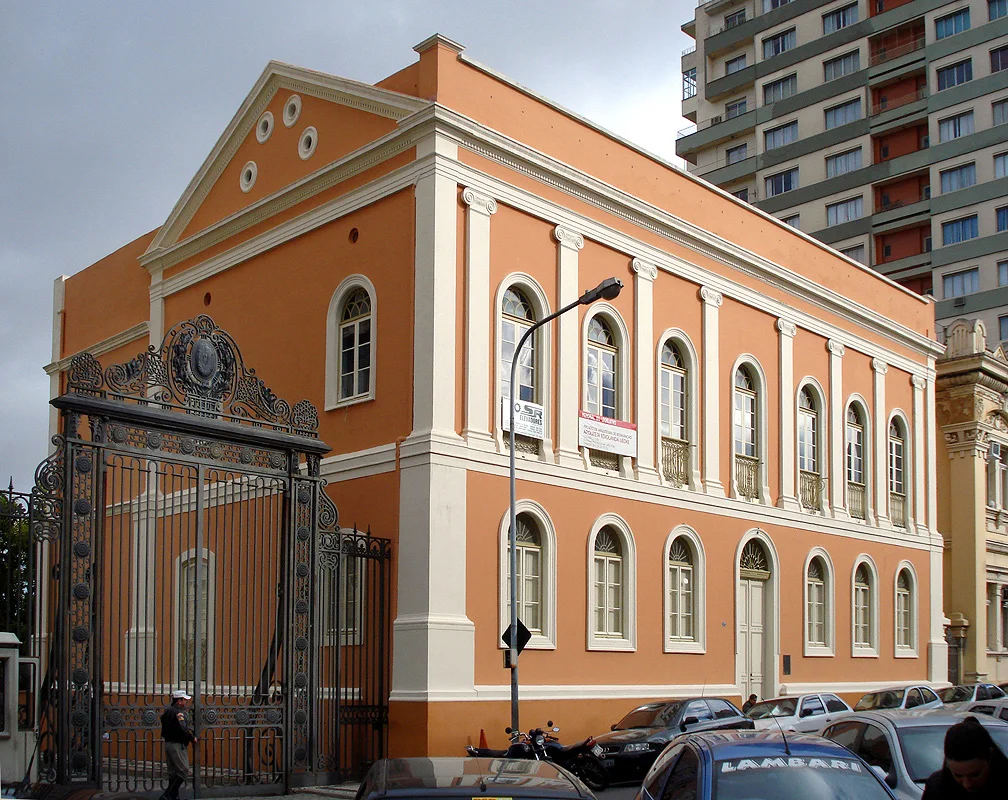

Casa da Junta
Count the eighteenth-century buildings still standing in Porto Alegre and you will run out of fingers before you run out of one hand. There is exactly one. On Duque de Caxias Street, in the heart of the historic center, the Casa da Junta has watched the city grow up around it for more than two hundred years, a low, dignified survivor among the towers and viaducts. The Portuguese settlers who raised it in 1790 could not have imagined the centuries of recess, ruin, and revival it would endure, nor that it would still be standing when nearly everything around it had fallen.
Born Into a Rebellion
Captain José Montanha drew the plans in 1790, working under the colonial administrator José Marcelino de Figueiredo. The building was conceived as half of a pair, joined to the old government palace next door, a tidy emblem of imperial order on the southern frontier. The order did not hold. In that very same year the legislative chamber went into recess, and soon the region was convulsed by the Ragamuffin War, the long separatist rebellion that gives the modern state assembly its name. The palace beside it would eventually be demolished to make room for the Piratini Palace. Its smaller companion endured, and the decades of silence had only just begun.
A Building That Kept Closing
Few legislatures have been interrupted as often as the one that met here. The chamber reopened in 1845, only to fall dark again between 1865 and 1870 during the Paraguayan War. It shut once more from 1937 to 1947, when Getúlio Vargas dissolved the legislatures of his Estado Novo. Each silence ended in renewal. The deputies returned in 1947 for a new constituent assembly, and the building served until 1967, when lawmakers moved to the modern Farroupilha Palace. To stand inside the Casa da Junta is to occupy a room that has been emptied by war, by dictatorship, by the ordinary churn of politics, and filled again every single time.
Reading the Façade
The architecture rewards a slow look. When it was first built the Casa da Junta rose only a single floor, a plain colonial box. The remodel of 1860 added a story and recast the whole in a more fashionable dress. A round-arched doorway sits at the center, flanked by two groups of three arched windows in careful symmetry. On the upper floor the openings become doors, fronted by parapets of worked metal and separated by slender Ionic pilasters. Above the lower and upper windows, blind tympanums hold panes of clear stained glass without images. On the gabled flanks, a triangular pediment is pierced by four small oculi, and beneath them a pair of round-arched windows survive from the original colonial design, the last visible traces of the building's first, humbler self.
The Long Way Home
Recognition came in 1981, when the state listed the building as protected heritage. A restoration the following year turned it over to the Civil House of the state government, and in 2004 ownership returned to the Legislative Assembly, where it began a new life as the seat of the Legislative Memorial. The story carried a fitting coda in 2023, when the gaúcho legislature convened a session inside its oldest home for the first time since 1967. After more than half a century, lawmakers once again filled the room where their predecessors had argued the fate of a frontier province, completing a circle that had taken 233 years to close.
The Last Witness
What makes the Casa da Junta worth seeking out is precisely how alone it stands in time. Porto Alegre grew up around the cattle trade and the river port, a young city by the standards of colonial Brazil, and it has never been sentimental about its old buildings; the viaduct-building decades of the twentieth century erased many that deserved better. Out of all of it, this one modest structure is the sole survivor from the 1700s, the only door in the entire city you can walk through and know that Azorean colonists and frontier governors walked through it too. Everything else from that founding generation is gone. The Casa da Junta remembers for the rest.
From the Air
The Casa da Junta sits at 30.0335 degrees south, 51.2312 degrees west, in the dense historic core of Porto Alegre on the eastern shore of Lake Guaíba. From the air the building is a small, pale rectangle nearly lost among the high-rises of the centro, best located by following Duque de Caxias Street near the Piratini Palace and the Metropolitan Cathedral. The nearest field is Salgado Filho International Airport (ICAO SBPA), roughly six nautical miles to the north-northeast; the regional gateway of Canoas Air Base (SBCO) lies a few miles farther north. Recommended viewing altitude is 1,500 to 2,500 feet AGL for the historic center, where the broad silver sheet of the Guaíba makes an unmistakable navigation landmark. Visibility is generally excellent on the clear, dry days of the southern Brazilian autumn and winter.
Nearby Stories
- Itapuã State Park 22 km away
- Nova Petrópolis 37 km away
- Aparados da Serra National Park 77 km away
- Santa Cruz do Sul 77 km away
- Serra Geral National Park 111 km away
- 2009 Brasil de Pelotas Bus Disaster 161 km away
- Passo Fundo 176 km away
- Battle of the River Plate 446 km away