
Casa de Cultura Mario Quintana
Apartment 217 was nothing special by the time Mário Quintana moved in. The Hotel Majestic had cut its rooms from three hundred down to one hundred, the grand staircases of its heyday had grown shabby, and the building had begun renting beds by the month to people who simply needed somewhere to live. One of them was the most beloved poet in Rio Grande do Sul. From 1968 to 1980, Quintana wrote in that faded room above the Araújo Ribeiro Passage, and when the state finally rescued the crumbling hotel, it did not name the new cultural center for the presidents who had slept there. It named it for the man in 217.
An Engineering Dare
When the German-Brazilian architect Theodor Wiederspahn designed the Majestic, he was attempting something Brazil had never seen. The hotel was the first large building in Porto Alegre to use reinforced concrete, and Wiederspahn pushed the new material to a bold conclusion: two blocks straddling the Araújo Ribeiro Passage, linked by walkways suspended over a public road. Nothing like those floating bridges had been built in the country before. Construction began in 1916, the first wing opened in 1918, and the full hotel was completed in 1933 for the businessman Horácio de Carvalho, rising seven stories in the east wing and five in the west, its silhouette an unmistakable announcement that Porto Alegre had arrived.
The Guest List
For two decades the Majestic was the address where the powerful and the famous stayed when they came to the gaúcho capital. Future presidents Getúlio Vargas and João Goulart passed through its doors. So did singers like Vicente Celestino and Francisco Alves, voices that defined an era of Brazilian popular music. The hotel sat at the social center of a city in its golden age. Then the center of gravity shifted. The neighborhood that had once made the Majestic glamorous became, in time, a problem of security and decline, and the luxury hotel slid quietly toward the rooming house it would become.
Saved From the Wrecking Ball
Rescue came through a careful bit of public maneuvering. In July 1980 the state bank Banrisul bought the failing hotel so that the government of Rio Grande do Sul could acquire it more cheaply, sealing the purchase on December 29, 1982. From 1983 the city pressed forward with a campaign to revive its historic center, and the Majestic was registered as a building of historical value. Architects Flávio Kiefer and Joel Gorski reimagined the interior, and on September 25, 1990, the Casa de Cultura Mario Quintana opened its doors. The hotel that had nearly been lost became one of the most active cultural houses in southern Brazil.
A Garden on the Roof
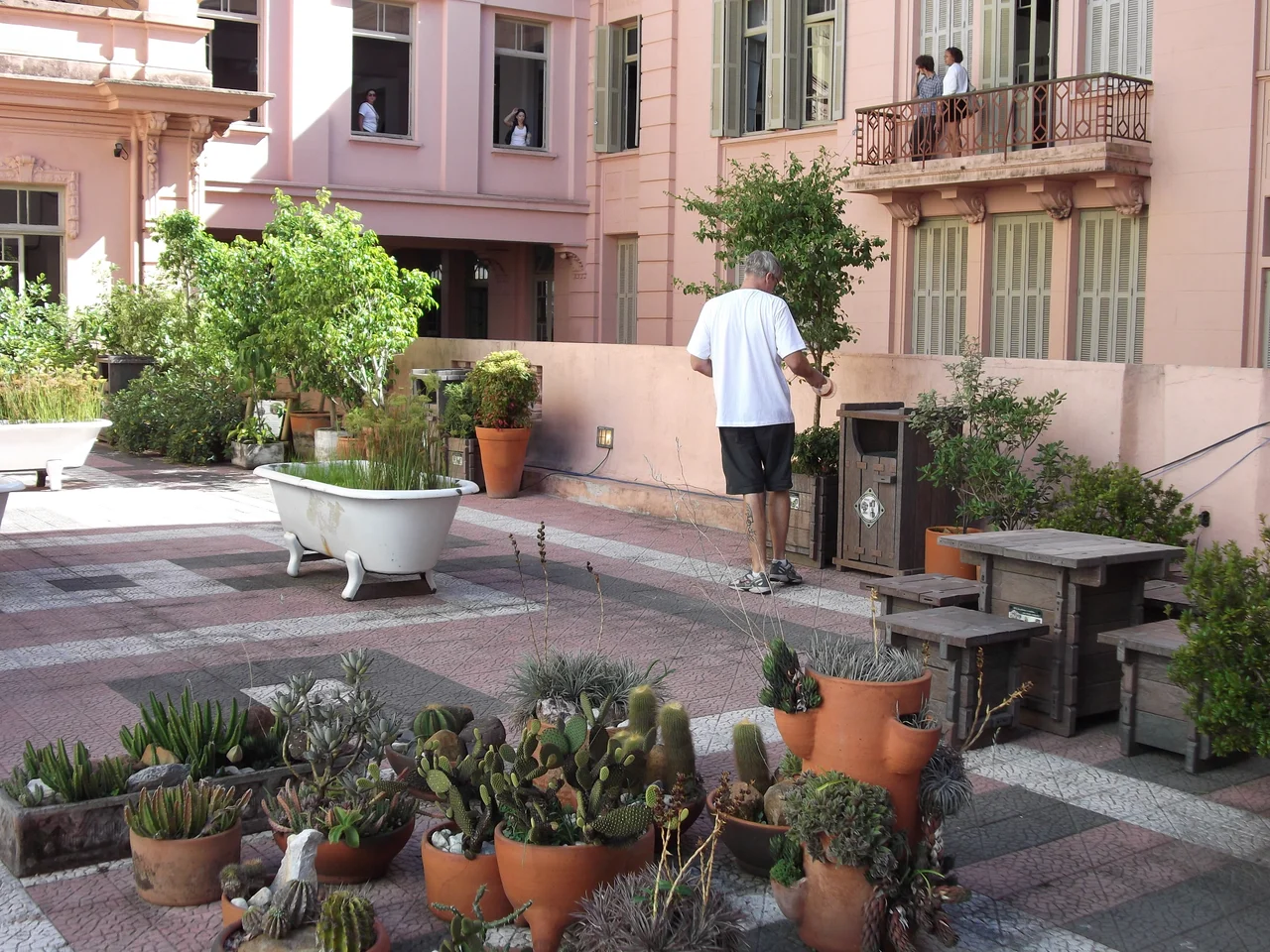
Today the building holds more than most visitors can absorb in a day: the Lucília Minssen and Érico Veríssimo libraries, theaters, three cinemas, galleries, and part of the Museu de Arte Contemporânea do Rio Grande do Sul, whose collection of 2,229 works leans toward the contemporary artists of the state. The most quietly affecting space is on the fifth-floor terrace. Installed in 2002 in memory of the environmentalist José Lutzenberger, who died that year, the rooftop garden gathers plants from marshes, deserts, prairies, and tropics, many of them growing in vases and bathtubs salvaged from the old Majestic itself, the bones of a vanished hotel coaxed back into bloom.
The Poet of Simple Things
The man whose name the building carries was, fittingly, someone who made his home in hotels. Mário Quintana was born in Alegrete in 1906 and came to Porto Alegre as a teenager in 1919 to study at the Military School. He earned his living as a journalist and translator, rendering Virginia Woolf's Mrs. Dalloway and dozens of other books into Portuguese, and his own verse made him beloved across Brazil as the poet of simple things, plain in surface and deep underneath. Solitary by nature, he never married and lived most of his life in rented rooms, the Majestic among them, until his death in 1994 at the age of eighty-seven. There is a quiet rightness in a building rescued for culture bearing the name of the unassuming poet who lingered in its decline, writing about small things in a faded room while the grand hotel emptied out around him.
From the Air
The Casa de Cultura Mario Quintana stands at 30.0313 degrees south, 51.2344 degrees west, in the historic center of Porto Alegre a short walk from the Praça da Alfândega and the waterfront. From the air it reads as a substantial multi-story block near the broad silver expanse of Lake Guaíba, the city's defining landmark for navigation. The nearest field is Salgado Filho International Airport (ICAO SBPA), about six nautical miles north-northeast, with Canoas Air Base (SBCO) a little farther north. Recommended viewing altitude over the centro is 1,500 to 2,500 feet AGL. The dry, settled air of the southern Brazilian autumn and winter typically delivers clean visibility across the lake and the historic core.
Nearby Stories
- Itapuã State Park 22 km away
- Nova Petrópolis 37 km away
- Aparados da Serra National Park 77 km away
- Santa Cruz do Sul 77 km away
- Serra Geral National Park 111 km away
- 2009 Brasil de Pelotas Bus Disaster 161 km away
- Passo Fundo 176 km away
- Battle of the River Plate 446 km away