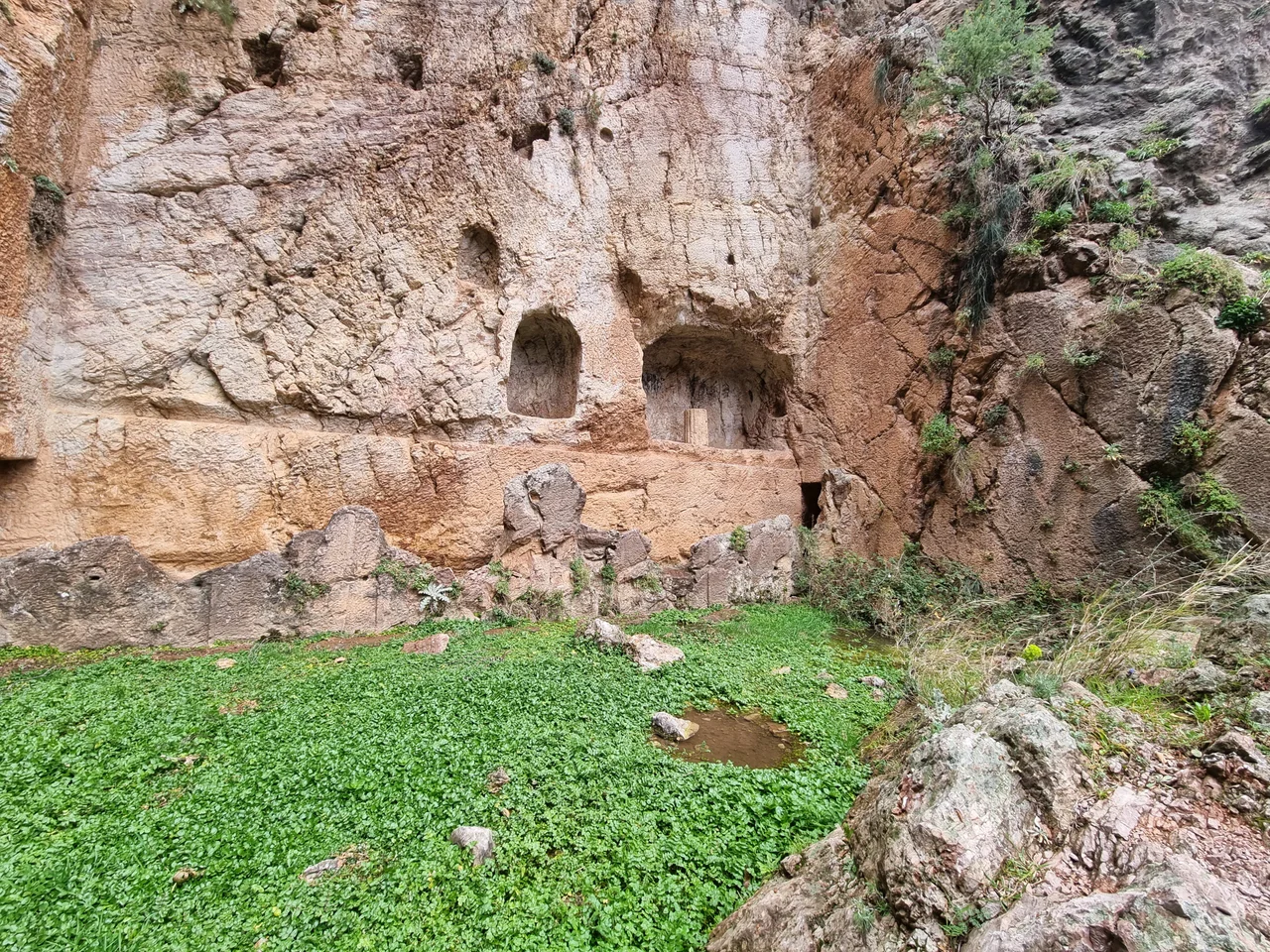

Castalian Spring
Before anyone approached the oracle, they came here first. The Castalian Spring rises in the ravine between the two great Phaedriades cliffs — the 'Shining Rocks' — above Delphi, and its water is cold and clear even in August. For centuries, every pilgrim who traveled to consult the Delphic Oracle stopped at the spring to wash. Every athlete entered the Pythian Games only after purifying themselves in its water. The Pythia, the oracle herself, cleansed herself here before the ceremony; so did the priests of Apollo. According to myth, Apollo killed the serpent Python at this very spring, and the killing made the water sacred. Later, Roman poets added a different kind of power: they believed that drinking from the Castalian Spring gave the gift of poetic inspiration. Two fountain houses still survive at the site — one archaic, one Roman, built five hundred years apart, both fed by the same cleft in the rock.
The Myth Behind the Water
The spring takes its name from Castalia, a daughter of the river god Achelous in one mythological tradition. But the more commonly told story associated with Delphi placed the spring's sacredness in Apollo's arrival at the site. Python, a monstrous serpent, had been guarding the spring when the god arrived and killed it, claiming the place and its water for his sanctuary. That killing — and the ritual pollution it created — was reenacted symbolically in the Pythian Games, Delphi's great festival held every four years, which included athletic competitions alongside contests in music, poetry, and dance. Before the games could begin, every participant underwent purification in the Castalian waters. For Roman poets — Ovid, Horace, and others who wrote about the spring — the water itself had become generative, a source from which verse could be drawn. The idea that a poet might 'drink from Castalia' became a shorthand for poetic ambition across Latin literature.
Two Fountains, Five Centuries Apart
The archaic fountain house dates to the 6th century BC and sits lower in the ravine. Its basin is marble-lined, surrounded by benches where pilgrims could sit after washing; water arrived via a short aqueduct and was dispensed through lion-headed spouts. The structure is spare and functional — designed for the practical act of ritual purification before the climb to the sanctuary. The Roman fountain, built in the 1st century BC, stands about fifty meters higher up the ravine and is more elaborate. Niches carved directly into the rock face held the votive offerings — the ex-votos — that pilgrims left behind; one of these niches was later converted into a small church of St. John the Baptist. On the fountain's facade, seven bronze spouts fed a paved courtyard furnished with stone benches on three sides. Both structures are still visible at the site, fed by the same spring water that has emerged from this cleft in the Phaedriades for millennia.
The Ritual Before the Oracle
The consultation of the Delphic Oracle was a formal procedure, not a spontaneous encounter. A supplicant who had traveled to Delphi — from Athens, Corinth, Sparta, or from kingdoms far to the east — did not simply walk up the Sacred Way and ask a question. The process required preparation, including payment of fees, consultation of priests, and, first of all, purification. The Castalian Spring was where that purification happened. The Pythia, the woman through whom Apollo was believed to speak, underwent her own cleansing here on the days when she would give oracles. The priests who managed the sanctuary did the same. The spring was therefore not incidental to the oracle; it was part of its ritual logic. To approach the god, you had to be clean. The water in the ravine between the shining cliffs was where the preparation began.
The Spring Today
The Castalian Spring lies just east of the main Delphi sanctuary, where the modern road from Arachova curves below the Phaedriades cliffs. Visitors can walk to both fountain houses; the archaic one is particularly evocative, its marble basin still intact, the rock walls of the ravine close on either side. The spring still flows. Looking up from the basin, the Phaedriades tower above — sheer limestone faces that catch light in ways that make the name 'shining rocks' feel earned. The water that emerges from the cleft has been flowing continuously from a time before Delphi became the center of the ancient world's attention. The oracle is long silent, but the spring is not.
From the Air
The Castalian Spring is located at approximately 38.4831°N, 22.5056°E, in the ravine between the Phaedriades cliffs just east of the main Delphi sanctuary. The Phaedriades themselves — two massive limestone cliff faces — are among the most visually distinctive features of the landscape when approaching Delphi from the south across the Gulf of Corinth. The ravine is not visible from altitude, but the cliff faces are unmistakable, rising nearly sheer above the sanctuary. Recommended viewing altitude: 5,000–8,000 feet for the Parnassus context; low passes along the escarpment reveal the sanctuary's relationship to the cliffs. The usual gateway airport is LGAV (Athens International, Eleftherios Venizelos), approximately 170 km to the southeast. LGRX (Araxos) provides an alternative approach from across the Gulf of Corinth.
Nearby Stories
- Battle of Vasilika 7.9 km away
- Siege of Negroponte (1470) 8.5 km away
- Battle of Kalavryta 13 km away
- Church of the Nativity of the Theotokos, Limni 14 km away
- Pellene 16 km away
- Panagia Varnakova Monastery 18 km away
- Megara 21 km away
- Karpenisi 41 km away