
Castle Maine
The castle was built on the bridge. Not beside it, not at one end of it - on it, in the middle, where the River Maine ran below and the only road between Kerry's interior and its southwest peninsulas crossed over. Maurice Fitzgerald built it in 1215 because the river flooded during heavy rains and became impassable, which meant whoever held this crossing held the country south of it. For four hundred and thirty-seven years, Castle Maine was one of the most fought-over fortifications in Munster - besieged, surrendered, retaken, garrisoned, demolished, rebuilt. Then in 1652 Cromwell's army arrived and tore it down for good. What remains today are the bridge foundations: unusually broad, with large stone arches, holding up nothing.
A Castle in the Middle of a River
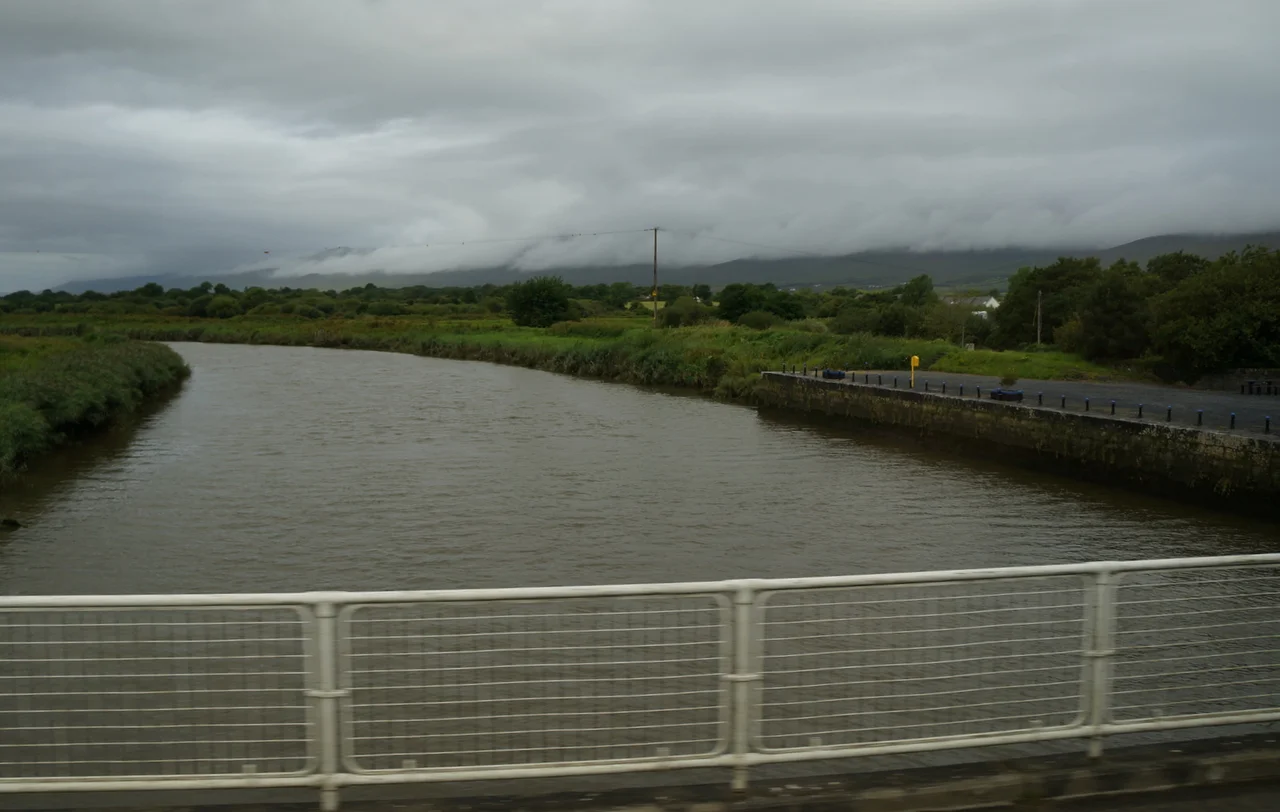
Maurice Fitzgerald, possibly a son of Thomas FitzMaurice FitzGerald, built Castle Maine in 1215 on a bridge across the River Maine, near what is now the village of Castlemaine in County Kerry. The river marked the southern boundary of land newly conquered from the MacCarthy Mor dynasty by the Anglo-Norman FitzGeralds. A drawing of the castle from around 1600 survives. It shows two central towers of unequal height, protected by walls, with a portcullis and drawbridge facing toward the southern end of the bridge. The bridge foundations that remain today are surprisingly broad, with large arches, indicating the size of the structure that once stood above. A local legend that the castle was built jointly by the FitzGeralds and MacCarthy Mor is, the records make clear, fictitious. The two clans were at war.
Perrot's Sieges
During the Desmond Rebellions of the late sixteenth century, Castle Maine became one of the last possessions of the Earl of Desmond. In 1571 Sir John Perrot, Lord Deputy of Ireland, summoned the chieftains of Munster to meet him at the castle with their forces on 24 June, intending to lay siege. Despite cannon fire against the walls, Perrot was forced to abandon the siege at the end of July - he was running out of gunpowder. He returned in June 1572. This time he had reinforcements: Maurice Roche, the 6th Viscount Fermoy, and Donald McCarthy, 1st Earl of Clancare. Scottish gallowglass mercenaries and native Irish troops served alongside the English forces. The castle's garrison of thirty men held out for twelve weeks before their provisions failed and they surrendered. From this point Castle Maine became an English Crown fortress with a standing garrison of twelve and a Constable - John Herbert was the first - to command it. On the night of 24 December 1573, the gates were opened to a group of men loyal to Lord Desmond. They seized the castle and threw the English garrison out.
Thirteen Months
The Nine Years' War brought the castle back to the centre of events. By December 1597, Sir Thomas Norris recorded that Castle Maine was the last fortress in Munster outside Cork that had not surrendered to forces loyal to Hugh O'Neill, Earl of Tyrone. In October 1598, a force led by the rebel James FitzThomas FitzGerald began a siege. He left two hundred men to continue it in January 1599. The castle held out for thirteen months without support from the English garrison at Cork. Thirteen months. The defenders ate whatever they had, then whatever they could find, then whatever they could not afford to eat. When the surrender finally came in November 1599, the Constable, Sir Warham St Leger, was heavily criticised - though he had been left without relief for over a year. James FitzThomas FitzGerald appointed Thomas Oge Fitzgerald as the new Constable and moved his personal correspondence to be stored at the castle. The next year Thomas Oge surrendered it to the English Lord President of Munster, George Carew, 1st Earl of Totnes.
Demolished and Remembered
When the Irish Rebellion of 1641 broke out, the castle was attacked by Daniel McCarthy of the Irish Catholic Confederates and taken after a few days. The Irish Confederates held it until 1649, when it was surrendered to David Crosbie acting for Murrough O'Brien, 1st Earl of Inchiquin. In 1652 New Model Army troops under Edmund Ludlow took the castle one last time and demolished it on Cromwell's order. The bridge had needed repair as early as 1620, after successive sieges. Now there was nothing left to garrison. But the position itself remained valuable, and Constables of Castle Maine continued to be appointed as sinecures - well-paid offices with no actual duties - until 1828. By the eighteenth century the post was worth £300 a year, with fishing rights on the River Maine and Castlemaine Harbour thrown in. The castle had been gone for nearly two centuries, and people were still paid to defend it.
From the Air
Located at 52.17 N, 9.70 W, at the modern village of Castlemaine, County Kerry, where the River Maine flows toward Castlemaine Harbour. Nearest airport: Kerry (EIKY) at Farranfore, about 12 km north. The Dingle Peninsula extends west, the Iveragh Peninsula south. The river's broad arch foundations - all that remains of the medieval bridge that held the castle - can be picked out from low altitude. The river floods seasonally, much as it did when the castle was strategically essential.
Nearby Stories
- Emlagh East Ogham Stone 2 km away
- Carrignacurra Castle 2.6 km away
- Uragh Stone Circle 5.2 km away
- Ballinskelligs 6.2 km away
- Eurovision Song Contest 1993 8.2 km away
- Newcastle West 9.6 km away
- Ballyheigue Castle 11 km away
- RMS Carinthia (1925) 98 km away