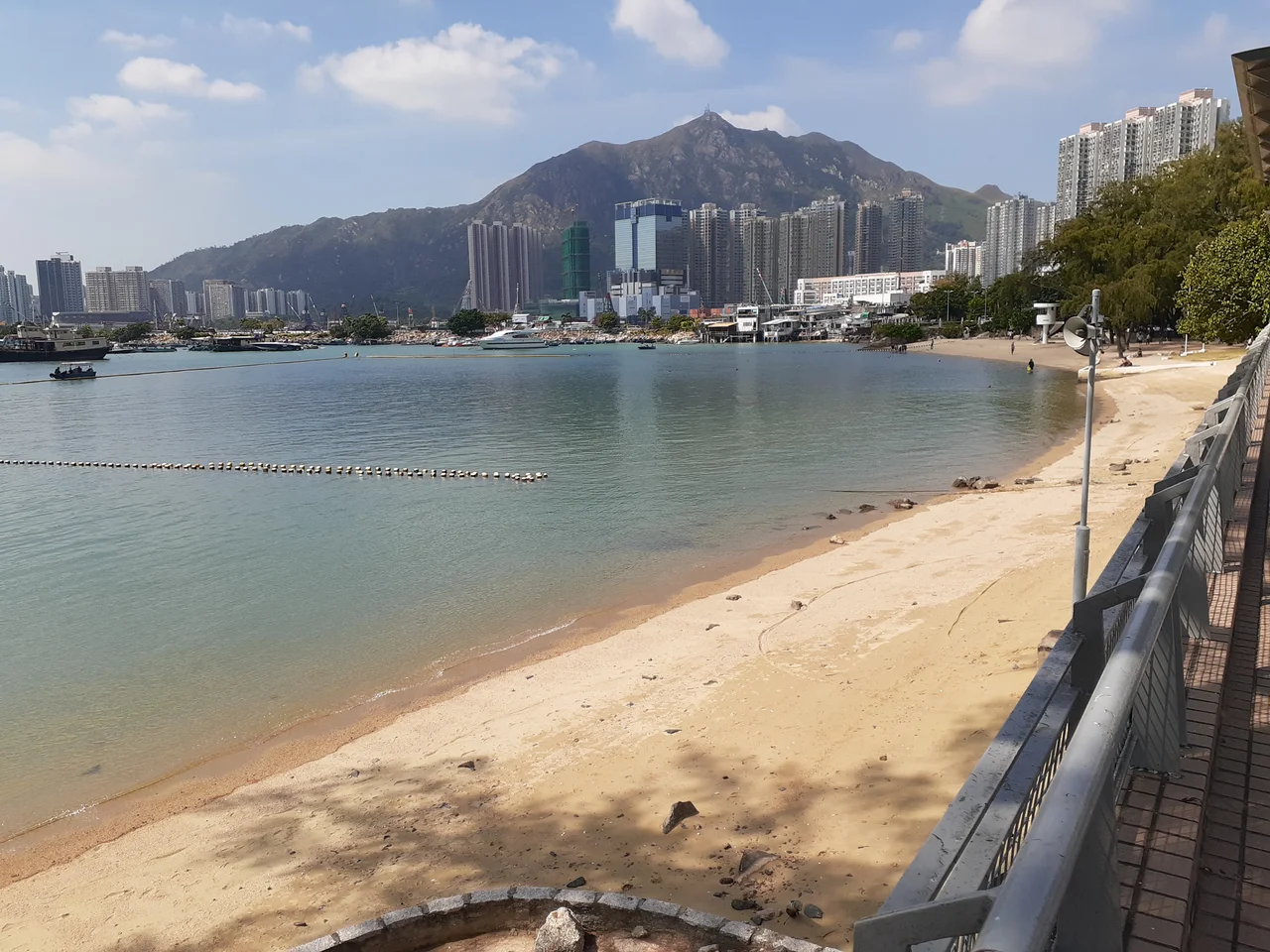

Castle Peak Beach
For nearly a quarter century, Castle Peak Beach had sand, a shark net, and barbecue facilities — but no swimmers. The beach in Tuen Mun's Sam Shing neighborhood looked across Castle Peak Bay toward the typhoon shelter, and it looked like a beach, but from 1981 until 2005 it was officially off-limits for swimming. The story of how it closed, how it languished, and how it eventually came back is a compressed history of Hong Kong's environmental reckoning — the decades it took to acknowledge the cost of rapid industrialization on the water quality of a city built around the sea.
Closed by Pollution, Damaged by Storm
The beach's troubles began with water quality. By 1981, the levels of contamination in the waters off Castle Peak Beach had deteriorated to the point where the government closed it to swimming entirely. Then in September 1983, a typhoon struck and compounded the problem, stripping sand from the beach and destroying trees. What remained was a degraded shoreline, its swimming zone's 0.8 hectares still protected by the old shark net in a body of water no one was permitted to enter. The beach itself — 2.97 hectares of it — sat largely unused along the Tuen Mun waterfront while the surrounding district grew into one of the New Territories' major population centers. The juxtaposition was strange: a gazetted beach, formally recognized by the government as a public recreation resource, that people could not use.
A HK$97 Million Attempt at Revival
In November 1994, the Tuen Mun District Board formally asked for the beach to be reopened. The Regional Council responded with a significant investment: HK$97 million to build new facilities, including a barbecue area, a children's play area, a sitting-out area, and a two-storey beach building with toilets, changing rooms, and showers. The facilities went up. They were finished. But the beach still could not be opened for swimming. The problem was the seabed itself — a layer of mud and refuse had accumulated over the years of closure, and conditions in the water remained unsuitable. The investment in infrastructure had run ahead of the environmental remediation that actually needed to happen first. It was a common enough story in the years when Hong Kong was racing to modernize: money spent on visible improvements, while the underlying problems persisted below the surface.
The Long Work of Cleaning the Water
Real improvement came in 1999, when a longer submarine outfall came into operation at the Pillar Point Sewage Treatment Works. By routing treated effluent farther out and away from the beaches, the new infrastructure gradually reduced contamination levels along the Tuen Mun coastline. Progress was slow. Water quality improved incrementally over the following years, monitored season by season. Finally, a shark net was installed on 24 May 2005. A week later, on 1 June 2005, Castle Peak Beach reopened for swimming — 24 years after it had been closed. For the families in Sam Shing Estate next door, who had lived beside a sealed-off beach for nearly a generation, the reopening represented something more than a recreational amenity restored. It was a visible sign that the environment they lived in could actually get better.
A Beach That Still Struggles
Castle Peak Beach's water quality remains imperfect. During the 2019 bathing season, the Environmental Protection Department found that Castle Peak had the highest mean E. coli levels of all 41 monitored beaches in Hong Kong — a sobering fact for a beach that fought so hard to earn back its swimming designation. Through most of that season, water quality hovered between Grade 2 (Fair) and Grade 3 (Poor) on the four-point Beach Grading System, dipping to Grade 1 (Very Poor) on at least one day. The beach sits on Castle Peak Bay with the Tuen Mun typhoon shelter nearby, separated from it by a breakwater. The Light Rail stops at Sam Shing, steps away. Multiple bus routes serve the area. The infrastructure is in place. The beach is open. But the water tells its own story about how long-term industrial and urban pressures on coastal environments do not disappear simply because a remediation project is declared finished.
From the Air
Castle Peak Beach sits at 22.3792°N, 113.9802°E on the eastern shore of Castle Peak Bay in Tuen Mun, roughly 5 km northeast of the main Castle Peak summit. Hong Kong International Airport (VHHH) on Lantau Island lies approximately 15 km to the southeast across the bay. The beach and the bay are clearly visible from the air — the typhoon shelter and its breakwater are distinctive from altitude, as is the Light Rail corridor running along the Tuen Mun waterfront. Recommended viewing altitude for the Tuen Mun coastline: 400–600 metres MSL in clear weather, when the relationship between Castle Peak mountain, the bay, and the urban district below becomes readily apparent.
Nearby Stories
- Chapel of St. Francis Xavier 3.5 km away
- Cuiheng 4.1 km away
- 2015 Shenzhen Landslide 16 km away
- Shunde 31 km away
- Wanshan Archipelago 37 km away
- Nanxiong Formation 96 km away
- Heyuan 149 km away
- Checheng Fu'an Temple 629 km away