
Galway Cathedral
It was built on the site of the city prison. The Cathedral of Our Lady Assumed into Heaven and St Nicholas opened in Galway on 15 August 1965 - the feast of the Assumption - and was promptly called the last great stone cathedral to be built in Europe. President Eamon de Valera lit the sanctuary candle. Cardinal Richard Cushing of Boston delivered the sermon, with the unanswerable title 'Why Build a Cathedral?' Four archbishops accompanied the Bishop of Galway, Michael Browne, at the altar. The building has not stopped dividing opinion since the day the prison was demolished to make way for it.
The Pro-Cathedral It Replaced
A parish chapel went up around 1750 on Middle Street, at the corner of Lower Abbeygate Street, when penal-law restrictions on Catholic worship were finally relaxing. In 1821 the chapel was replaced with a limestone Gothic church dedicated to St Patrick. When the Diocese of Galway was created in 1831, St Patrick's became the pro-cathedral - the temporary cathedral, a working substitute for a proper one. It stayed temporary for 134 years. The diocese had been Pro-Cathedral, Pro-Cathedral, Pro-Cathedral for more than a century by the time Bishop Michael Browne, an ambitious and contentious figure, decided that Galway should have a stone cathedral of its own. The site Browne chose was the old city jail near the Salmon Weir Bridge, which the local council had agreed to make available.
John J. Robinson's Design
The architect was John J. Robinson, who had previously designed many churches across Dublin and the country. The brief was traditional - Browne wanted neither Modernism nor a 1950s glass-and-steel essay. Robinson reached for the Renaissance: a Latin cross plan with a great central dome rising 44.2 metres above the crossing, pillars and pendentives in the Italian tradition, plus rose windows and mosaics drawn from the broader history of Christian art. The whole building was constructed nearly entirely of local limestone - quarried from the same Burren karst that lies twenty miles south. By the time the cathedral was finished, no other Irish public building was being built of stone in this way. The phrase 'last stone public building in Ireland' has been applied since. The dome, lit at night, is the largest single object on the Galway city skyline.
The Late Late Show, 1966
Approval was not universal. Some local critics had wanted a contemporary 1960s design, the kind of soaring concrete-and-glass cathedral being built in Liverpool, Coventry, and Brasilia at the same period. The traditionalist choice provoked predictable cross-fire. The most notorious moment came in April 1966, six months after the opening, when a Trinity College Dublin student named Brian Trevaskis appeared on Telefis Eireann's The Late Late Show and called the cathedral a 'ghastly monstrosity.' He criticised Bishop Browne in terms that, in 1966 Ireland, were close to scandalous. The episode is remembered as a marker of Ireland's shifting relationship with church authority. More recently the Irish Times included Galway Cathedral in a feature on 'ugly' Irish buildings, where readers nominated it variously as a 'squatting Frankenstein's monster' and 'a monument to the hubris of its soft-handed sponsors.' Others love it. The dome is undeniable.
Inside the Building
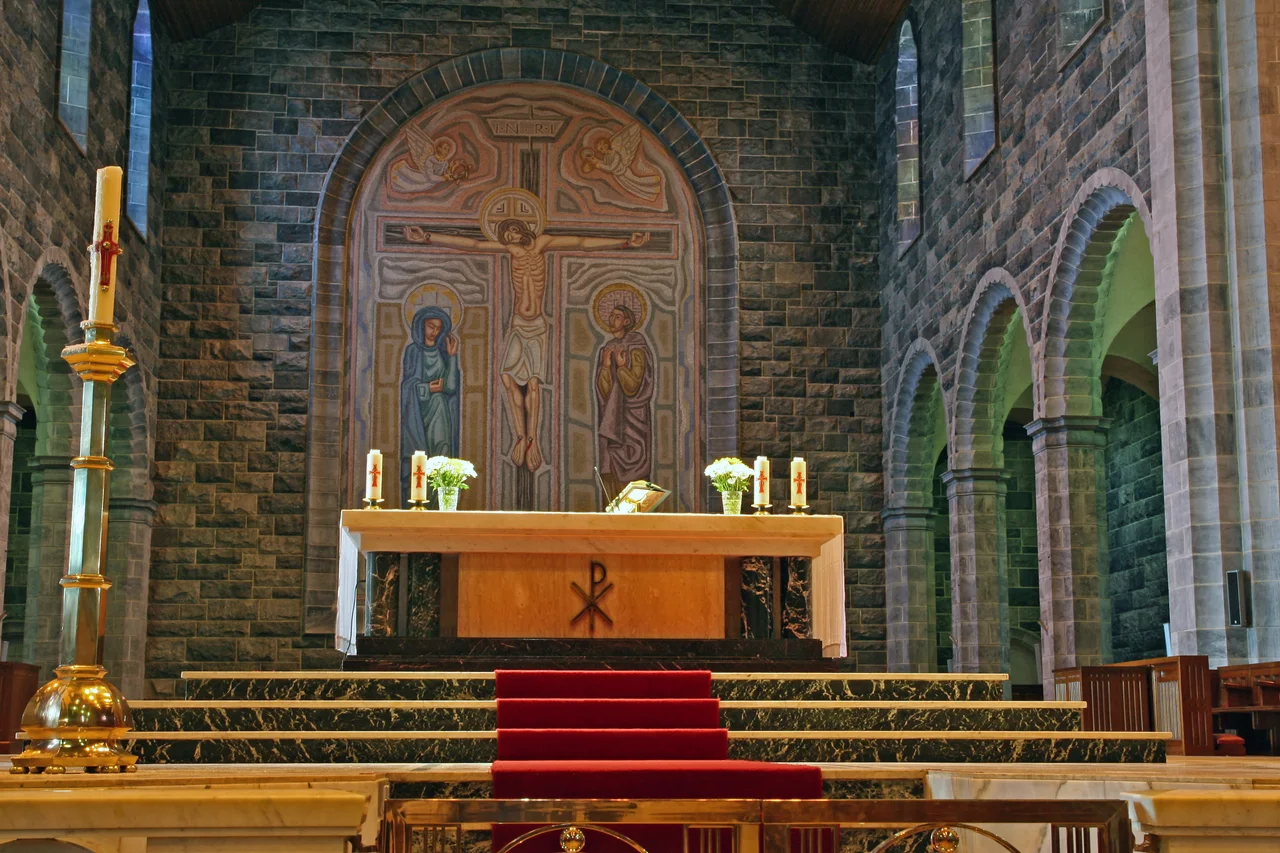
Past the heavy doors the cathedral opens out into a single vast space - a nave running west to east, a transept crossing under the central dome, the high altar at the eastern end backed by mosaic. The interior is lighter than the limestone exterior suggests, with stained glass in the rose windows feeding colour onto pale stone. Mosaics and sculpture mark the side chapels. The pipe organ in the west gallery was originally built by Rushworth & Dreaper of Liverpool in 1966, and was substantially expanded by the Irish organ-builder Trevor Crowe between 2006 and 2007 - three manuals, fifty-nine speaking stops, electro-pneumatic key action with 999-slot sequencer memory for liturgical setups. A smaller portable instrument of one manual and four stops handles the side chapels. The adult choir, in existence since the dedication in 1965, sings the 10:30 Sunday Mass with a repertoire spanning Gregorian chant, Renaissance polyphony, modern composers, and Irish traditional music.
What the Building Holds
Mass is said every day. Saturday vigil at six. Sundays at nine in Irish, then ten-thirty, twelve-thirty, and six in the evening. The rhythm of the place is fundamentally that of a working parish church on an unusual scale. The bishops buried within - Michael Browne who built it, Eamonn Casey whose later life was clouded by scandal, Thomas O'Doherty, Thomas O'Dea, James McLoughlin - rest under the same dome. Galway is a city that has changed enormously since 1965. The university next door has tripled in size. The pro-cathedral was deconsecrated. The Cathedral of Our Lady Assumed into Heaven and St Nicholas remains - much-discussed, much-photographed, much-loved by some and much-not-loved by others, an enormous limestone dome looking out across the River Corrib at a city the building's commissioners would no longer recognise.
From the Air
Galway Cathedral sits at 53.28 N, 9.06 W on the eastern bank of the River Corrib, just north of the medieval city centre and beside the Salmon Weir Bridge. Galway Airport (EICM) lies about 8 km east. The cathedral's 44-metre limestone dome is the most distinctive feature on the Galway skyline from any direction - visible from altitude, on river level, from Salthill across the bay. The Corrib flowing south to the bay, the university campus to the north-east, the Spanish Arch and Long Walk to the south-west all frame the structure. Best viewed in clear afternoon light when the limestone catches the sun.
Nearby Stories
- Inis Oirr 3.9 km away
- Milltown, County Galway 4.2 km away
- Kilmacduagh Monastery 6.4 km away
- Ahascragh 8.9 km away
- Acadamh na hOllscolaíochta Gaeilge 12 km away
- Roscommon 17 km away
- Croagh Patrick 20 km away
- Lorrha 21 km away