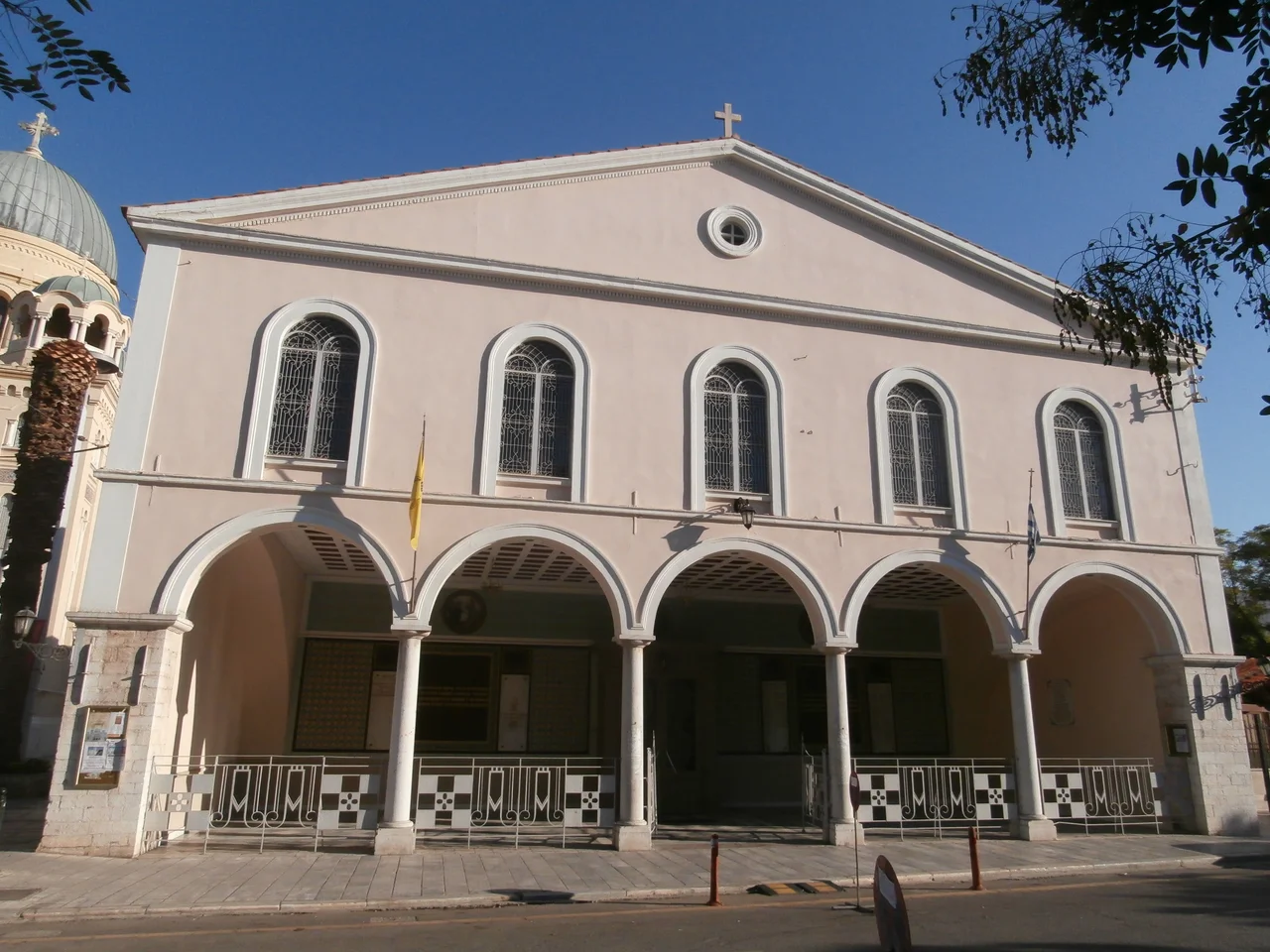

Cathedral of Saint Andrew, Patras
In September 1964, fifteen Roman Catholic cardinals stepped off a plane in Patras carrying a silver reliquary. Inside it: the skull of the Apostle Andrew, patron saint of the city, absent from Greece for roughly seven centuries. Pope Paul VI had ordered its return from St. Peter's Basilica in Rome, and thousands of Greeks lined the streets — among them Prime Minister Georgios Papandreou — to watch the procession bring it home. The moment captured something essential about this city on the northwestern tip of the Peloponnese: Patras has always claimed Andrew as its own, and the great cathedral built to honor him is the architectural proof.
Sixty-Six Years in the Making
Construction of Hagios Andreas — the Cathedral of Saint Andrew — began in 1908 under architect Anastasios Metaxas, who had previously directed the restoration of the Panathenaic Stadium for the 1896 Olympics. The work stretched across six decades, interrupted by wars, occupations, and the ordinary difficulties of building something enormous. It was finally inaugurated in 1974. The delay gives the cathedral a curious quality: it is at once ancient in spirit and modern in completion, a twentieth-century building that feels like it belongs to Byzantium.
The numbers make clear why it took so long. The church covers 1,900 square meters on the ground floor alone, with an additional 700 square meters on the upper level — the gynaeconitis, the women's gallery of traditional Orthodox design. Its length runs about 60 meters, its width about 52. It holds 7,000 people. Over the central dome stands a gold-plated cross five meters tall; twelve smaller crosses crown the surrounding domes, one for each apostle.
Among the Balkans' Great Churches
The Cathedral of Saint Andrew is considered the largest Orthodox church in Greece — a claim that draws some debate, with the Church of Saint Panteleimon in Acharnai occasionally put forward as a rival. What is not disputed is its regional standing: it ranks as the third-largest Byzantine-style church in the Balkans, behind the Cathedral of Saint Sava in Belgrade and the Alexander Nevsky Cathedral in Sofia.
The interior rewards those comparisons. Byzantine-style wall paintings and mosaics cover the walls and vaulted ceilings. Beneath the central dome hangs the horos, the great circular chandelier of traditional Orthodox churches, its ring of icons facing outward toward the congregation. The marble templon — the screen separating nave from sanctuary — carries painted panels of Panagia, the Virgin Mary, depicted as protector of the city of Patras. Everything in the design aspires to the same idea: that this particular place, in this particular city, stands at the center of something ancient and ongoing.
The Relics and the Cross
The cathedral's greatest treasures are housed in a special shrine: the little finger and part of the top of the cranium of the Apostle Andrew, together with portions of the X-shaped cross on which he was martyred. The skull's journey home in 1964, led by Cardinal Augustin Bea with a delegation of fourteen other cardinals, was an act of ecumenical diplomacy as much as religious devotion — a gesture from Rome to the Orthodox world at a moment when dialogue between the two churches was cautiously reopening.
The cross had its own long exile. Crusaders took it from Greece during the medieval period; it ended up at the Abbey of Saint Victor in Marseille, where it remained for centuries. On 19 January 1980, a Roman Catholic delegation led by Cardinal Roger Etchegaray presented the relics of the cross to Bishop Nicodemus of Patras. Two returns, separated by sixteen years: the Church of Rome giving back, piece by piece, what history had scattered.
The Older Church Next Door
Standing directly beside the great cathedral is its predecessor — a much smaller church of Saint Andrew, designed by architect Lysandros Kaftanzoglou in the late nineteenth century. The contrast between them is instructive. The old church is intimate, human-scaled, worn with use. The new one is monumental, a statement in stone and mosaic about the ambitions of a city that has always thought of itself as a threshold between worlds.
Together the two churches form a pilgrimage complex that draws Orthodox Christians from across Greece and beyond. Tradition holds that Andrew the Apostle preached in Patras, and that he was martyred here — bound, not nailed, to his distinctive diagonal cross so that his suffering would last longer. Whether or not every detail of that story is historically certain, the belief has shaped this city for two millennia, and the cathedral is its most visible expression.
A Landmark at the Gulf's Edge
The cathedral occupies the western edge of Patras's city center, close to the waterfront where ferries depart for Italy. Its dome is visible from the gulf, a pale landmark against the green hills of the Peloponnese. The city behind it climbs toward the Byzantine castle on the acropolis, and the whole arrangement — port, cathedral, fortress — tells the story of Patras in one view: a place that has faced the sea for four thousand years, absorbed every empire that arrived by water, and remained, somehow, itself.
From the Air
The Cathedral of Saint Andrew sits at approximately 38.2424°N, 21.7279°E on the western edge of Patras city center, about 800 meters from the waterfront. At 3,000–5,000 feet the dome and its gold-plated cross are visible against the urban grid; the Gulf of Patras stretches to the north and west, with the mountains of Aitoloakarnania visible on the far shore. The nearest major airport is LGRX (Araxos), approximately 40 km to the west-northwest along the coast. On clear days the Rio-Antirrio Bridge is visible to the northeast. Approach from the gulf for the best view of both the cathedral and the castle on the acropolis hill above it.
Nearby Stories
- Thermos (Aetolia) 8.2 km away
- 1861 Eliki Earthquake 9.6 km away
- Pheneus 14 km away
- Battle of the Echinades (1427) 15 km away
- HMS Perseus (N36) 19 km away
- Amfissa 20 km away
- Astras 21 km away
- Acarnania 28 km away