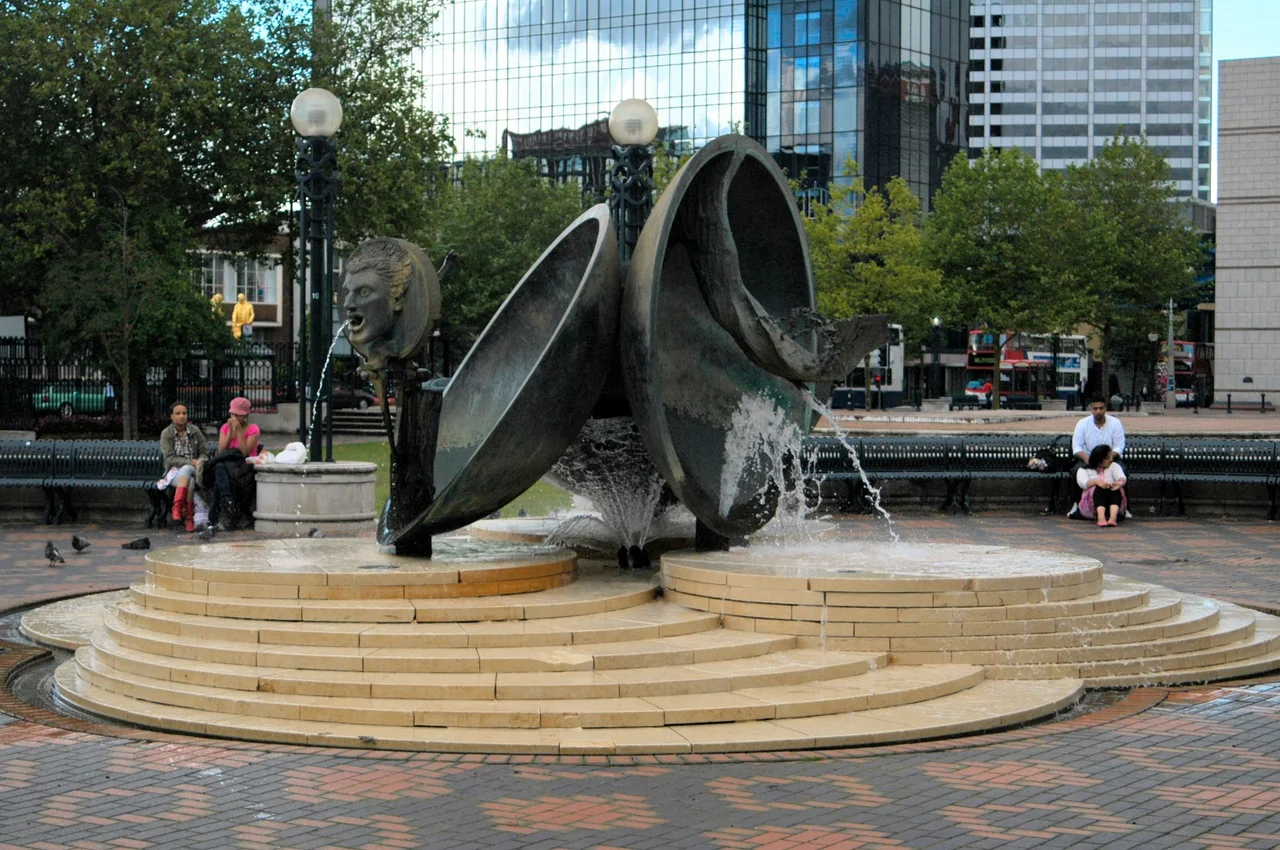

Centenary Square
On a July night in 1791, a Birmingham mob set fire to John Baskerville's old house on this land. He had been dead sixteen years by then, but his grave was in the garden, and the rioters did not stop for it. The fire was part of the Priestley Riots, three days of arson aimed at Dissenters, scientists, and anyone associated with the wrong politics of revolution. The house came down, the gardens went under iron foundries, and by the late twentieth century the gardens and the foundries alike were gone, replaced by Centenary Square - named in 1989 for the hundredth year since Birmingham became a city, and now the most-walked civic space in the West Midlands.
The Civic Centre That Never Was
William Haywood published a book in 1918 called The Development of Birmingham, in which he proposed a grand civic centre west of Victoria Square. His sketches included a cathedral, two exhibition halls, a Natural History Museum, a War Museum, an Opera House, a new post office, and formal gardens. The council cleared the site in the 1920s. They built the Hall of Memory, the colonnade, half of Baskerville House by 1940. Then the Luftwaffe started arriving over Birmingham, the budget vanished, and the civic centre was never finished. Haywood tried again in 1940-41 with a 42-metre column topped by a ten-foot statue of the Spirit of Birmingham. William Bloye made the maquette in 1948. The council adopted the design in 1944 and abandoned it as too expensive in 1949. Alwyn Sheppard Fidler tried again in 1958. Nothing of his survived except a much-modified version of the residential towers near Cambridge Street. The square that exists today is what was left when the dreaming stopped.
Tess Jaray's Persian Rug
When the International Convention Centre and Symphony Hall opened on the western end in 1991 and 1992, the council finally had a reason to finish the square. They renamed it for the centenary, built Centenary Way across the Inner Ring Road so pedestrians could walk in from Paradise Circus instead of crawling through a subway, and gave the artist Tess Jaray the job of designing the paving, railings, and street furniture. She laid out 525,000 pavers in the pattern of a Persian rug, working with sculptor Tom Lomax. From the ground the design is hard to read. From the upper floors of Baskerville House or the Library across the way, the geometry resolves: a vast carpet of brick unrolled across the centre of Birmingham. Much of it was lifted in 2017 when the square was redesigned again, including the removal of a ninety-year-old London Plane tree at the Broad Street edge - protested by local campaigners, but cut down anyway to make room for security bollards and the new tram line.
The Lurpak Sculpture
Raymond Mason's sculpture Forward was unveiled in the square in 1991. It depicted a procession of Birmingham figures striding into the future - workers, families, civic faces - rendered in painted fibreglass at a price of two hundred and seventy-five thousand pounds. The Birmingham public, with characteristic bluntness, nicknamed it 'the Lurpak sculpture' because of its butter-yellow surface. On 17 April 2003 someone set it on fire. The blaze destroyed it completely. Mason, then in his seventies, surveyed the wreckage in person. He kept his composure for the cameras, but the loss was real: it had been the largest public commission of his career, and it was gone in an evening. The square never replaced it with anything similar. A Ferris wheel appeared in 2005, closed in 2006, and was sold to a company in Australia.
Boulton, Watt, and Murdoch
On the south side of the square, gold-leafed and looking purposeful, three Victorian-era industrialists in bronze are bent over a set of engine drawings. The statue is William Bloye's, unveiled 14 September 1956, depicting Matthew Boulton, James Watt, and William Murdoch in the middle of inventing the modern world. Boulton ran the Soho Manufactory just north of Birmingham. Watt's separate condenser made the steam engine practical. Murdoch developed gas lighting in his Cornish workshop using coal gas distilled in an iron retort. The 4.65-metre figure was originally meant to stand outside a planetarium as part of the never-built civic centre. Instead it ended up here, outside what was once the House of Sport. Nearby, David Patten's monument to Baskerville himself stands as eight Portland stone blocks spelling the word VIRGIL in bronze - a reference to the 1757 Baskerville edition of Virgil that established the printer's typographic reputation across Europe. Baskerville was originally buried in a small mausoleum in his own garden, on the ground that is now part of Centenary Square. His coffin was disturbed by canal works in 1821, passed through several improvised resting places, and was finally interred in Warstone Lane Cemetery's catacombs in 1898.
What the Square Holds Now
The Library of Birmingham opened on the north side in 2013. Its skin of interlocking metal circles makes it instantly recognisable from any window facing the square. The Rep Theatre sits next to it. Baskerville House holds council offices in the building begun in 1938 and finished by halves. On the south side stands the Birmingham Municipal Bank headquarters from 1933, Grade-II-listed, the first municipal bank in the country, waiting for a use. The Frankfurt Christmas Market spreads across the paving every December, an enormous Continental import that draws several million visitors a year. New Year's celebrations, Remembrance Day services, ice rinks, Ferris wheels, civic launches - the square absorbs all of it. A century after the city status that gave it its name, Centenary Square does the work that Haywood's never-built civic centre was supposed to do. It just took longer than he expected.
From the Air
Centenary Square sits at 52.479 degrees north, 1.9087 degrees west, immediately northwest of central Birmingham. From cruising altitude in clear conditions, look for the distinctive perforated metal facade of the Library of Birmingham on the square's north side and the curved roofs of the International Convention Centre to the west. The square is a roughly rectangular pale open space, surrounded by stone, brick, and glass civic buildings. Birmingham Airport (EGBB) lies about eight miles east-southeast; Coventry Airport (EGBE) is roughly nineteen miles southeast. Best viewing altitudes are 1,500 to 3,000 feet.
Nearby Stories
- Shepshed 8.5 km away
- Battle of Evesham 11 km away
- Hixon rail crash 12 km away
- Battle of Cropredy Bridge 12 km away
- Wenlock Priory 15 km away
- RAF Shawbury 16 km away
- Market Bosworth 17 km away