
Chaeronea
In the summer of 338 BC, the armies of Athens and Thebes made their stand at a narrow defile in the Cephissus river valley. It was the last serious natural obstacle before the open plains of central Greece, and both cities understood what the battle meant. Philip II of Macedon had been extending his power southward for years; this was the alliance's best chance to stop him. It failed. The Macedonian forces, including a cavalry wing commanded by Philip's eighteen-year-old son Alexander, broke the Athenian left and then wheeled on the Theban Sacred Band — the elite unit of three hundred paired warriors who had never been defeated in open battle. At Chaeronea, the Sacred Band died where they stood. Every one of them. What ended that day was not only a battle: it was the era of the independent Greek polis.
The Battle and What It Ended
The Battle of Chaeronea on August 2, 338 BC was decisive in a way that few battles are. Philip II of Macedon commanded a professional army that had fought and won across the Greek peninsula for decades. Against him, the allied cities of Athens and Thebes had assembled a coalition, their combined forces holding the defile near Chaeronea — a position that should have favored the defenders. The battle did not unfold in the defenders' favor. Philip's forces broke through. The Athenian contingent on the left flank collapsed; the Theban forces on the right held longer, but with their flank exposed, the outcome was already determined. After Chaeronea, Philip imposed a settlement on the Greek city-states that left them nominally autonomous but effectively subject to Macedonian power. Athens retained its walls and its fleet but could no longer act independently in foreign affairs. The era of competing, self-governing poleis — which had produced the Persian Wars, the Peloponnesian War, the drama and philosophy and architecture of the classical age — was over. Chaeronea is where it ended.
The Sacred Band of Thebes
The Theban Sacred Band was an elite military unit of 150 pairs of men — 300 warriors in total — organized on the principle that soldiers who fought alongside those they loved would fight to the death rather than show cowardice before them. The Sacred Band had been founded in the early 4th century BC and had never been defeated in battle; their most famous victory came at Leuctra in 371 BC, where they broke the Spartan phalanx and ended Sparta's military dominance. At Chaeronea, they were the last unit still fighting when the rest of the allied line had broken. Plutarch records that when Philip surveyed the field after the battle and saw where the Sacred Band had fallen — all three hundred in the same place, wounds to the front — he wept. 'Perish any man who suspects that these men either did or suffered anything that was base,' he said, according to the account. The men of the Sacred Band were buried together in the mass grave where they fell.
The Lion That Marks Their Grave
Above the mass grave of the Sacred Band, the Thebans erected a monument: a colossal stone lion, nearly five meters tall, that stood watch over the dead. It stood there for roughly two thousand years before it was found shattered, toppled at some point in the intervening centuries. English travelers rediscovered it in 1818. The pieces were reassembled and the lion was installed on its pedestal in 1902 by an organization called the Order of Chaeronea. Panagiotis Stamatakis excavated the site of the mass grave in 1879–80 and found the remains of the Sacred Band beneath it — 254 skeletons, arranged in seven rows. The lion stands today at the side of the road in the village, its stone weathered but its posture still clear: haunched, vigilant, gazing southeast across the valley where the battle was fought. It is one of the few ancient monuments that stands directly above the people it was built to honor.
Plutarch's Town
Chaeronea is also the birthplace of Plutarch, who lived here in the late 1st and early 2nd centuries AD and became one of antiquity's most important biographers. His Parallel Lives — paired biographies of Greek and Roman figures — remained a primary source for ancient history through the Renaissance and beyond. Shakespeare drew on North's translation of Plutarch for Julius Caesar, Antony and Cleopatra, and Coriolanus. Plutarch was clearly fond of his home town and returned to it throughout his life, referring to it in his writings on multiple occasions. He served as a priest at Delphi, a few dozen kilometers to the west, and held civic offices in Chaeronea itself. The town that produced him was the same town that witnessed the battle he would describe in his Life of Pelopidas — the biography of the general who created the Sacred Band.
The Village Today
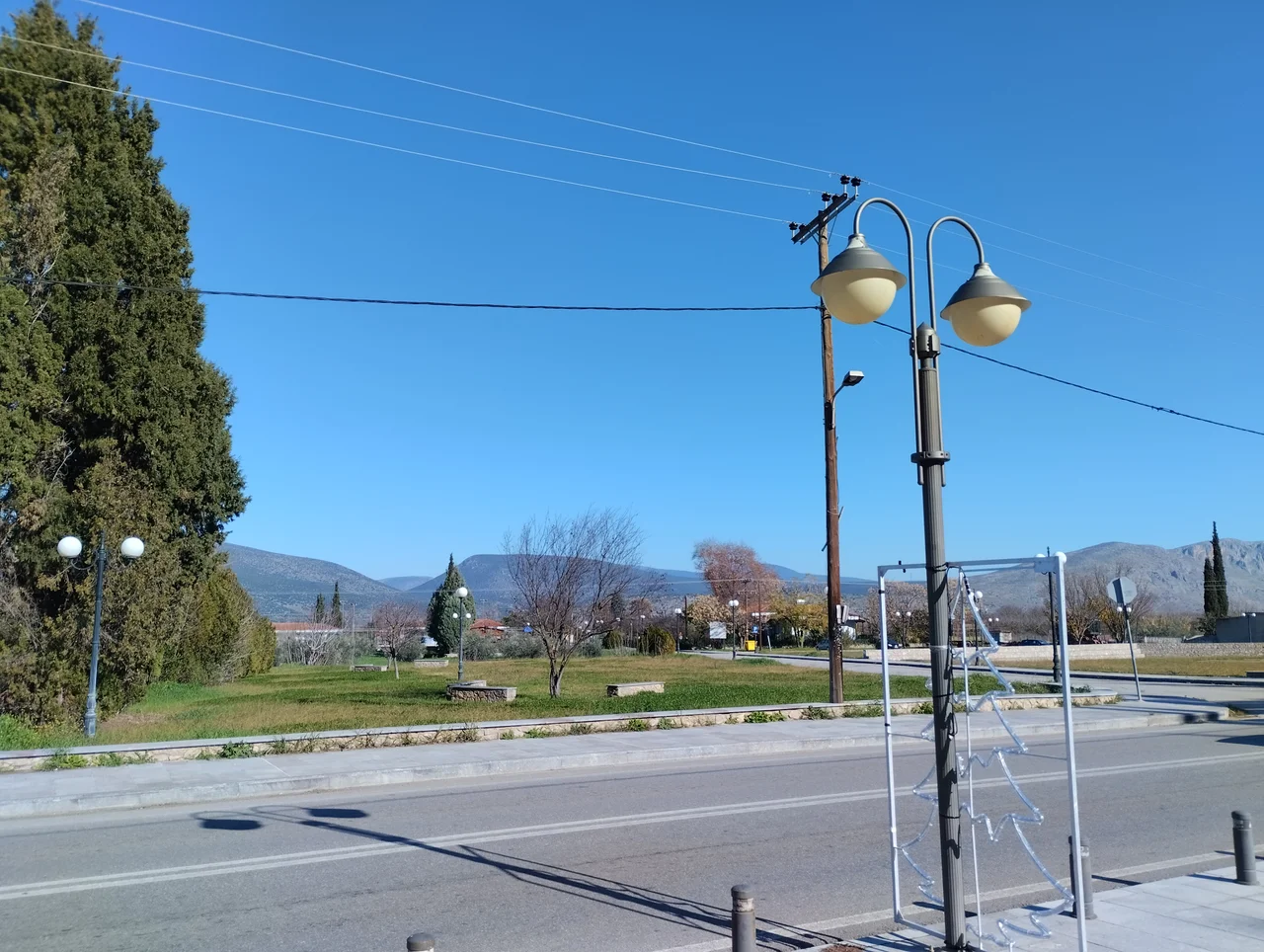
Modern Chaeronea is a village of about a thousand people in the Cephissus river valley, about 35 kilometers east of Delphi. The village sits near Mount Thourion, and the flat ground of the valley floor — the same ground where the phalanxes met in 338 BC — is now agricultural land. The railway serves the settlement with local stopping services to Athens and Leianokladi. The lion monument is the primary reason most visitors come; it stands in a small enclosure near the center of the village, still enormous, still watching. The prehistoric site of Magoula Balomenou, where the settlement was first established, was excavated in the early 20th century. Remains of an early Christian basilica dedicated to Saint Paraskevi survive from the Byzantine period. The town that history made famous once, two and a half millennia ago, continues its quiet existence on the plain below the hills where Philip made his camp.
From the Air
Chaeronea lies at approximately 38.495°N, 22.848°E in the Cephissus river valley in Boeotia, about 35 km east of Delphi and roughly 100 km northwest of Athens. The valley is broad and flat at this point, bounded by ridges to the north and south; the strategic defile that made Chaeronea militarily significant for centuries is visible in the terrain when approaching from the east. The Lion of Chaeronea stands in the village center but is too small to identify from altitude. Recommended viewing altitude: 4,000–6,000 feet for the valley geometry and approach terrain. The primary gateway airport is LGAV (Athens International, Eleftherios Venizelos), approximately 100 km to the southeast via the Boeotian plain. Weather in the Cephissus valley is generally clear in summer; the surrounding ridges can generate turbulence in strong northerly flow.
Nearby Stories
- Battle of Vasilika 7.9 km away
- Siege of Negroponte (1470) 8.5 km away
- Battle of Kalavryta 13 km away
- Church of the Nativity of the Theotokos, Limni 14 km away
- Pellene 16 km away
- Panagia Varnakova Monastery 18 km away
- Megara 21 km away
- Karpenisi 41 km away