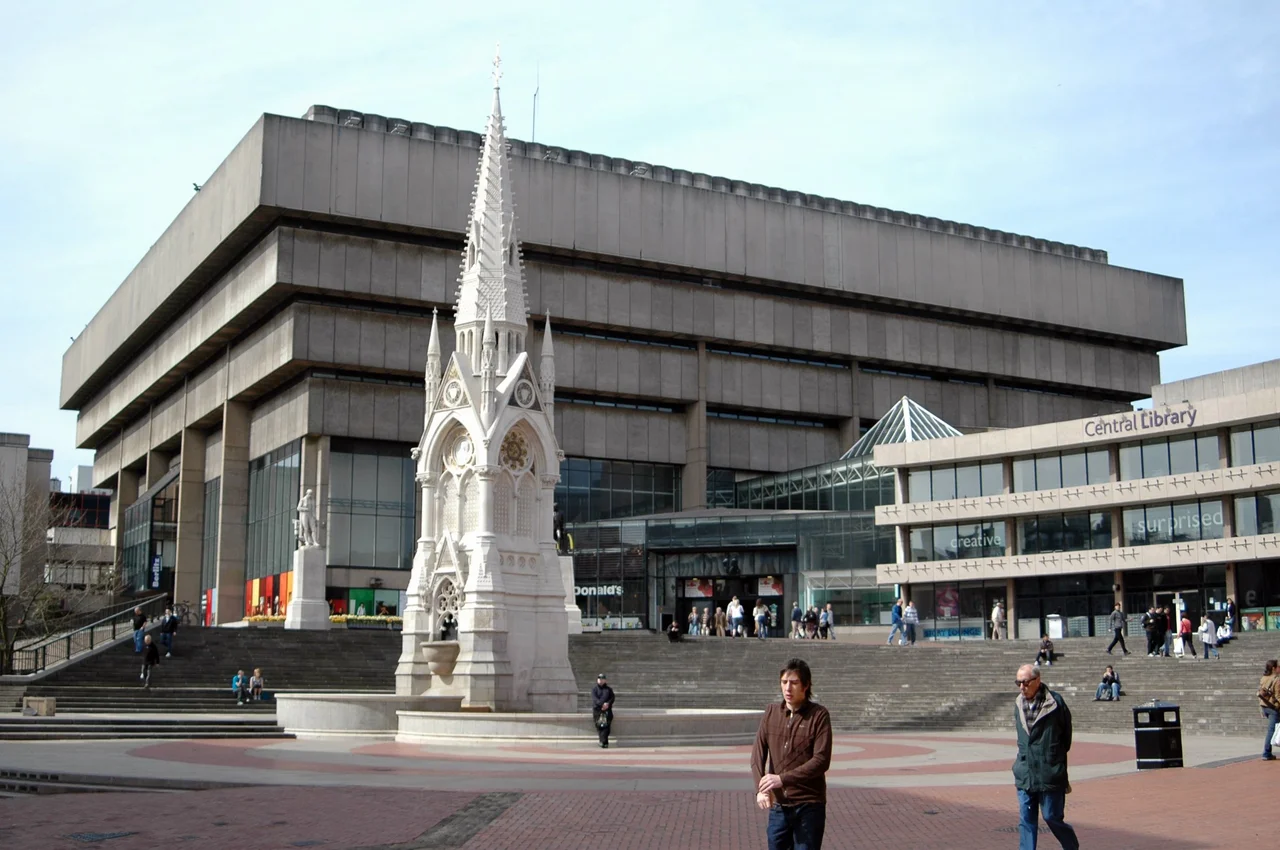

Chamberlain Square
On the steps of this Birmingham square sits a bronze figure who has come down off his plinth. He is Thomas Attwood, economist and political reformer, sculpted in 1993 by Sioban Coppinger and Fiona Peever. His original pedestal stands empty above him; his bronze pages are scattered around his feet, mid-fall. The sculpture is one of the most unusual public monuments in Britain - a statue of a man who refused to be statuesque. Attwood led the Birmingham Political Union that helped force the Reform Act of 1832 through Parliament. He demanded the vote for ordinary men, then sat down. Now his bronze double sits permanently on the steps of Chamberlain Square, watching what the city did with the franchise he won.
Joseph Chamberlain's Birmingham
The square is named for Joseph Chamberlain, mayor of Birmingham from 1873 to 1876, the man who municipalised the city's gas, water, and sewerage and put a generation of Victorian wealth into civic infrastructure. He was the kind of figure who is hard to imagine now: a former screw-manufacturer who became a national politician, a Liberal who broke with Gladstone over Irish Home Rule, the father of Neville Chamberlain and the half-brother of Austen. His memorial fountain, designed by John Henry Chamberlain (no relation), was unveiled in his presence on 10 October 1880 as the centrepiece of the new public square. The 20-metre stone canopy still stands. Chamberlain himself lived another thirty-four years after the unveiling, long enough to watch the square fill up with statues of the city's other heroes.
Priestley and Watt
Joseph Priestley's statue stands here, moved from Victoria Square - then called Council House Square - in some earlier reshuffling. Priestley discovered oxygen in 1774, only to have his Birmingham laboratory and library destroyed in the Priestley Riots of 1791, the same riots that took Baskerville's house a few blocks west. He fled to America. His bronze in Chamberlain Square is one of the city's quieter apologies. Nearby stands James Watt, the Scottish engineer whose improvements to the steam engine made the Industrial Revolution practical and who spent most of his working life in Birmingham as Matthew Boulton's partner at the Soho Manufactory. Watt's statue was originally on Paradise Street next to the Town Hall. The Chamberlain Memorial fountain, Priestley, Watt, and Attwood: four versions of what Birmingham wanted to remember about itself in the late nineteenth century, gathered into one square.
Five Years of Closure
In November 2015 the square closed to the public. It would not reopen until March 2021. The reason was the Paradise scheme, a seven-hundred-million-pound redevelopment by Argent Group that took down the Brutalist Birmingham Central Library and the Paradise Forum beneath it, both of them landmarks of 1970s civic architecture that the public had grown to dislike. Grant Associates won the contract for the new public realm in 2014. New paving, new steps, new lighting, and two enormous commercial buildings - One Chamberlain Square and Two Chamberlain Square - now define the western edge, offering a combined 350,000 square feet of office space. The square reopened as the final piece of Phase One of Paradise, six years after the works began. Many Birmingham residents are still adjusting to a city centre without the Central Library.
Winterval and the Markets
The square hosts the Birmingham Christmas Craft Fair from the third Friday in November to 23 December each year. The event started in 1997 under the name Winterval - a portmanteau the council adopted to bundle a long stretch of seasonal programming together, and one that briefly became a culture-war flashpoint when tabloids accused Birmingham of secularising Christmas. The council had done no such thing. They had simply run a long marketing campaign. But the name stuck in the national imagination and Winterval became a recurring grievance in British newspapers for years afterwards. The fair itself - mulled wine, handmade gifts, a brass band tuning up near the Chamberlain Memorial - has carried on regardless. So has the BBC Big Screen, which once stood here until September 2007 broadcasting sports and ceremonies to whoever happened to be passing.
What the Square Looks Onto
Stand at Attwood's bronze steps and turn slowly. On one side is the City of Birmingham Council House, whose side elevation forms the eastern wall of the square. On another is the entrance to Birmingham Museum and Art Gallery, partly housed within the same building. Across from that is Birmingham Town Hall, the 1834 neoclassical concert hall modelled on the Temple of Castor and Pollux in Rome. Behind you are the two new Chamberlain Square buildings of the Paradise development, all stone-coloured panels and tall windows, designed to sit politely next to the Victorian neighbours without pretending to be Victorian themselves. Chamberlain's bronze face looks out over all of it from the top of the memorial fountain. He saw the Victorian version. He did not see the Brutalist version. The version he is looking at now is the third one this square has tried.
From the Air
Chamberlain Square sits at 52.48 degrees north, 1.9043 degrees west, just southwest of Birmingham's central core. From cruising altitude in clear conditions, look for the Council House dome of Birmingham Town Hall just to the south, and the pale rectilinear roofs of the new Paradise development buildings flanking the square. The square itself appears as a small pale rectangle stepping down toward the canal corridor. Birmingham Airport (EGBB) lies about eight miles east-southeast; Coventry (EGBE) is roughly nineteen miles southeast. Best viewing altitudes are 1,500 to 3,000 feet.
Nearby Stories
- Shepshed 8.5 km away
- Battle of Evesham 11 km away
- Hixon rail crash 12 km away
- Battle of Cropredy Bridge 12 km away
- Wenlock Priory 15 km away
- RAF Shawbury 16 km away
- Market Bosworth 17 km away