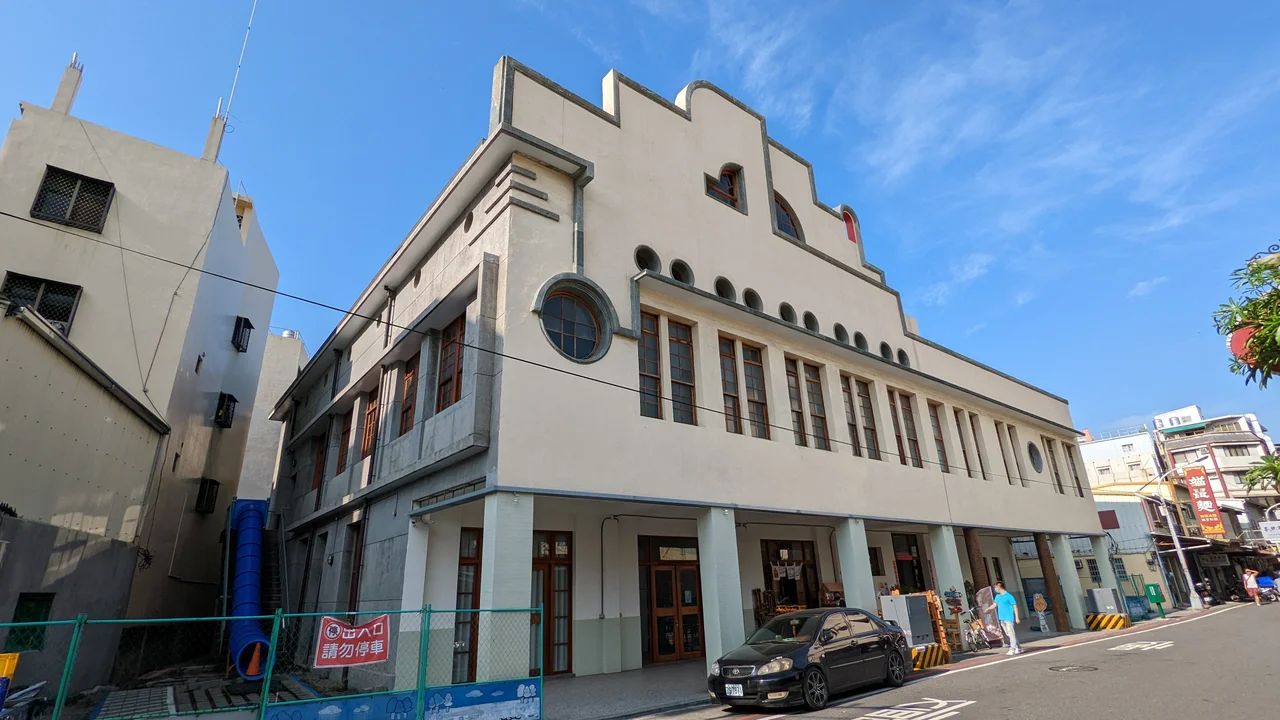

Changhua Railway Hospital
Wang Bing-chi had been impressed by what he saw in Taipei. On his return to Changhua, he described it to his father and to his associate Yang Hsin-yen, and together they decided to build something similar — a restaurant that would be worthy of the city, something modern and elegant and unapologetically ambitious. Construction began in 1937. The second floor went up in January 1938. By May of that year, the building was complete: two stories of streamlined modernist architecture, with one section of the exterior curved in a shape that echoed the prow of a ship.
The House That Kaobinge Built
The restaurant that opened in the building was called Kaobinge, and it drew a notable clientele. Loa Ho — the poet and physician who is considered one of the founding figures of Taiwanese-language literature — was a frequent patron. So was Tu Tsung-ming, a pharmacologist who would go on to become one of the most distinguished medical scientists in Chinese-speaking Asia. The building's architect, Chang Shih-fan, and lead construction supervisor, Wei Lin-mu, had produced something that went well beyond ordinary commercial architecture: a venue where the arts, medicine, and civic life intersected over meals in an upper-floor dining room that included a stage.
The ground floor handled the kitchen and staff quarters. The second floor, with its stage and dining spaces, was where Changhua's intellectual life gathered. Kaobinge was, by the standards of a colonial provincial city in the 1930s, genuinely cosmopolitan.
War and Silence
The Second Sino-Japanese War that began in 1937 cast a long shadow over civilian life in Taiwan. As the conflict consumed more resources and attention, a restaurant as gracious as Kaobinge became difficult to sustain. The economics simply stopped working — customers grew fewer, supplies more uncertain — and roughly five years after it opened, Kaobinge closed.
The building changed hands. The Japanese-run predecessor of what would become the Taiwan Railways Administration acquired it, with plans to convert it into a railway hospital. Those plans stalled. Through the final years of Japanese administration, the building drifted between uses: dormitory, office space, storage. It was present and functional, but its original purpose had been abandoned. The elegant second-floor dining room, once lit by conversation and performance, sat quiet.
Hospital Years
In 1950, five years after Japan's surrender and the transfer of Taiwan to the Republic of China, the building was repurposed as a medical facility — the use its most recent owner had always intended. It served in that capacity for more than three decades, becoming the Changhua Railway Hospital officially in 1971. The hospital closed in 1984.
For the next two decades, the building cycled through tenants: a wedding photography studio, then a cafe. These uses preserved the structure without honoring it. The building remained, but the memory of what it had been — and who had passed through it — was fading.
Saved by a Vote
In 2008, there was a proposal to demolish the building. The land it occupied, close to Changhua railway station, had become valuable; a larger parking lot would be more useful than a weathered two-story structure with an uncertain past. It was not an unreasonable calculation, and in many Taiwanese cities in the early 2000s, buildings with comparable histories had been torn down on similar logic.
Changhua chose differently. In 2011, the Changhua County Government's Cultural Affairs Bureau designated the building a county-level historic heritage site. Demolition was no longer an option. A formal restoration project followed, funded jointly by Taiwan's Ministry of Culture, the Changhua Cultural Affairs Bureau, and the Taiwan Railways Administration. Work began in 2016 and was completed in 2018, at a reported cost of NT$50 million — roughly US$1.6 million — returning the building as closely as possible to its 1938 appearance.
A Second Life
The restored Changhua Railway Hospital is now one of the more striking buildings in central Changhua — the ship-prow corner, the modernist fenestration, the clean two-story profile that announced itself even in the colonial cityscape of the 1930s. Visitors can trace the layers of its history: the restaurant that hosted poets and pharmacologists, the years of institutional use, the near-loss, the recovery.
It sits in a neighborhood that has grown and changed around it, close to a train station that still sends passengers up and down Taiwan's west coast. The building has outlasted the empire that built it, the restaurant that gave it life, and the hospital that gave it its current name. What remains is the architecture — and the argument, implicit in every restored beam and repainted facade, that some things are worth keeping.
From the Air
The Changhua Railway Hospital stands at approximately 24.08°N, 120.54°E in central Changhua City, very close to Changhua railway station on Taiwan's main west-coast rail line. From altitude, Changhua is visible as a compact urban grid between the Taiwan Strait coast and the slopes of Bagua Mountain to the east. The nearest major airport is Taichung International Airport (RCMQ), approximately 15 km to the northeast. Flying south from Taichung along the coastal plain, Changhua City appears as a dense cluster of low-rise urban development before the landscape opens into the agricultural fields of the Changhua coastal lowlands.
Nearby Stories
- Huwei, Yunlin 2.8 km away
- Geographic Center of Taiwan 4.2 km away
- Gaomei Wetlands 15 km away
- China Airlines Flight 611 21 km away
- Shei-Pa National Park 25 km away
- Yushan Weather Station 27 km away
- TransAsia Airways Flight 222 30 km away
- Battle of Xiapi 1136 km away