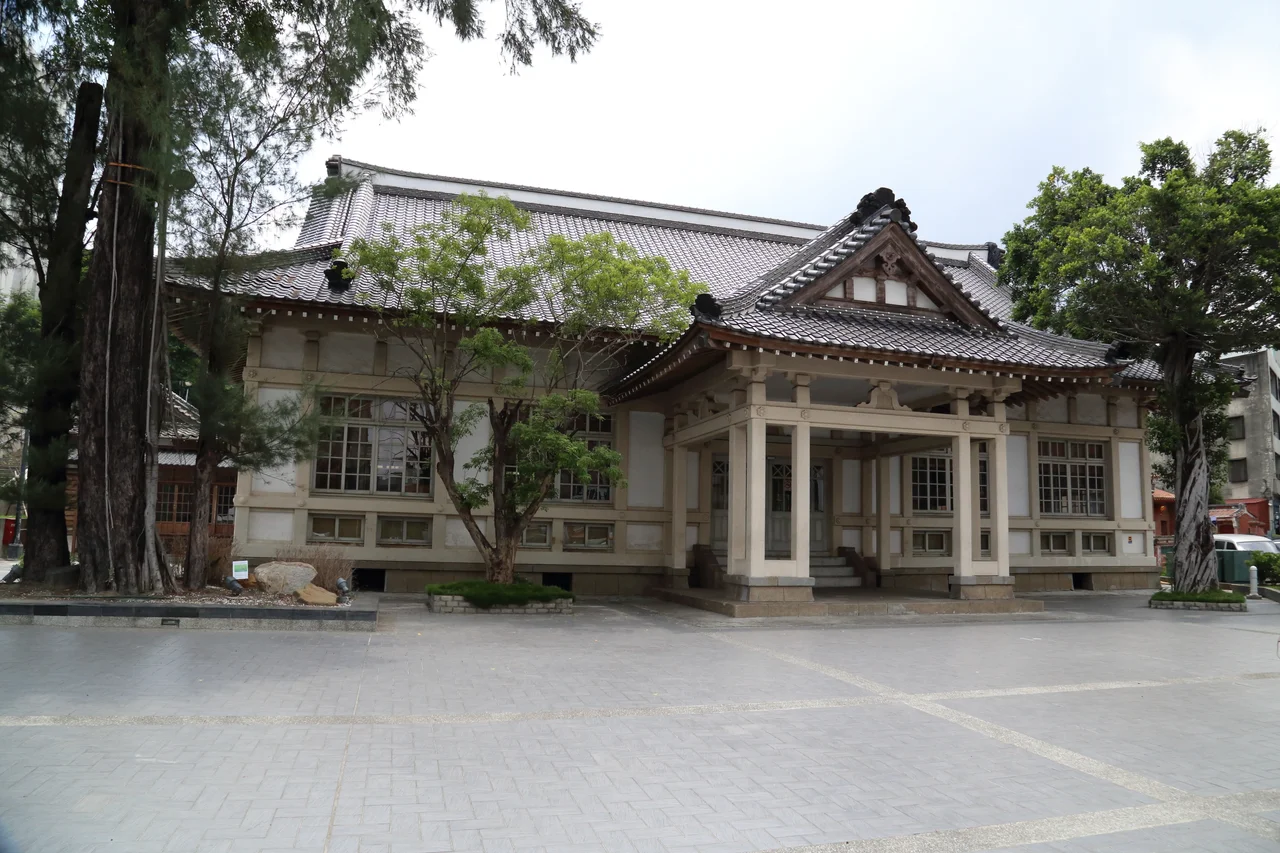

Changhua Wude Hall
The name says it plainly: Wude Hall, the Hall of Martial Virtue. In the vocabulary of Japanese colonial administration, "wude" — Japanese *butoku* — carried specific meaning: the moral dimensions of martial practice, the idea that disciplined physical training produced not just fighters but better citizens. The Dai Nippon Butokukai, the organization that promoted this concept across Japan and its territories, had built hundreds of these halls. Changhua's version went up between 1929 and 1930, completed on October 18 of that year, intended as a civic anchor for a city the colonial government was reshaping in its own image.
Built for the Body, Built for the State
The Dai Nippon Butokukai — the Greater Japan Martial Virtue Association — was a government-backed organization founded in Kyoto in 1895, the same year Japan took control of Taiwan. Its mission was to systematize and promote Japanese martial arts: kendo, judo, kyudo, sumo. By the 1920s and 1930s, the organization was building training halls, called butokuden, throughout Japan and across its colonial territories. Taiwan received several of them.
The Changhua hall, completed in 1930, was built in the architectural style characteristic of these facilities: a formal structure with traditional Japanese roof elements combined with colonial civic design. It served its intended purpose through the remaining years of Japanese rule — a space for martial training, for competitions, for the cultivation of the disciplined body the colonial state valued. It stood near Changhua railway station, close to the administrative and commercial center of the colonial city, visible and institutional.
After the Handover
When Japan surrendered in August 1945 and Taiwan was transferred to the Republic of China, the function of the Wude Hall changed. The institution it had served no longer existed; the empire that had built it was gone. The building was repurposed as the Changhua Martyrs' Shrine — a facility for commemorating the war dead of the new administration, replacing one form of civic ritual with another.
This kind of repurposing was common across Taiwan in the postwar years. Japanese-era buildings were adapted rather than demolished, at least initially, because the practical pressures of the transition period left little time or money for wholesale replacement. The Wude Hall's physical structure survived intact through this transition, its Japanese architectural character preserved inside a building that now served a different political purpose.
The Earth Moves
On September 21, 1999, a magnitude-7.6 earthquake struck near Jiji, in Nantou County — one of the most powerful earthquakes in Taiwan's recorded history. The tremors were felt across central Taiwan; Changhua, roughly 30 kilometers northwest of the epicenter, sustained significant damage to older structures throughout the city.
The Wude Hall was partially damaged. What happened next matters: rather than simply repairing the building in the most expedient way, those overseeing the restoration took care to maintain its original appearance. This was not a given. Earthquake repairs in Taiwan, as elsewhere, sometimes result in reconstructions that preserve the footprint but lose the character. The decision to prioritize historical fidelity during the Wude Hall's repair was a deliberate one, and it shaped what the building would become.
Recognition and Restoration
On December 13, 2001, the Changhua Wude Hall was formally designated a historical building — an official recognition that the structure had value worth protecting. Restoration work followed, proceeding carefully and taking years to complete. The project was fully finished in October 2005.
The result is a building that carries its age visibly and honestly. The roofline, the entry treatment, the proportions of the main hall — all reflect the architectural conventions of the Japanese colonial period in Taiwan, a style that draws on traditional Japanese forms while adapting them to the institutional purposes of colonial governance. It is neither a purely Japanese building nor a purely Taiwanese one; it is a document of a particular moment in Taiwan's complicated history, preserved in brick and timber.
Walking Distance from the Station
The Wude Hall sits southeast of Changhua railway station, close enough to reach on foot. This proximity is part of its original logic — the colonial city was designed to concentrate its civic institutions near the railway, the spine of Japanese-era urban planning in Taiwan. The station is still there, still sending trains north to Taichung and south toward Chiayi and Tainan. The Wude Hall is still there too, a short walk away, in a neighborhood that has filled in around it over nine decades.
Visitors to Changhua often move between the Wude Hall, the Railway Hospital a few blocks away, and the Confucian Temple farther into the old city — a circuit that traces three different eras of the city's past, each preserved in a different kind of building, each telling a different story about who built Changhua and why.
From the Air
The Changhua Wude Hall stands at approximately 24.08°N, 120.55°E, within easy walking distance southeast of Changhua railway station in the heart of Changhua City. From altitude, Changhua is identifiable as a compact urban cluster on the western coastal plain, with Bagua Mountain rising immediately to the east. The nearest major airport is Taichung International Airport (RCMQ), approximately 15 km to the northeast. A low-altitude pass over central Changhua reveals the historic core of the city concentrated around the railway station, with the city's historic buildings visible within a compact radius.
Nearby Stories
- Huwei, Yunlin 2.8 km away
- Geographic Center of Taiwan 4.2 km away
- Gaomei Wetlands 15 km away
- China Airlines Flight 611 21 km away
- Shei-Pa National Park 25 km away
- Yushan Weather Station 27 km away
- TransAsia Airways Flight 222 30 km away
- Battle of Xiapi 1136 km away