
Charles Dickens
When the warehouse moved to Chandos Street in Covent Garden, the boys were placed in a room where the window opened onto the street. Small audiences would gather to watch them work, pasting labels onto pots of boot-blacking. The Dickens biographer Simon Callow has called the public display "a new refinement added to his misery." Charles was twelve years old. His father was in the Marshalsea debtors' prison a few miles south. The other children labelling pots that summer of 1824 would forget the room. Charles would spend the rest of his life writing about it.
Twelve, in Covent Garden
John Dickens had been a clerk in the Navy Pay Office, comfortably middle-class, until debt overtook him. In February 1824, he was sent to the Marshalsea Prison in Southwark, taking his wife and youngest children with him. Charles, the second of eight children, was put to work at Warren's Blacking Warehouse near Hungerford Stairs on the Thames, pasting labels onto pots of shoe blacking for six shillings a week. When the warehouse relocated to Chandos Street, he and another boy worked in the window for the entertainment of passers-by. He lodged alone in Camden Town, walking each day to the warehouse and on Sundays to the prison to visit his family. The job lasted perhaps a year. It would have lasted longer except that his father quarrelled with the warehouse owner. His mother wanted Charles sent back to work; his father refused. Years later, Dickens wrote that he could never forgive his mother for that wish. He spoke of the warehouse to no one for thirty years. He wrote it into David Copperfield in 1850 — the murky bottles, the worn floor, the boy in the window — and only then revealed in a fragment of autobiography what had really happened. The fragment was found among his papers after his death.
Walking the City
London became, for the rest of his life, the place he walked. He covered eight, ten, twelve miles in a night. He worked out plot problems on foot. He absorbed the city the way other writers absorbed books: the lamplighters and chop-houses, the river fogs along Wapping, the rotting tenements of Jacob's Island, the lawyers in their Inns of Court, the secondhand clothes-dealers in Monmouth Street, the great Smithfield meat market in the small hours. He invented the urban novel for English literature, or rediscovered it from Hogarth, and gave back to London a version of itself in which the city was not background but character. Bleak House opens with fog, fog everywhere — fog up the river, fog down the river, fog in the eyes and throats of pensioners wheezing by firesides. Oliver Twist follows a child through the rookeries of Saffron Hill. Little Dorrit, which begins in the Marshalsea where Dickens's father had been imprisoned, traces the prison's invisible reach into every life it touches.
The Performer
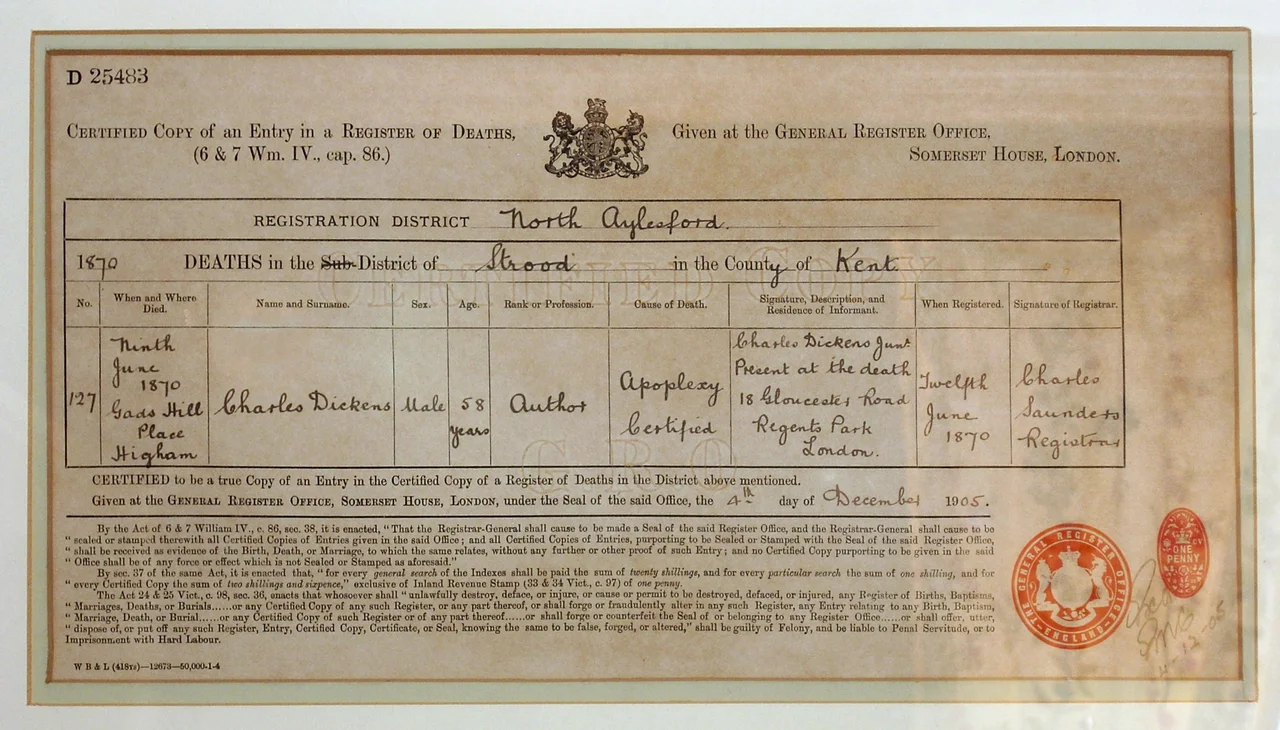
Dickens was, before he was anything else, a performer. He nearly went on the stage as a young man; he gave amateur theatricals all his life; he loved costumes and accents and dramatic effect. In 1858, he began the public readings that would, in the end, kill him. He toured the British Isles and twice toured America, performing scenes from his novels — particularly the murder of Nancy from Oliver Twist, which left him shaking and feverish and his audiences pale. The readings paid extraordinarily well. They also broke him down. By 1869 he had suffered a mild stroke. He continued reading, against the urgent advice of his doctors. "A spirit-impatience to be at the theatre," was how he put it to a friend. The exhaustion of the road, the railway journeys, the doubling and redoubling of audiences who wanted Sikes and Nancy one more time — all of it killed him. He died at Gad's Hill Place in Kent on 9 June 1870, having collapsed the day before while finishing dinner. He was 58. His wife — from whom he had been separated since 1858, in a public estrangement that did real damage to the woman he left — survived him by nine years.
Compassion and Reform
Dickens used his fame for causes. He worked with the heiress Angela Burdett-Coutts on Urania Cottage, a home for women trying to leave prostitution, designing the regime himself and interviewing prospective residents. He campaigned against ragged-school neglect, against the abuses of the Yorkshire boarding schools (which he savaged in Nicholas Nickleby), against capital punishment in public, against the conditions in workhouses, against the slow violence of the Court of Chancery. The books were instruments. Oliver Twist made the slums real to readers who had never set foot in them. Hard Times brought the industrial north into drawing rooms in the south. A Christmas Carol — written in six weeks in 1843 to pay off debts — invented, almost single-handedly, the modern English Christmas, and shamed a generation of Scrooges into giving a little more. The reformer who began all of this was the twelve-year-old in the Chandos Street window, who never quite stopped looking out through that pane of glass.
What Covent Garden Remembers
Chandos Place runs east-west off St Martin's Lane, a short walk from Trafalgar Square. The warehouse is long gone, replaced by buildings that come and go in the way of central London. A plaque on Chandos Place marks the approximate site. The Marshalsea prison, in Southwark, was closed in 1842, and most of its buildings were demolished; the boundary wall still stands behind the Borough Underground station, with a small plaque acknowledging that it once held the Dickens family. The Dickens Museum, at 48 Doughty Street in Bloomsbury, occupies the only one of his London houses to survive — the modest Georgian terrace where, between 1837 and 1839, he wrote The Pickwick Papers, Oliver Twist, and Nicholas Nickleby. He had moved in at twenty-five, recently married, on the verge of a fame his twelve-year-old self could not have imagined and would never quite have believed. He carried that boy with him into every house and every novel for the rest of his life.
From the Air
Charles Dickens spent most of his London life in the area between Covent Garden and Bloomsbury, with the central point near 51.50N, 0.13W. From the air, the relevant landmarks form a triangle: Covent Garden's market hall, the British Museum a half-mile north in Bloomsbury, and the Thames south at the Strand. London City Airport (EGLC) lies six miles east; London Heathrow (EGLL) fifteen miles west. Best viewed from 1,500 to 3,000 feet on a clear day. The Marshalsea site in Southwark lies just south of London Bridge.
Nearby Stories
- Battle of Britain, Northfleet 1.1 km away
- Bayham Old Abbey 5.4 km away
- Catharine Macaulay 6.4 km away
- Hatfield rail crash 8.8 km away
- Chequers 8.9 km away
- Chelmsford Cathedral 10 km away
- Queen Victoria Hospital 13 km away
- Fishbourne Roman Palace 36 km away