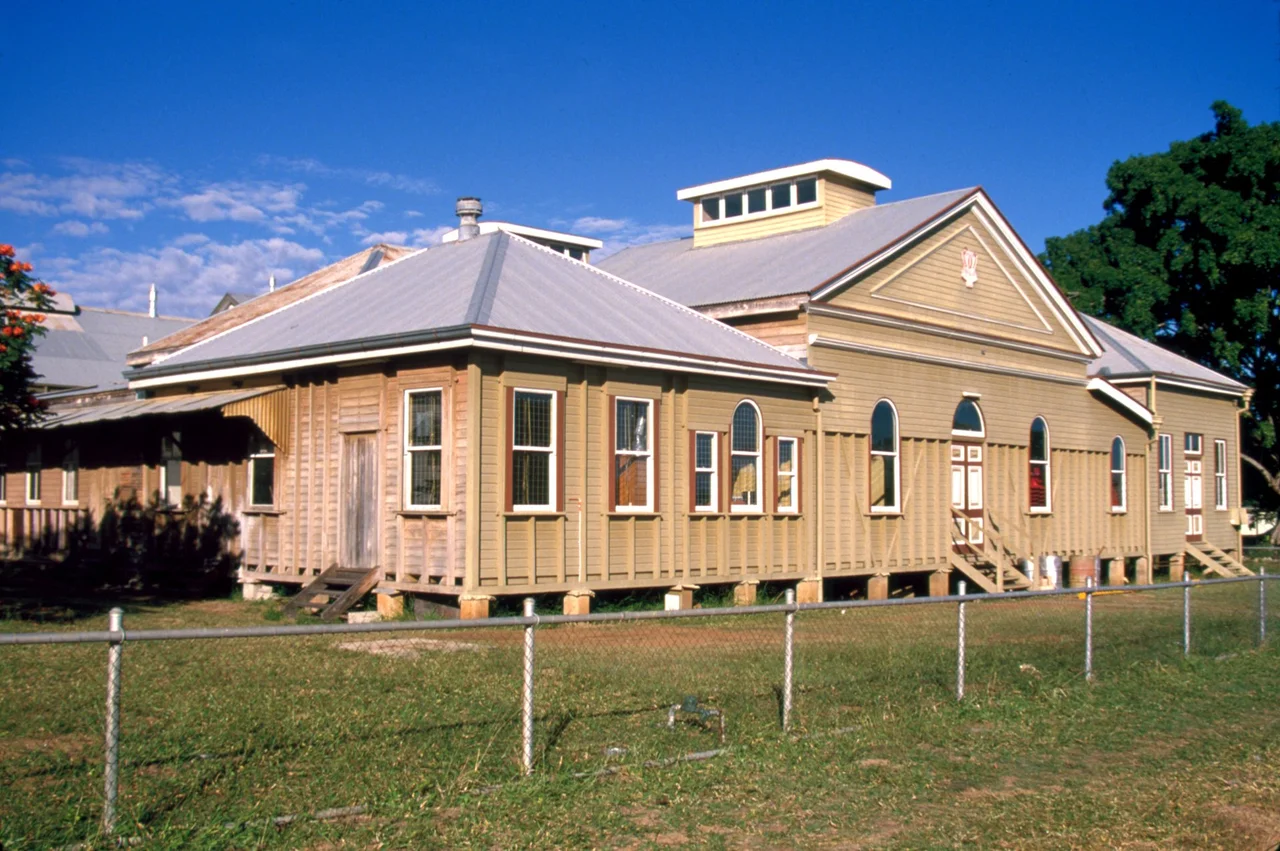
Charters Towers School of Mines
The first attempt failed completely. When the local Mining Institute opened a School of Mines in 1899, paid for by public subscription, sixty or seventy students enrolled, eager to learn the science behind the gold that surrounded them. By the end of the year, two were left. The need for trained mining men was real; the means to deliver it was not. So the Institute handed the whole experiment to the Queensland Government, and out of that failure grew one of the most respected technical schools in the country, a single-storey timber building on Hodgkinson Street that still stands beside the courthouse today.
A Science for the Goldfield
Charters Towers needed this school more than most towns. Its gold lay deep in sloping reefs, and pulling it out was not a matter of luck but of geology, chemistry and engineering. When the government took over in 1900 and reopened the school in 1901, the curriculum reflected exactly what the field demanded: geology and mineralogy to understand the ground, surveying to map the workings, assaying and chemistry to test the ore. There were lecture rooms, laboratories, a balance room, a mechanical drawing office and a survey department. The foundation stone, laid by E.D. Miles, was set as one of the very stumps holding up the timber building, a literal cornerstone of the goldfield's education.
Lectures After Dark
The school's first director, W.A. McLeod, was a graduate of the Otago School of Mines in New Zealand, and he arrived with an idea that was considered genuinely novel. He believed working men deserved a chance to rise in their industry, not just the sons of families who could spare them from wages. So he had his lectures repeated in the evening, after the day shift came up from underground, allowing miners to study by lamplight after a full day at the face. At the time this was thought to be unique in Australia. A man could descend a shaft in the morning and learn the science of the rock he was breaking that same night.
Growing With Success
Response to the school was strong, and the building grew with it. In 1903 it was extended eastward for a reading room and office, the new section marked off by its squared sash windows and a fresh hip roof. McLeod left in 1904 to manage the Brilliant Extended Mine, having set the curriculum, and his successor W. Poole built the school into something formidable. By January 1907 a whole western wing had been added: a drawing office, a lecture preparation room, a new laboratory and extended assay rooms with their own balances. Within a few years the modest timber structure had more than doubled in size and wrapped itself around a courtyard.
Outlasting the Gold
There is a poignant timing to all this. The school reached its full flourishing in the very years the goldfield was dying. Charters Towers had peaked in 1899, and by 1912 people were already leaving; the field effectively closed in 1916. Yet the school kept producing a small, highly regarded stream of graduates who carried their training into mines across Queensland and far beyond. It finally closed in 1925, absorbed into the Department of Education. The men it trained outlived the gold that had built it, dispersing the goldfield's hard-won expertise across the mining world just as Charters Towers itself faded from boom to memory.
A House of Art
Saved once already from demolition, the building came close to being lost in 1977 when the public works department planned to tear down its main portion. The residents of Charters Towers reacted strongly, and the National Trust of Queensland stepped in to take a lease and make the place usable again. Today the rooms where miners once bent over assay scales and survey tables belong to Towers Arts, the town's largest community of artists. Paintings, ceramics, quilts and jewellery now fill the spaces designed for chemistry and geology, and the school's halls house the city's most extensive art galleries, light pouring in through the same windows that once lit lessons in extracting gold.
From the Air
The Charters Towers School of Mines stands at 24-26 Hodgkinson Street, beside the courthouse in the town centre, at approximately 20.078 degrees south, 146.260 degrees east. From the air it is part of the dense heritage grid of central Charters Towers, set on the dry inland plateau about 130 km south-west of Townsville; look for the compact older streetscape between the bald dome of Towers Hill to the south and the surrounding spread of suburbs. A recommended viewing altitude is 2,000 to 4,000 feet AGL over the town centre. Charters Towers Airport (YCHT) sits on the north-eastern edge of town at roughly 20.04 S, 146.27 E; Townsville Airport (YBTL) is about 102 km to the north-east. Visibility is typically excellent through the dry season (April to October), with summer haze and storm activity more likely from November to March.
Nearby Stories
- Bindal People 44 km away
- Herveys Range Heritage Tea Rooms 57 km away
- Bowen River Hotel 65 km away
- Radar Station, Charlie's Hill 71 km away
- Strathmore Homestead 126 km away
- Porcupine Gorge 153 km away
- Undara Volcanic National Park 230 km away
- Lake Dunn 276 km away