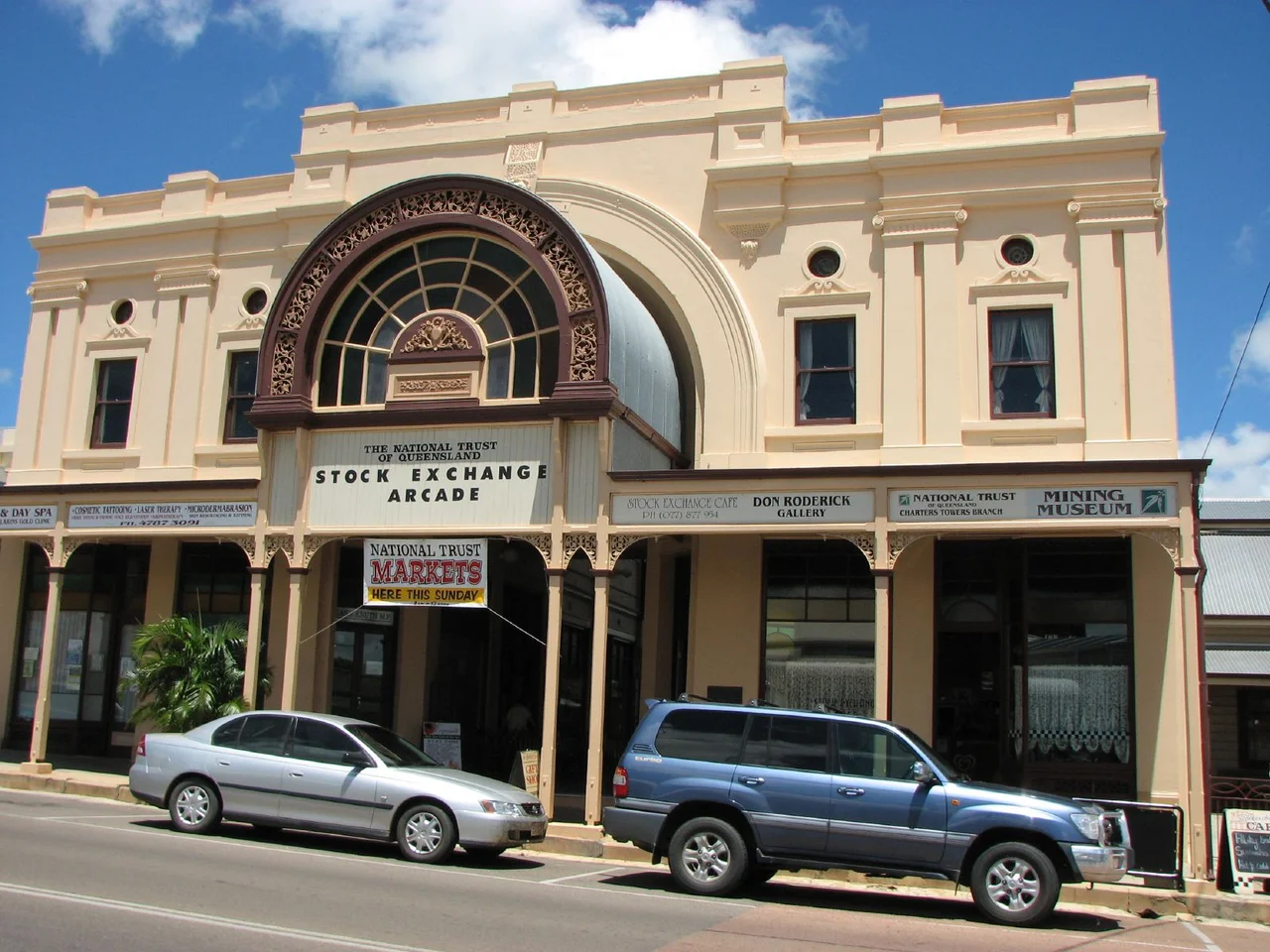

Charters Towers Stock Exchange Arcade
Each evening a crowd would gather in the courtyard of the Royal Arcade, under its long glazed vault, and listen to a man call out numbers. Share by share, mine by mine, the wealth of Charters Towers was auctioned aloud in the cool of the night, and the public came to watch the way others might come to the theatre. This was the Stock Exchange Arcade, and for a quarter of a century it was the beating financial heart of Australia's third-richest goldfield, the place where ounces of gold from deep underground were turned into paper fortunes.
The Boy Who Found It
All of this traced back to a thunderstorm and a twelve-year-old boy. In late December 1871, a small prospecting party was working the country near what is now Charters Towers: Hugh Mosman, George Clark, James Fraser, and a young Aboriginal boy named Jupiter, who worked with Mosman. When their horses scattered in a fierce storm, it was Jupiter who, searching for them the next morning, found the gold-bearing stone at the foot of Towers Hill that started everything. He was given the surname Mosman, and in his old age the people of the town successfully petitioned the government to care for him, since as an Aboriginal man he was denied the pension other Australians received. The grand arcade, the share calls, the millions in gold, all of it rested on what one Aboriginal child found in a creek bed.
Why the Money Came
The boom Jupiter began had an unusual shape, because of how the gold lay. There was little to pan from the surface; the wealth was in deep reefs that demanded machinery, shafts and serious money. By 1885 several mining agents had formed a Mining Exchange so that shares in the mines could be bought and sold. The following year, a display of Charters Towers ore at the Colonial and Indian Exhibition in London set off a wave of British speculation. That first boom collapsed in 1888, but the discovery of the fabled Brilliant Reef the very next year revived the field's fortunes, and the appetite for shares only grew.
An Arcade Fit for a Boom
The confidence of those years pushed local businessmen to replace their old timber buildings with brick. Alexander Malcolm, a civic leader who had been on the field since the early 1870s, commissioned the Sydney architect Mark Cooper Day to build him an elegant arcade of shops and offices on Mosman Street, completed in 1888 by the Sandbrook Brothers and named the Royal Arcade. It was a grand thing: small offices ranged along both sides of a central court, covered by a glazed vault on steel trusses and entered beneath a barrel-vaulted portico jutting over the footpath. In 1890 the reorganised Stock Exchange leased an office and the courtyard here for ten pounds a month, and the Royal Arcade became the exchange.
The Call
Two calls were made each day. The noon call was for business; the evening call was open to the public, and the public came in crowds. To stand in that courtyard and hear the shares cried out was to hear the goldfield's pulse in real time. This was no ordinary place of trade. It was one of only two stock exchanges in Queensland outside the capital, and both stood on goldfields, the other being Gympie. The cyanide process arrived in 1892 and lifted production further, until the field peaked in 1899 at over 319,000 ounces and the town's population reached around 26,500, making Charters Towers the second most important city in Queensland and a goldfield famous around the world.
The Abrupt Ending
Then the gold ran out, or rather ran too deep to pay. After 1899 the yields fell while costs climbed, until in 1912 the mining warden reported that the limit of profitable depth had been reached. People left for the coastal towns, investors lost interest, and in 1916 the stock exchange simply closed. The arcade had always looked slightly unfinished, ending abruptly as if it expected to grow larger, and that very incompleteness now reads as a monument to boom and bust. Too grand for the shrunken town, it fell into disrepair until the 1970s, when the National Trust restored it. Today its offices and shops are quiet, and an upstairs gallery holds art where brokers once shouted prices into the night.
From the Air
The Stock Exchange Arcade stands at 76 Mosman Street in central Charters Towers, at approximately 20.076 degrees south, 146.257 degrees east, on the dry inland plateau about 130 km south-west of Townsville. From the air, look for the compact grid of the old town centre along Mosman and Gill Streets, just north of the bald rise of Towers Hill, surrounded by the spread of later suburbs; the arcade's glazed vault is a small feature within that heritage core. A recommended viewing altitude is 2,000 to 4,000 feet AGL over the town centre. Charters Towers Airport (YCHT) lies on the north-eastern edge of town at roughly 20.04 S, 146.27 E, with Townsville Airport (YBTL) about 102 km to the north-east. The dry season (April to October) offers excellent visibility; expect haze and possible storms in the summer months.
Nearby Stories
- Bindal People 44 km away
- Herveys Range Heritage Tea Rooms 57 km away
- Bowen River Hotel 65 km away
- Radar Station, Charlie's Hill 71 km away
- Strathmore Homestead 126 km away
- Porcupine Gorge 153 km away
- Undara Volcanic National Park 230 km away
- Lake Dunn 276 km away