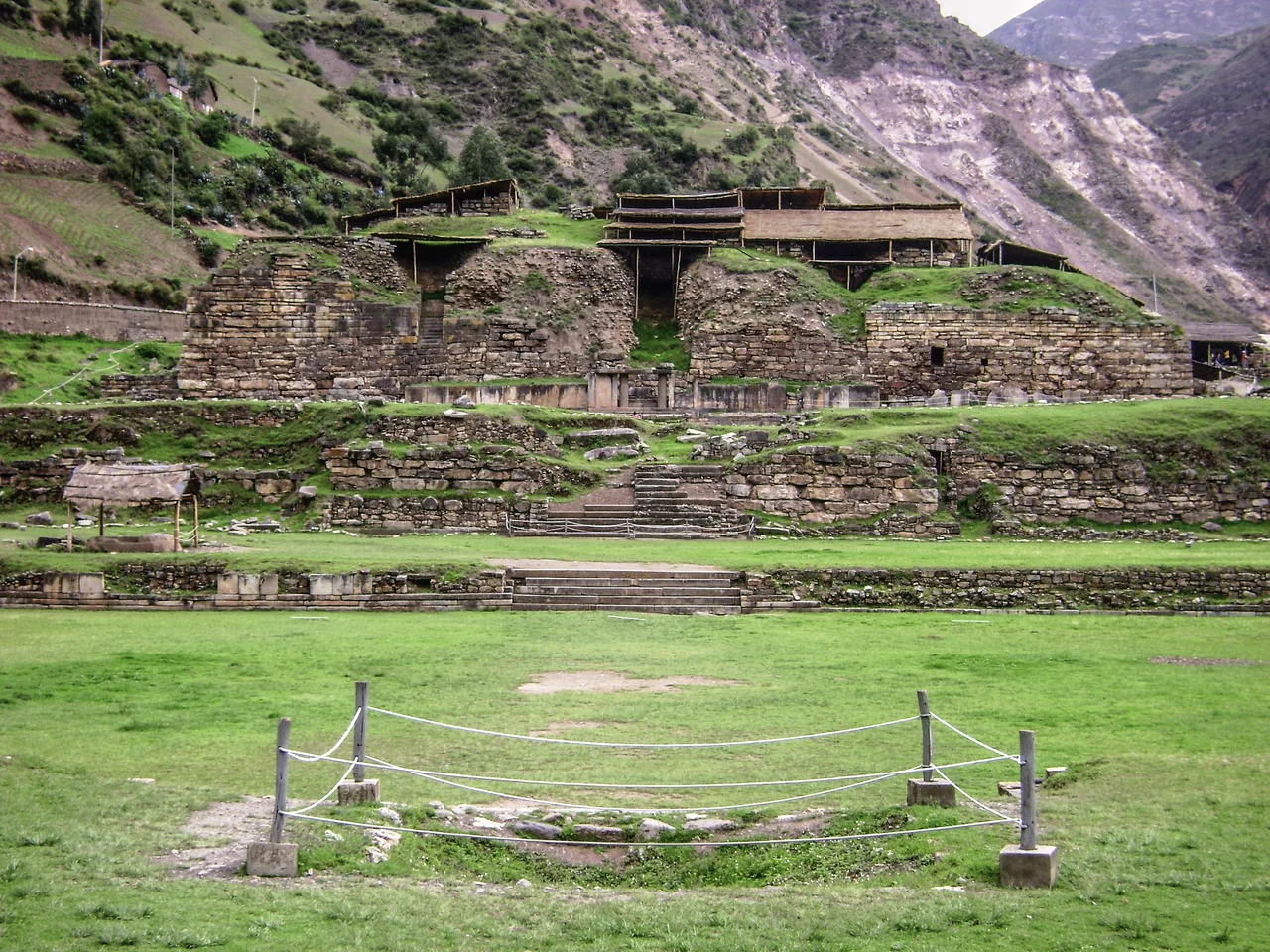

Chavín de Huántar
The bus from Huaraz climbs south to Cátac, then turns east and starts ascending. Several hours later it enters Huascarán National Park, plunges through the Kahuish tunnel under the spine of the Cordillera Blanca, and emerges into the eastern Andes. The road descends into the valley of Chavín de Huántar, where about nine thousand people live around the most important pre-Columbian temple complex in the central Andes. The town and the ruins share a name. The temple has been there for nearly three thousand years. The town has grown up beside it, mostly bilingual in Spanish and Quechua, perched at 3,137 meters in a landscape that includes snow-capped peaks, alpine lakes, and stretches of the Inca road network. The temple is a UNESCO World Heritage Site. The town is the basecamp.
What the Temple Was
From the 15th century BCE through the 3rd century BCE, Chavín de Huántar was a pilgrimage destination drawing visitors from across what is now Peru. It influenced cultures from the Pacific coast to the highlands and the edge of the Amazon. The site contains the Old Temple (built roughly 900 to 500 BCE) and the New Temple (built roughly 500 to 200 BCE) added onto it. Inside the Old Temple stands the Lanzón, a 4.5-meter granite shaft carved with a fanged deity, accessible only through a small interior gallery. The temple complex makes extensive use of underground galleries and stone-carved tenon heads (massive fanged jaguar faces that project from the walls). UNESCO designated the site a World Heritage Site for its outstanding example of Andean ceremonial architecture. Visitors today can walk through the partially restored complex and the on-site National Museum, which displays carved stelae and tenon heads that have been moved indoors for protection. The site also draws visitors interested in the spiritual and entheogenic traditions associated with the temple, including the San Pedro cactus that featured in ancient ceremonies and is still used by some local practitioners.
Getting to Chavín
Daily buses run from Huaraz, Huari, Llamellín, and Lima. The Huaraz route, on a paved road, takes at least two hours and goes through the Kahuish tunnel under the Cordillera Blanca, a road experience that is half journey and half scenic tour. Several bus companies on Mariscal Caceres avenue in Huaraz offer regular departures, with fares around twelve soles. Long-distance buses from elsewhere also stop at Chavín around midnight, but unless accommodation is sorted in advance, that arrival time is rough. Shared taxis and combis from Huaraz are sometimes available. From the nearby town of San Marcos, taxi colectivos and combis make the short final leg. Tours from Huaraz package transportation with a guide for thirty-five to forty soles. For those with time and stamina, hiking trails of two days or longer pass through Huascarán National Park to reach the town. The most famous is the Olleros-Chavín trail, beginning in the village of Olleros near Huaraz, covering 38 kilometers and crossing the Yanashallash mountain pass. The trail follows a well-preserved section of the Inka naani, part of the UNESCO-listed Qhapaq Ñan network of Inca roads.
Living at 3,137 Meters
Chavín sits in the tropics, but the altitude moderates the temperature in a way that often surprises first-time visitors. Daytime highs stay below 20 degrees Celsius year-round. Nights drop a few degrees below 10. What changes through the year is not the temperature but the rain. The dry season, sometimes called the Andean summer, runs from April through November. The rainy season, December through March, can deliver up to 1,000 millimeters in a few months. Months on either side of the rainy season are not entirely dry. Altitude sickness is a real risk, especially for travelers arriving directly from sea level. Sunburn happens fast at this elevation because the thinner atmosphere filters out less ultraviolet radiation. The town has a health center and pharmacies, but the nearest hospitals are 38 kilometers away in Huari and 104 kilometers in Huaraz. Mobile coverage exists from Claro and Movistar, with 3G in town and 2G further out. Some hotels offer Wi-Fi.
The Surroundings
The town's location on the eastern side of the Cordillera Blanca puts visitors within reach of one of South America's most spectacular alpine landscapes. Part of the district lies inside Huascarán National Park, named for Peru's highest mountain, which rises to 6,768 meters not far away. Day hikes and multi-day treks lead to snow-capped peaks, alpine waterfalls, and high lakes. The town itself preserves long traditions of carved stone art, and shops near the main plaza sell pieces by local artisans, including miniature reproductions of the tenon heads and Chavín iconography. Restaurants offer traditional Andean cuisine including spicy cuy (guinea pig), a regional specialty. Most accommodations are concentrated downtown, within easy walking distance of the temple entrance. The combination of the world heritage temple, the high mountain landscape, and the small Andean town make Chavín de Huántar a destination that rewards travelers who treat it as more than a day trip from Huaraz. Two or three days lets the altitude settle, the temple reveal its details, and the surrounding peaks come into focus on a clear morning.
From the Air
Chavín de Huántar sits at 9.59°S, 77.18°W in Ancash Region, Peru, at 3,137 m elevation on the eastern side of the Cordillera Blanca. Nearest airport is Anta/Huaraz (SPHZ), about 110 km west by road through the Kahuish tunnel. From altitude the town appears as a small settlement in a deep valley with the Mosna and Huachecsa rivers visible converging nearby. The Cordillera Blanca's snow-covered peaks (including Huascarán at 6,768 m) rise dramatically to the west. Mountain flying conditions: expect strong winds, rapid weather changes, and afternoon convection. Best visibility in dry season (April-November).
Nearby Stories
- Pampas Grande 17 km away
- Cordillera Negra 38 km away
- Huánuco 45 km away
- Huaricanga 72 km away
- Inca Civil War 73 km away
- Raura Mountain Range 79 km away
- Huacrachuco 79 km away
- Pucallpa 252 km away