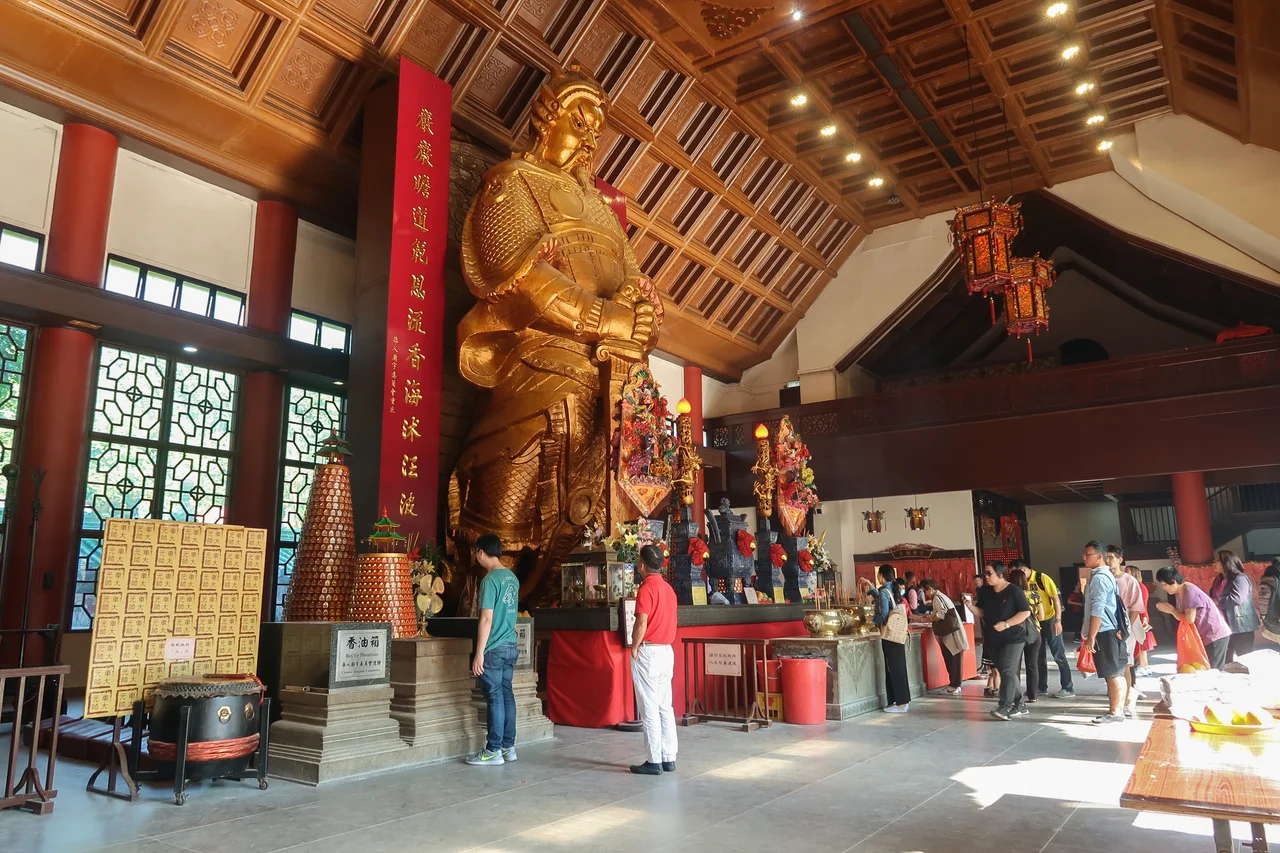

Che Kung Temple
On the third day of the Lunar New Year, Hong Kong government officials file into a temple in Sha Tin alongside tens of thousands of ordinary residents, all of them hoping a general dead for seven centuries will tell them how the city's year will go. They strike a drum called the Drum of Heaven to announce their arrival. They burn incense so their wishes rise to him in the smoke. And someone — once a senior minister, now a rural council leader — draws a bamboo divination stick on behalf of the whole city. In 2003, the stick was the worst possible omen. That same year, SARS arrived.
A General Becomes a God
Che Kung was a military commander in the Southern Song dynasty, the rump state that survived after Mongol forces seized northern China in the twelfth century. According to tradition, he protected the young Emperor Bing of Song during the court's desperate flight southward — a journey that ended in 1279 when the last Song forces were crushed at the sea battle of Yamen. The emperor drowned. Che Kung's loyalty outlasted the dynasty he served.
Song loyalists who fled to what is now Hong Kong brought their veneration with them. During a plague that struck Sha Tin in the late Ming dynasty — possibly the epidemic of 1629 — the god was, as oral tradition puts it, 'invited' from an existing Che Kung temple at Ho Chung village in Sai Kung to the stricken community. The epidemic subsided. The temple stayed. A similar pattern has repeated across Hong Kong's history: disaster, appeal to Che Kung, deliverance, gratitude cast in stone and incense.
The Temple on Che Kung Miu Road
The best-known Che Kung temple stands in Tai Wai, Sha Tin District, positioned on Che Kung Miu Road midway between two MTR stations. The original structure was jointly managed by nine Sha Tin villages, with Tin Sam Village retaining special privileges in worship. Since 1936, the Chinese Temples Committee has administered the site. When worshipper numbers surged past what the old building could hold, a new temple was built directly in front of it at a cost of HK$48 million, completed in 1994.
An older, quieter Che Kung temple exists in Ho Chung, half a mile from the village that gave rise to the Sha Tin cult. Built in the mid-sixteenth century, the Ho Chung temple is one of the oldest in Hong Kong. It venerates not just Che Kung himself but his son and grandson — a lineage of loyalty that the community chose to honor across generations.
The Language of Pinwheels and Smoke
The Birthday of Che Kung, celebrated on the third day of the first lunar month, draws roughly 100,000 people to the Tai Wai temple. The rituals have a careful grammar. Worshippers strike the Drum of Heaven first, announcing themselves. They place fruits, candles and incense before the statue, speaking their wishes aloud while the smoke carries them upward. They burn paper money and paper clothes in the designated area.
Then they turn to the pinwheels. Golden and spinning beside Che Kung's effigy, each one is considered a wheel of fortune. Spinning it clockwise prolongs good luck from the previous year; counterclockwise reverses bad luck into good. Worshippers buy personal pinwheels to take home and position according to feng shui principles. Students write their names and wishes on slips of paper pressed to a board called the Jinbang — named for the imperial examination announcement boards of old dynasties — praying for academic success.
A Living Oracle
The divination tradition at Che Kung Temple carries unusual civic weight. For years, Hong Kong's Minister of Home Affairs drew the annual fortune stick on behalf of the territory, a ritual that blended folk religion with colonial governance. In 2003, Minister Patrick Ho drew the worst possible stick — and that year brought SARS, the epidemic that killed 299 people in Hong Kong and sent the economy into crisis. The coincidence was not lost on anyone. From 2004 onward, the task passed to Lau Wong Fat, the minister of Heung Yee Kuk, the statutory body representing the indigenous New Territories villages.
The temple has also served as political theater. During the controversy over Hong Kong's high-speed rail link, anti-rail demonstrators joined the official divination ceremony and drew their own sticks as an act of protest. In a city navigating between tradition and modernity, between local identity and mainland authority, the Che Kung Temple remains a space where both piety and politics feel entirely at home.
Devotion Across Centuries
Che Kung sits within a Hong Kong tradition of worshipping military generals who demonstrated the virtues Confucian culture most admires: loyalty, bravery, and sacrifice for people over self. He is often compared to Guandi, the deified general worshipped across the Chinese diaspora as a protector of communities. But Che Kung's story is distinctly local — a Song dynasty commander whose legacy arrived with the refugees of a fallen empire and took root in the hills and valleys of the New Territories.
Four annual festivals mark his calendar: the third day of the first lunar month, the 27th of the third, the sixth of the sixth, and the 16th of the eighth. Each draws its own worshippers. The Lunar New Year festival is largest, its crowd management requiring police coordination every year. But the smaller festivals matter too, filling the courtyards of Tai Wai with incense and intention — a community still turning to a seven-century-old general for guidance on how to face the year ahead.
From the Air
Che Kung Temple sits at 22.3735°N, 114.1829°E in Tai Wai, Sha Tin District, New Territories. From the air at 2,000–3,000 feet, the temple complex is visible near the confluence of the Shing Mun River and the MTR Sha Tin corridor. The distinctive red-roofed temple structure stands against the dense urban fabric between Tai Wai and Sha Tin towns. Tolo Harbour is visible to the northeast, Kowloon hills to the south. Nearest airport: VHHH (Hong Kong International Airport) at Lantau Island, approximately 28 km to the southwest. Sha Tin New Town's green hills and reservoir provide clear orientation landmarks in good visibility.
Nearby Stories
- Chapel of St. Francis Xavier 3.5 km away
- Cuiheng 4.1 km away
- 2015 Shenzhen Landslide 16 km away
- Shunde 31 km away
- Wanshan Archipelago 37 km away
- Nanxiong Formation 96 km away
- Heyuan 149 km away
- Checheng Fu'an Temple 629 km away