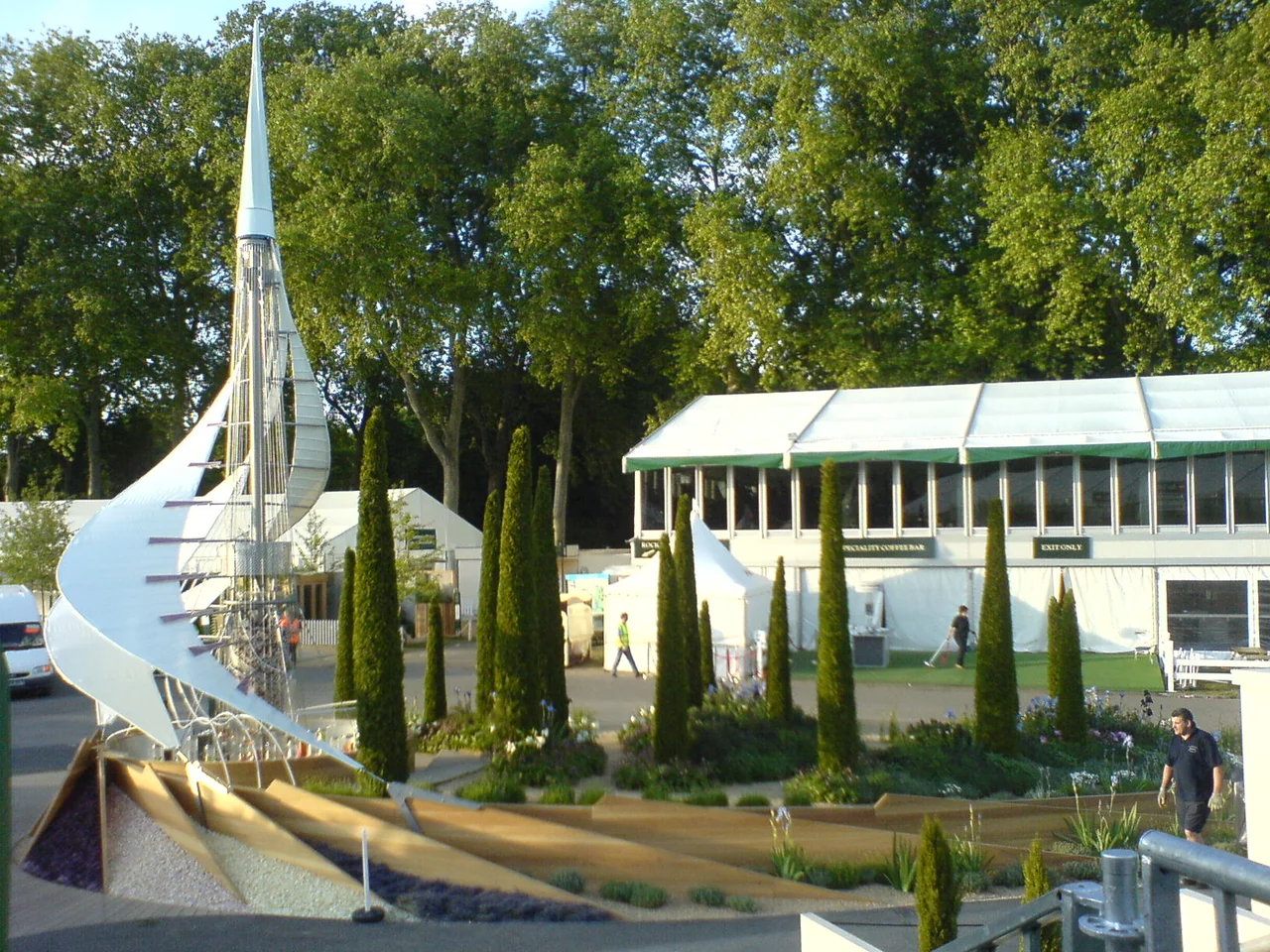

Chelsea Flower Show
James May spent the better part of a year making a garden out of Plasticine. By the time he arrived at the Royal Hospital Chelsea in May 2009, every flower in his show garden, every leaf, every blade of grass and every individual carrot top had been hand-rolled from coloured modelling clay by volunteers across Britain. Paradise in Plasticine took its place in the rose-and-lawn tradition of the world's most famous flower show — a show that has, in its 113 years at Chelsea, made room for radio-controlled lawn mowers, suspended Irish gardens hung from cranes, Brenda Hyatt's auriculas, a New Zealand thermal pool, and a 38-tonne Pullman railway carriage parked in the Great Pavilion.
The Great Spring Show
The Royal Horticultural Society's Great Spring Show is older than the Chelsea grounds it now occupies. The first show was held in 1862 in the RHS's Kensington garden; flower shows had run under the RHS banner from 1833 at the society's earlier garden in Chiswick. The Show moved between several London sites — the gardens of Holland House in Kensington, the Olympia exhibition hall — before settling at the Royal Hospital Chelsea in 1913, the year after the Royal International Horticultural Exhibition had successfully used the hospital's eleven acres. It has been there ever since, with cancellations only for the two world wars (1917–18, 1939–46) and 2020. The grounds belong to a Christopher Wren building, finished in 1694, that still houses retired British soldiers — the Chelsea Pensioners in their scarlet coats are a familiar sight at the show.
Avant-Garde Lawns
Chelsea is now a serious avant-garde event. The show gardens, designed by leading names, are temporary installations built across weeks at enormous expense — sometimes with mature trees crane-lifted into place, sometimes with water features that exist nowhere else on earth. A gold medal at Chelsea can launch a designer's career. In 1991, John Van Hage of the Daily Express Garden became the youngest designer to win an RHS gold; in 2002, Mary Reynolds took the same honour with an Irish garden. Diarmuid Gavin's 2011 Irish Sky Garden was the first garden to be suspended in the air, a restaurant-in-the-sky concept lifted on cables above the showground. In 2016, Bowdens Nursery brought in the British Belmond Pullman carriage Zena — sixty-three feet long, thirty-eight tonnes — and built a walk-through plant-hunters' display around it that drew 30,000 visitors and changed what a Great Pavilion exhibit could be. The same year saw 300,000 individually crocheted poppies covering nearly the entire showground, made by over 50,000 contributors.
Why Tickets Are So Hard to Get
The show's popularity has been its persistent management problem. Visitor numbers climbed steadily through the second half of the twentieth century — in 1978 alone, attendance rose by 6,000 in a single year. By 1979 the morning turnstiles had to be closed for crowding. In 1980 the show began opening at 8 a.m. and closing at 8.30 p.m. to spread the visitors more evenly through the day. In 1988, after years of debate, a cap of 40,000 visitors per day was imposed — a reduction of 90,000 from the previous year's total — and RHS members were charged for tickets for the first time. The Council looked seriously at moving the show to Battersea Park, Osterley, or RHS Garden Wisley. They consulted Land Use Consultants. They considered limiting Chelsea to plant sales and shifting the trade stands elsewhere. In the end, they kept the show where it was and started a sister show — the Hampton Court Palace Flower Show, which the RHS took over in 1993 and which now draws crowds of its own. Today's attendance settles at 157,000 across five days. Every ticket must be bought in advance.
Royal Custom
The royal family attends a preview before the show opens to the public, as part of the RHS's royal patronage. Queen Elizabeth II attended in 1953, the year of her coronation, and was a regular visitor for the rest of her life. The 2022 show featured the Queen's Platinum Jubilee Garden: laser-cut steel silhouettes of the Queen surrounded by seventy terracotta pots planted with lily of the valley, her favourite flower. After her death later that year, the 2023 show became a memorial occasion — King Charles III and Queen Camilla attended, viewing a special display in honour of his mother, and the Garden of Royal Reflection and Celebration marked the coronation. Catherine, Princess of Wales, who had co-designed the Back to Nature Garden in 2019 with Andree Davies and Adam White, hosted the first children's picnic at the new show garden with pupils from ten schools across the RHS's school gardening campaign. The show has been sponsored since 2022 by The Newt in Somerset.
What Stays at Chelsea
Some things at Chelsea outlast the gardens that contained them. Sherman Hoyt's 1929 exhibit of American cacti, complete with painted Mojave backdrops, was acquired afterwards by Kew Gardens and had its own glasshouse there for over half a century before being absorbed into the Princess of Wales Conservatory. Wisley's 1968 hostas display made hostas fashionable in British gardens for the next generation. Brenda Hyatt's 1982 auriculas — small Alpine primulas in startling colours — relaunched the plants in the British market. The 1968 first garden for the disabled at Chelsea quietly set a standard that has since become universal. The Show is broadcast across daytime BBC One and evening BBC Two, with presenters including Monty Don, Carol Klein, Sue Kent, and Frances Tophill in 2025 — a horticultural ritual that runs in parallel with the bell strikes of Big Ben as one of the things that marks a London year. Five days every May, the lawns of an old soldiers' hospital become the most carefully tended eleven acres on Earth, before everything is dismantled and the cycle begins again.
From the Air
The Chelsea Flower Show is held in the eleven-acre grounds of the Royal Hospital Chelsea, at 51.49N, 0.16W on the north bank of the Thames in the Royal Borough of Kensington and Chelsea. From the air, the hospital's distinctive Wren-designed brick complex is clearly visible just north of Chelsea Bridge, with the temporary show pavilions and tents springing up across the lawns in May. London Heathrow (EGLL) lies twelve miles west, London City (EGLC) eight miles east. Best viewed from 2,000 to 4,000 feet on a clear day, using the Thames bend and Battersea Power Station to the south as references.
Nearby Stories
- Battle of Britain, Northfleet 1.1 km away
- Bayham Old Abbey 5.4 km away
- Catharine Macaulay 6.4 km away
- Hatfield rail crash 8.8 km away
- Chequers 8.9 km away
- Chelmsford Cathedral 10 km away
- Queen Victoria Hospital 13 km away
- Fishbourne Roman Palace 36 km away