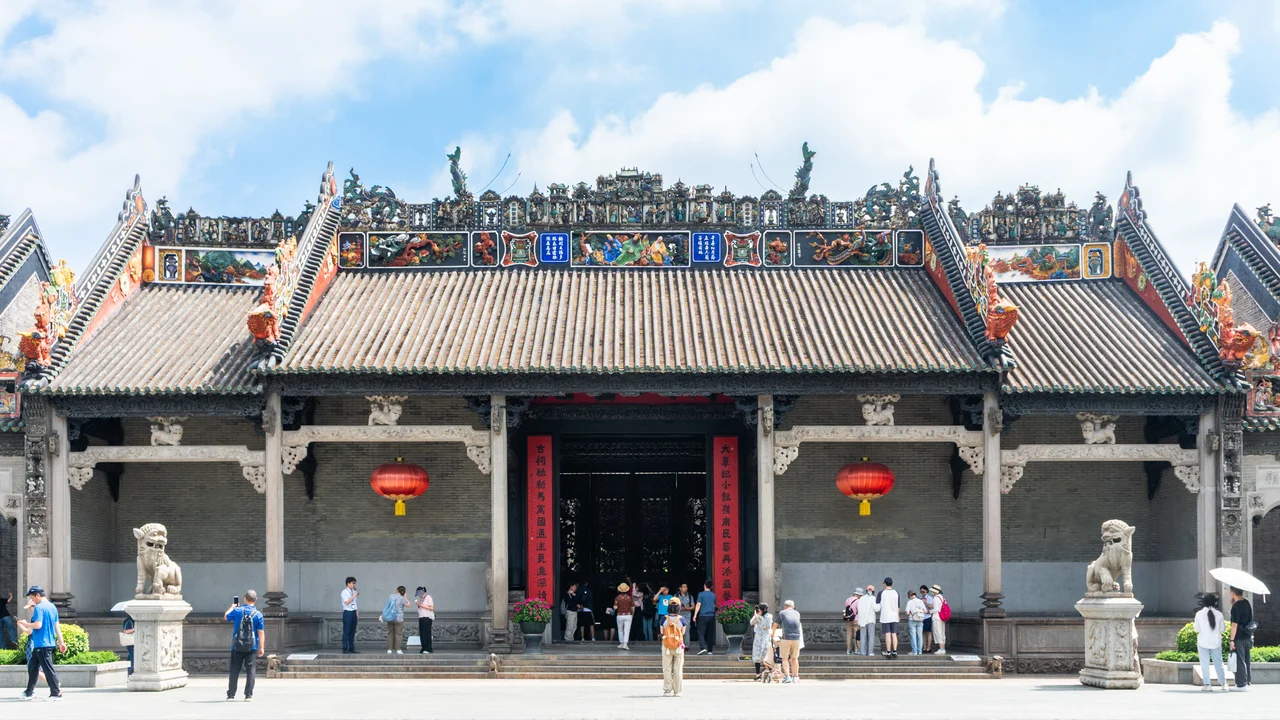

Chen Clan Ancestral Hall
Two cousins returned from America with a plan. Chen Ruinan and Zhaonan had seen the wider world, and what they wanted to bring home to Guangzhou was not technology or merchandise but something older — a shared place where every branch of the Chen lineage could honour their ancestors and prepare their sons for the imperial examinations. The hall they built in 1894 turned into something none of them anticipated: a statement so extravagant, so dense with carved stone and gilded wood and moulded plaster, that it has been called one of the finest examples of Lingnan craftsmanship on earth.
Seventy-Two Clans, One Hall
The Chen surname is one of the most common in China, and in Guangdong province the family networks crossing city and countryside were enormous. When Ruinan and Zhaonan proposed the project in the late Qing dynasty, they were asking 72 separate Chen lineages to pool resources. What they collectively funded was a symmetric complex of 19 buildings arranged around nine halls and six courtyards, all oriented on a strict north-south axis and covering 13,200 square metres. Completed in 1894, it served its intended purpose for only a few decades before history intervened — it later became an industrial college, then a series of middle schools — but the architecture never changed. In 1988 the Chinese state added it to the national list of protected cultural relics. Today it houses the Guangdong Folk Art Museum, and the buildings themselves are the exhibit.
Stories Carved in Wood
The most celebrated objects inside the Chen Clan Ancestral Hall are sixteen double-sided screen doors installed at the back of the Gathering Hall. Each door is carved in full relief with a scene from classical literature — episodes from the Romance of the Three Kingdoms, episodes from the Biography of Yue Fei — and the figures are so precisely rendered that individual facial expressions are distinguishable. This is not decorative craft in any casual sense. The carvers were working in a tradition that expected the viewer to recognise every character and every scene, so legibility demanded the same attention as beauty. Cantonese wood carving from Guangdong province fills the folk art and craft gallery as well, showing the wider regional tradition from which the screen doors emerged.
Plaster That Grows from the Wall
Across the ridgelines and corridor roofs of the complex runs 1,800 metres of plaster carving — longer than sixteen football pitches laid end to end. The subjects are the same as on the pottery crests that crown the rooflines: traditional drama scenes, birds and flowers, pavilions and river landscapes. In old Cantonese houses this material was called 'grass tails' because the patterns curl at the ends like grasses, placed where walls meet air. Wealthy families used more of it, and more elaborate. At the Chen Clan Ancestral Hall the craftsmanship reaches an extreme: some sections pass entirely through the wall plane, and others project up to 60 centimetres outward, giving a three-dimensional sculptural depth that normal architectural ornament never attempts.
Brick, Iron, and the Quiet Borders
Less conspicuous than the screen doors or the plaster ridges but no less deliberate, the brick carvings on the inner walls of each great hall tell their own stories. The carving on the east wall depicts Liu Qing taming a wild horse called 'the Wolf' — a Northern Song tale — with more than forty figures, each with its own posture and expression, compressed into a single panel. Then there are the iron railings on the platform borders, dim-coloured and geometrically precise, carrying four symbolic themes: the Qilin and the Phoenix, Dragons and Orbs, the Three Goats, and Goldfish in a Pond. These iron engravings are considered rare in traditional Cantonese architecture, a medium usually left to other craftsmen, used here because nothing was too small to warrant attention.
What the Museum Holds
The Guangdong Folk Art Museum that now occupies the Chen Clan Ancestral Hall does not compete with its surroundings — it extends them. Alongside the permanent display of wood carving, embroidery, pottery, and ivory work from across the region, the courtyard gardens provide the kind of quiet that makes ornament legible. Coming here is not like visiting a collection in a neutral gallery. The art and the architecture are inseparable: the walls themselves are the collection, and the collection is housed in walls that are also art. The metro station outside carries the hall's name into Guangzhou's daily commute, a small reminder that what was built by 72 clans as a private place of learning has become a public landmark.
From the Air
The Chen Clan Ancestral Hall sits at 23.130°N, 113.240°E in the Liwan District of central Guangzhou, about 10 km west-northwest of Guangzhou Baiyun International Airport (ZGGG). At 2,000 to 3,000 feet AGL on a clear day, the dense urban grid of Liwan District is visible as the city's older western quarter. The Pearl River runs roughly 2 km to the south. ZGGG lies northeast; look for the elevated highway interchanges of central Guangzhou as a navigation reference.
Nearby Stories
- Shunde 12 km away
- 2015 Shenzhen Landslide 15 km away
- Mount Luofu 23 km away
- Qingyuan Maglev Tourist Line 32 km away
- Kaiping 56 km away
- Heyuan 90 km away
- Chikan, Kaiping 92 km away
- Erlitou Site Museum of the Xia Capital 1257 km away