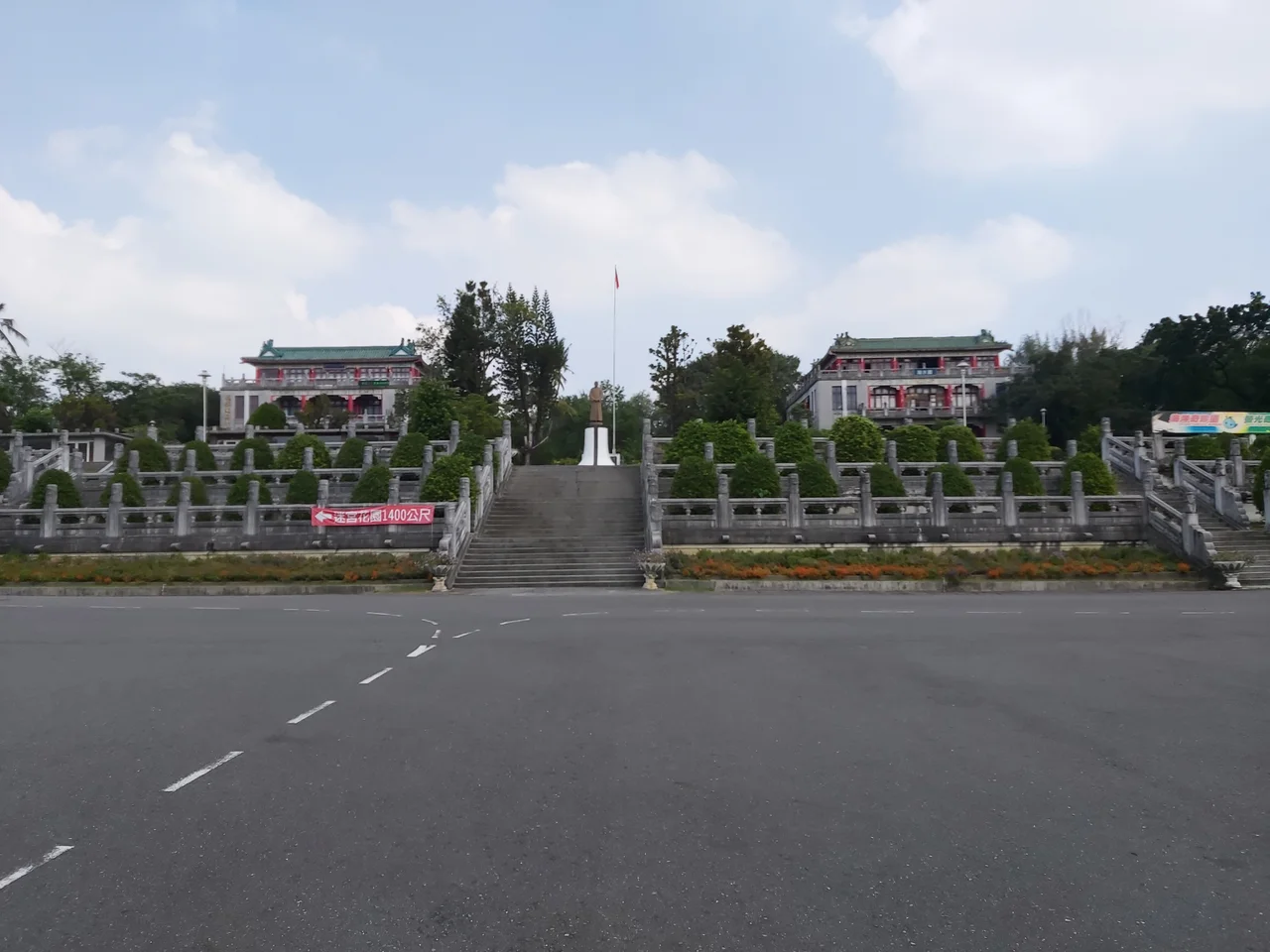

Chengcing Lake
The Bridge of Nine Turns was built in 1960, zigzagging across the water in right angles because straight lines, according to Chinese tradition, allow evil spirits to travel too easily. Whether the bridge was doing its job spiritually is uncertain, but the lake it crosses has accumulated a remarkable density of history for a reservoir in the Kaohsiung suburbs. Chengcing Lake — also called Cheng Ching Lake, Dabei Lake, or Toapi Lake in Taiwanese — is an artificial lake in Niaosong District, about twelve kilometers from downtown Kaohsiung, and it holds more than water.
A Lake Built for a City
Chengcing Lake is not a natural feature. It was constructed to supply water to the Kaohsiung region, and for much of its history that utilitarian purpose defined it. The lake's position in the flat suburban landscape between Kaohsiung and Fengshan made it a convenient reservoir, close to population but set apart by its gated park perimeter. In the decades after World War II, as the Republic of China government consolidated its position on Taiwan, the lake area took on additional significance — not just as water infrastructure but as a place of retreat and contingency planning for the country's leadership. What began as a reservoir became something more layered: a scenic park, a presidential refuge, and a Cold War artifact all at once.
The Tunnel Under the Lake
In 1961, workers bored a tunnel system into the lakeshore — not for drainage or utility, but as a nuclear-hardened underground military headquarters for Chiang Kai-shek, the Republic of China's president and military commander. The facility was designed to survive an attack and allow the government to continue operating from below ground. It was never used for that purpose. Decades later, after the strategic calculus that built it had shifted, the tunnel complex was repurposed in one of Taiwan's more unexpected institutional transformations: it became the Cheng Ching Lake Exotic Marine Life Museum, a public aquarium. Visitors now walk through the same hardened corridors where a government once planned to shelter from nuclear war, watching fish drift past illuminated tanks. The conversion is either an act of supreme practicality or a quietly profound statement about what time does to the architecture of fear.
The Bridge, the Pagoda, and the Island
The park surrounding the lake rewards slow exploration. The Bridge of Nine Turns, completed in 1960, stretches 230 meters across the water at 2.5 meters wide — nine right-angled turns making it difficult to walk quickly, which may be the point. The Zhongxing Pagoda stands as the tallest structure in the lake area at 43 meters, its restored form visible from a considerable distance, with winding interior stairs leading to views across the water and the surrounding hills. On the lake itself, a small artificial island was constructed in November 1955. It was named Fuguo Island — meaning, roughly, "enrich the nation" — as a memorial to a remarkable episode: in 1953, General Huang Chieh led approximately 30,000 Republic of China Army soldiers back to Taiwan after years of internment on Phu Quoc Island in Vietnam following the 1949 change of government on the mainland. The island carries the weight of that displacement quietly.
Chiang's Chateau
A chateau associated with Chiang Kai-shek stands within the gated park area near the lake. Properties like this — presidential guesthouses, retreats, and command facilities — dot Taiwan's landscape from that era, each one a reminder of the decades of authoritarian rule that gave way, eventually, to Taiwan's democratic transition. The Chengcing Lake chateau is one of several such sites that have been opened to visitors over the years, allowing a kind of archaeological tourism: encountering the physical spaces where power was exercised and decisions were made. The chateau's lakeside setting, with its views of the water and the wooded hills behind, makes clear why it was chosen. It is a beautiful place. That beauty coexisted with what it was used for, which is its own kind of complexity.
The Lake Today
Chengcing Lake Scenic Area functions today as a popular weekend destination for Kaohsiung residents — families on the Bridge of Nine Turns, visitors climbing the pagoda for views, school groups touring the aquarium in the old bunker. The water itself remains part of Kaohsiung's supply network. Lotus flowers bloom in the shallow margins in summer; egrets and herons work the edges year-round. The combination of genuine scenic beauty with an unusually dense accumulation of historical layers — lagoon, Cold War bunker, presidential retreat, soldiers' memorial, public park — gives Chengcing Lake a character that's difficult to find elsewhere.
From the Air
Chengcing Lake is located at approximately 22.661°N, 120.351°E in Niaosong District, Kaohsiung. From the air at 2,000-3,000 feet, the lake is a clear visual reference point — an elongated body of water set among the flat suburban terrain east of downtown Kaohsiung. The Bridge of Nine Turns and the Zhongxing Pagoda are identifiable at lower altitudes. RCKH (Kaohsiung International Airport) is approximately 10 kilometers to the west-southwest. The lake makes a reliable landmark for visual navigation into and out of Kaohsiung.
Nearby Stories
- Taimali 7.2 km away
- Meinong East Gate Tower 15 km away
- Kunci Temple 20 km away
- Checheng Fu'an Temple 42 km away
- Dongji Island 49 km away
- Orchid Island 69 km away
- South Penghu Marine National Park 77 km away
- Hong Kong 12 549 km away