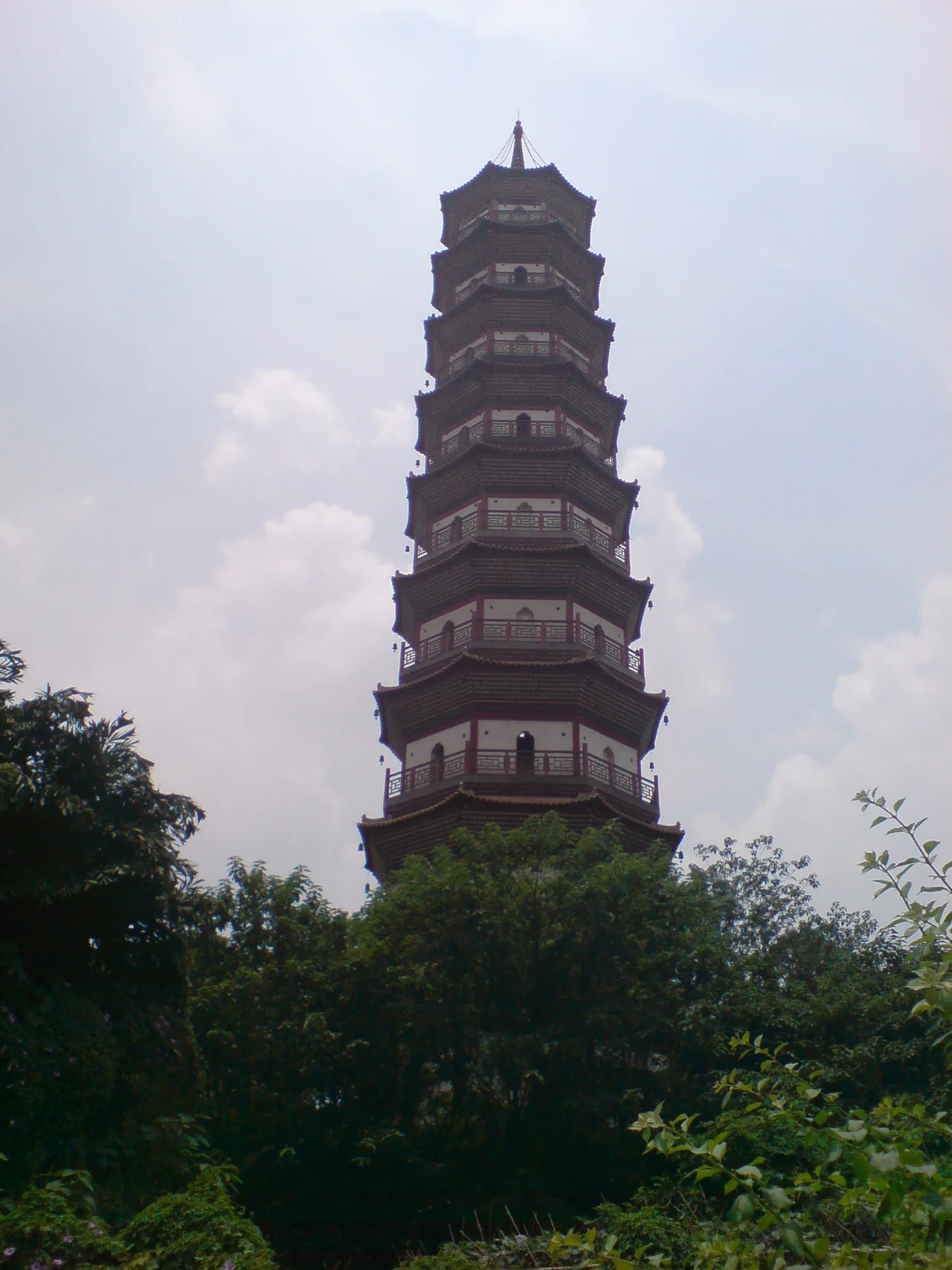

Chigang Pagoda
Three pagodas, one purpose. In 1619, during the reign of the Wanli Emperor, builders working in red sandstone raised the Chigang Pagoda on the south bank of the Pearl River with the explicit intention of anchoring the luck of Guangzhou. The river carried commerce, carried threats, carried the weight of the city's ambitions. Placing a pagoda at the right point — and fengshui principles were meticulous about rightness — was understood as an act of civic protection. Together with the Pazhou Pagoda and the Lotus Pagoda, the Chigang formed a triangle of stone meant to hold the city's good fortune in place. Four centuries later, it still stands, though not quite straight.
Red Stone Rising
The name gives it away immediately: Chigang means Red Stone Hill, and the pagoda's deep-red sandstone exterior distinguishes it from the pale masonry of most pagodas built in the same era. It rises in nine exterior tiers to a height of 53.7 metres, with a base diameter of 12.5 metres. Step inside and the structure reveals a different arithmetic: seventeen internal levels serve to tie the nine exterior sections together, a clever structural arrangement that was characteristic of Ming dynasty engineering. The octagonal plan is standard for the period, each face presenting the same disciplined geometry, and the whole was designed to echo the nearby Pazhou Pagoda — a twin of stone and intention, placed to create a balanced symmetry across the river landscape.
What Fengshui Built
The decision to build the Chigang Pagoda in 1619 was not simply an aesthetic choice. Fengshui — the Chinese practice of aligning structures with the flow of environmental energy — was deeply embedded in how Guangzhou's civic authorities understood their city's fortunes. The mouth of the Pearl River was both an economic artery and a point of vulnerability, and the three pagodas placed there were conceived as architectural anchors. The Wanli Emperor's reign was a period of intense construction and cultural assertion across the Ming dynasty; in that context, placing protective towers at the gateway to the city's commercial heartland made both spiritual and political sense. The pagodas were not temples in any devotional sense — they were guardians in stone.
Lean and Recovery
Centuries without adequate maintenance took a visible toll. The external walls cracked, the foundation began to sink unevenly, and the floors shifted. At one point the pagoda leaned 1.05 metres from the vertical — not dramatically, but enough to make its survival feel provisional. Restoration work began in 1996, stalled for want of funds, and resumed in 1998 when the Guangzhou Municipal Cultural Relics Management raised 1.60 million renminbi to complete the project. By mid-1999 the work was done, the structure stabilised, and what had been a deteriorating landmark became a secured one. The lean has been corrected; the pagoda stands again as its builders intended, though it remains closed to the public and visible mainly from the outside.
A Landmark You Cannot Enter
There is something fitting about a pagoda that does its work simply by existing. The Chigang Pagoda is not a pilgrimage site or a tourist attraction in the conventional sense — it does not offer interior views or guided tours. What it offers is presence. From across the Pearl River or from the elevated walkways of Haizhu District, the red sandstone tower asserts itself against the modern skyline of Guangzhou with a composure that four centuries of weather and neglect and restoration have not erased. The nearest metro stations are Chigang Pagoda station on Line 12 and Canton Tower station on Line 3, and the proximity to Canton Tower — one of the tallest structures in the world — makes for one of Guangzhou's more striking urban contrasts: old guardian, new giant, river between them.
From the Air
The Chigang Pagoda stands at 23.104°N, 113.317°E in Haizhu District, on the south bank of the Pearl River roughly 11 km south-southeast of Guangzhou Baiyun International Airport (ZGGG). At 2,000 feet AGL the Pearl River is the dominant navigation feature; the Canton Tower's distinctive hourglass silhouette rises about 1.5 km to the northwest and serves as an unmistakeable visual reference. The red sandstone tower is visible from low-level approaches in clear conditions.
Nearby Stories
- Shunde 12 km away
- 2015 Shenzhen Landslide 15 km away
- Mount Luofu 23 km away
- Qingyuan Maglev Tourist Line 32 km away
- Kaiping 56 km away
- Heyuan 90 km away
- Chikan, Kaiping 92 km away
- Erlitou Site Museum of the Xia Capital 1257 km away