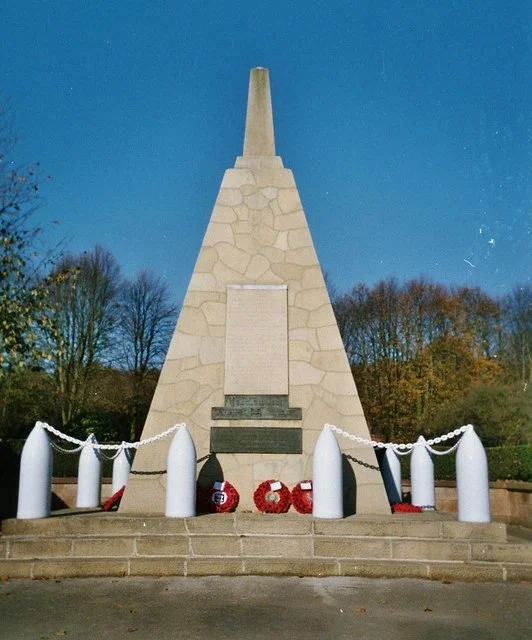

Chilwell Filling Factory Memorial
Of the one hundred and thirty-four people killed in the National Shell Filling Factory at Chilwell on the evening of 1 July 1918, only thirty-two could be identified. The rest were buried together in a mass grave at the parish church of St Mary's in Attenborough, two miles down the valley. They are still there. The memorial that names them — a concrete truncated pyramid on three steps, ringed with white-painted shell casings linked by chains — stands inside the security perimeter of Chetwynd Barracks, almost on the spot where the Mixing House used to be. You cannot walk up to it without a pass. The blast that scattered the bodies it commemorates landed on the ground you are standing on.
Eight Tons of Amatol
The factory had opened in February 1916, in the second year of the war, on a stretch of meadow between Nottingham and Ashby de la Zouch. Empty shell casings arrived by rail from foundries elsewhere in Britain. At Chilwell they were filled with amatol — one part TNT, four parts ammonium nitrate, mixed on site under the oversight of Viscount Chetwynd. By the middle of 1916 the factory was filling one hundred and thirty thousand shells a week. There had been small explosions in those first two years, killing one or two workers each. On a hot evening in July 1918, eight tons of explosive detonated in the Mixing House and the TNT Mill at once. The Mixing House, its extension, the TNT Mill, and the stores were destroyed. Buildings several miles away were damaged. Every worker inside the Mixing House and the TNT Mill died.
The Names Not Known
Two hundred and fifty more were injured. Of the 134 dead, twenty-five were women — the figure was almost certainly higher counting both shifts in adjacent buildings, but twenty-five is what the Home Office record settled on for the women alone. Many of the bodies could not be told apart. Bone and cloth and ash got separated from individual lives by a force that the human eye cannot resolve. Thirty-two coffins were positively named. The other hundred and two went into a single grave at Attenborough Church, the parish nearest the works. They were people: framework-knitters' daughters from Beeston, married women from Stapleford, men who had come to the factory because they were too old or too injured for the trenches. Twelve workers were awarded the British Empire Medal for trying to save the others. The works manager, Arthur Hilary Bristowe, who tipped burning TNT off conveyor trays with his bare hands in the TNT Mill, received the Edward Medal.
The Cause They Never Found
A Home Office committee published its report on the explosion on 7 August 1918, five weeks after the event. The police investigated suspicions of sabotage. Neither inquiry could conclusively identify what had triggered the blast. Sabotage was the wartime instinct — Lord Chetwynd is alleged to have told Scotland Yard he was convinced of it, and even to have named a culprit. The more sober explanation, settled on by later historians, is the combination of a workforce pushed to meet ever-tougher production targets, lax handling of an unstable compound, and the warmth of an unseasonably hot July day. Whatever happened, it was not reported honestly at the time. The morning papers carried a small notice — sixty feared dead in a Midlands factory explosion — and moved on. The country was four months from armistice. The Ministry of Munitions wanted shells, not headlines.
A Pyramid Built by the Workforce
The memorial was built by the factory's own workmen, under the supervision of the construction manager S.A. Kay. They cast a concrete truncated pyramid on three steps and topped it with a short obelisk. Around the top they mounted shell casings — the same kind they had been filling — and joined them with chains, the whole thing painted white. The Duke of Portland unveiled it on 13 March 1919, four months after the war ended. Its inscriptions are a strange mixture of grief and accountancy. ERECTED TO THE MEMORY OF THOSE MEN AND WOMEN WHO LOST THEIR LIVES BY EXPLOSIONS AT THE NATIONAL SHELL FILLING FACTORY CHILWELL 1916 TO 1918 reads the front panel. Below it, almost without pause: PRINCIPAL HISTORICAL FACTS OF THE FACTORY. FIRST SHELL FILLED 8TH JANUARY 1916. TOTAL SHELLS FILLED 19,359,000. TOTAL TONNAGE OF EXPLOSIVE USED 121,360 TONS. It is the way the early twentieth century talked about its own dead — through tonnage and output, as if the numbers might add up to a meaning.
The Grave at Attenborough
For most of the century the people who wanted to mourn the dead of Chilwell could not visit the memorial; it was inside an Army depot. They went to the parish church at Attenborough instead, where the mass grave had its own modest marker. In 2018, on the hundredth anniversary, the Royal Engineers of Chetwynd Barracks designed a new monument for that grave: a simplified Celtic cross in weathering Corten steel, with a superimposed sword in stainless steel rising up its length. It echoes a wooden cross that had stood on the grave originally before vandalism took it down. The Bishop of Southwell and Nottingham re-dedicated the grave on 1 July 2018, a hundred years to the day after the explosion. A century is long enough to admit what is true: that the country needed the shells, and the people who made them were paid in their lives, and we still owe them their names.
From the Air
52.912 N, 1.245 W, inside Chetwynd Barracks on the western edge of Chilwell. View from 1,500 to 3,500 ft AGL; the barracks compound is unmistakable but access is restricted on the ground. St Mary's Church, Attenborough — site of the mass grave — lies 1 nm SW across the Trent floodplain and is publicly accessible. East Midlands (EGNX) is 5 nm SW; Nottingham/Tollerton (EGBN) is 8 nm E.
Nearby Stories
- Rutland Railway Museum 2.4 km away
- Welbeck Abbey 5 km away
- Lichfield rail crash 6 km away
- Peveril Castle 8.8 km away
- Grantham Rail Accident 11 km away
- Croxden Abbey 11 km away
- RAF Scampton 11 km away
- Leicester Abbey 11 km away