
Chinese University of Hong Kong
When the People's Republic of China closed every Christian college and university on the mainland after 1949, the scholars and students didn't simply disappear. Some came to Hong Kong. Protestant churches there founded Chung Chi College in 1951, gathering 63 students in borrowed church halls and rented rooms on Hong Kong Island, continuing work that the Communist revolution had interrupted. New Asia College and United College had already established themselves in the colony. In 1963, the Hong Kong government brought all three together into something new: a federal university where Chinese, not English, was the intended medium of instruction. They called it The Chinese University of Hong Kong, the 'the' carrying deliberate weight — a specific institution with a specific identity in a city where that identity was still being defined.
Built on Borrowed Ground
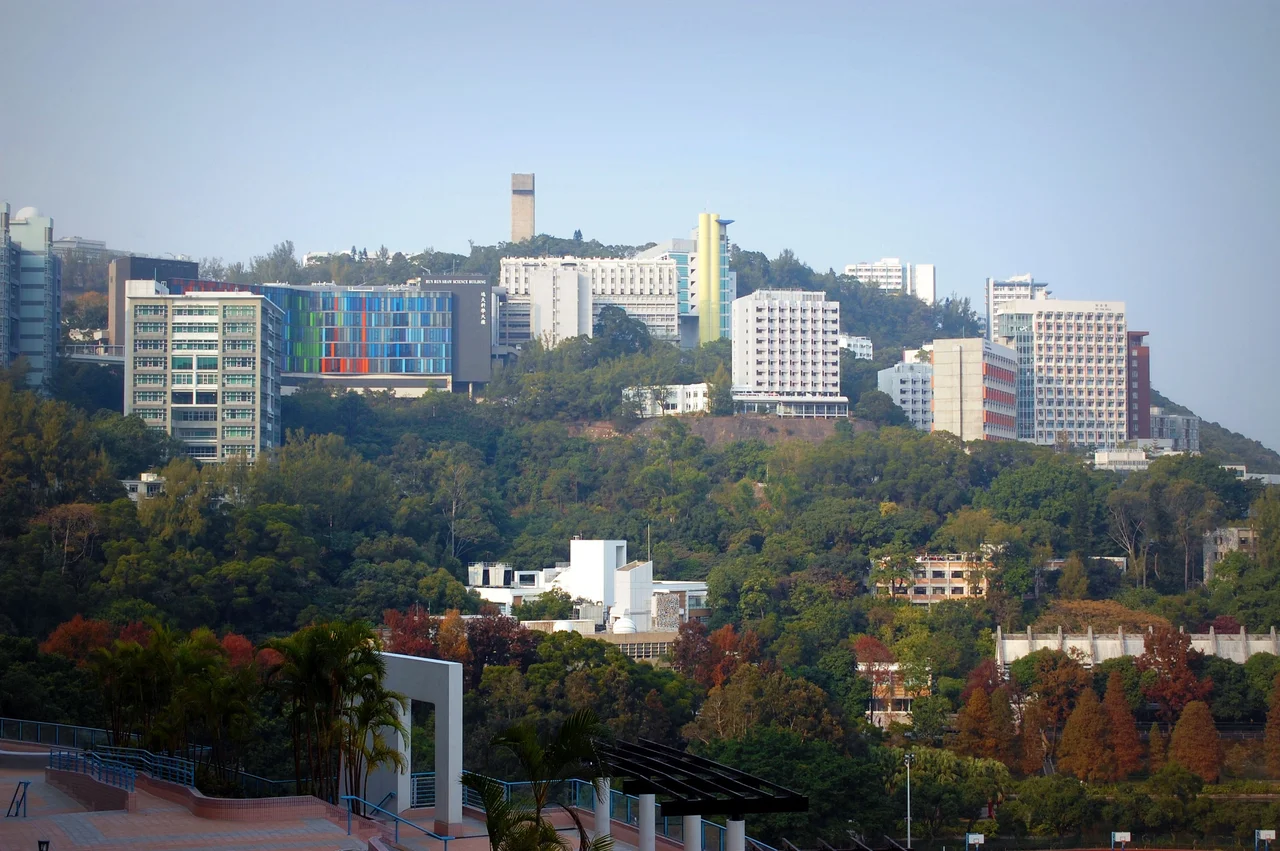
The site chosen for the new university was Ma Liu Shui, on the southern shore of Tolo Harbour in the New Territories — land that Chung Chi College had already occupied since 1956. Above the valley where Chung Chi's buildings sat, two plateaux formed by granite quarrying for the Plover Cove dam provided space for the other colleges. The architecture that went up through the 1960s — designed to a development plan by W. Szeto and Partners — favored subdued concrete, a monumental axis called the University Mall, and buildings meant to last rather than impress.
The 138.4-hectare campus is hilly enough that the university runs a free shuttle bus system connecting the MTR station to academic buildings and residential colleges. Many structures incorporate lifts and internal bridges to manage the terrain. From certain points on campus — the Pavilion of Harmony in New Asia College is the most celebrated — the views sweep across Tide Cove and Tolo Harbour toward the green ridgelines of the New Territories. It is, by any measure, one of the most beautiful university settings in Asia.
The Collegiate Argument
From its founding, CUHK has organized itself as a collegiate university — the only one in Hong Kong — in which constituent colleges retain meaningful autonomy over student life, pastoral care, and character. Nine colleges now make up the university: the three founding ones (Chung Chi, New Asia, United), Shaw College established in 1990 with a HK$500 million donation from Sir Run Run Shaw, and five smaller colleges announced in 2006 and 2007.
This structure has never been without tension. In 1976, following a government commission chaired by John Fulton, the university consolidated power centrally, diminishing college autonomy. New Asia College's Board of Governors flatly rejected the changes, calling the colleges 'empty shells.' Critics within Chung Chi warned that college leaders would be reduced to 'nothing more than managers of an estate.' The debate between collegiate community and administrative efficiency has continued across every subsequent decade — a structural argument about what a university is fundamentally for.
Laureates and Legacy
Four Nobel Prize winners have been associated with CUHK, making it the only tertiary institution in Hong Kong with Nobel, Turing Award, Fields Medal, and Veblen Prize recipients on faculty simultaneously. Former vice-chancellor Sir Charles K. Kao received the Nobel Prize in Physics in 2009 for pioneering fiber optic communication — work that made the modern internet possible. Chen Ning Yang received the Nobel Prize in Physics in 1957. James Mirrlees shared the Nobel in Economics in 1996. Robert Mundell, the Nobel Economics laureate in 1999, was also a faculty member.
Mathematician Shing-Tung Yau, who won the Fields Medal in 1982, taught at CUHK, as did Turing Award laureate Andrew Yao. The concentration of distinction is unusual for a university founded in 1963 — the product of institutional ambition, a bilingual research culture, and the particular position Hong Kong occupies as a bridge between Chinese scholarship and global academic networks.
The Goddess and the Siege
CUHK has twice in recent memory been a flashpoint for Hong Kong's political tensions. In 2010, the student union sought to permanently install a 'Goddess of Democracy' statue on campus — a replica of the figure erected by students in Tiananmen Square in 1989 before the crackdown. The university's administration initially refused, citing the need for political neutrality. Students and staff pushed back, calling it self-censorship. After 2,000 students gathered and public pressure mounted, the university relented. The statue went up.
Nine years later, the stakes were higher. During the 2019–20 Hong Kong protests, CUHK's campus became one of the most intense battlegrounds in the city. On 12 November 2019, riot police entered the campus to disperse protesters, firing 1,567 tear gas rounds, 380 bean bag rounds, and 1,312 rubber bullets. Protesters built barricades and threw bricks and petrol bombs. Vice-chancellor Rocky Tuan sought mediation; the police rejected it. The campus was besieged for two days. At least 70 students were injured. The university senate voted to cancel the semester, and the campus was evacuated — mainland students departing by Marine Police vessels.
A University Without a Simple Story
CUHK was ranked 32nd worldwide in the QS World University Rankings 2026 — the product of six decades of sustained academic investment in a city that has often had other things on its mind. Its medical school, ranked 28th globally in QS rankings in 2024, opened in 1981 and now operates a private teaching hospital. The Hong Kong Internet Exchange, founded at CUHK in 1995, remains a major internet hub for the region. The graduate school, the first in Hong Kong, awarded its first master's degrees in 1967.
The university carries all of this forward while navigating the same pressures that have reshaped Hong Kong itself: the relationship between local identity and mainland authority, between academic freedom and political reality, between the traditions its founding colleges carried from Shanghai and Guangzhou and the demands of the twenty-first century. It remains, as it was at its founding, a place where those arguments happen — loudly, in two languages, on a hillside above the harbor.
From the Air
The Chinese University of Hong Kong campus lies at approximately 22.4197°N, 114.2068°E, spread across forested hillsides above the southern shore of Tolo Harbour in Sha Tin District. From 3,000–4,000 feet, the campus reads as an unusually large green and grey expanse against the surrounding Kowloon hills, with Tolo Harbour's inlet visible to the north and east. The University's railway station on the MTR East Rail Line provides a clear orientation point near the campus's southern edge. Plover Cove Reservoir and the Shing Mun Country Park hills provide dramatic backdrop to the north. Nearest airport: VHHH (Hong Kong International Airport) approximately 32 km to the southwest. Pat Sin Leng ridge is visible to the northeast on clear days.
Nearby Stories
- Chapel of St. Francis Xavier 3.5 km away
- Cuiheng 4.1 km away
- 2015 Shenzhen Landslide 16 km away
- Shunde 31 km away
- Wanshan Archipelago 37 km away
- Nanxiong Formation 96 km away
- Heyuan 149 km away
- Checheng Fu'an Temple 629 km away