
Ching Chung Koon
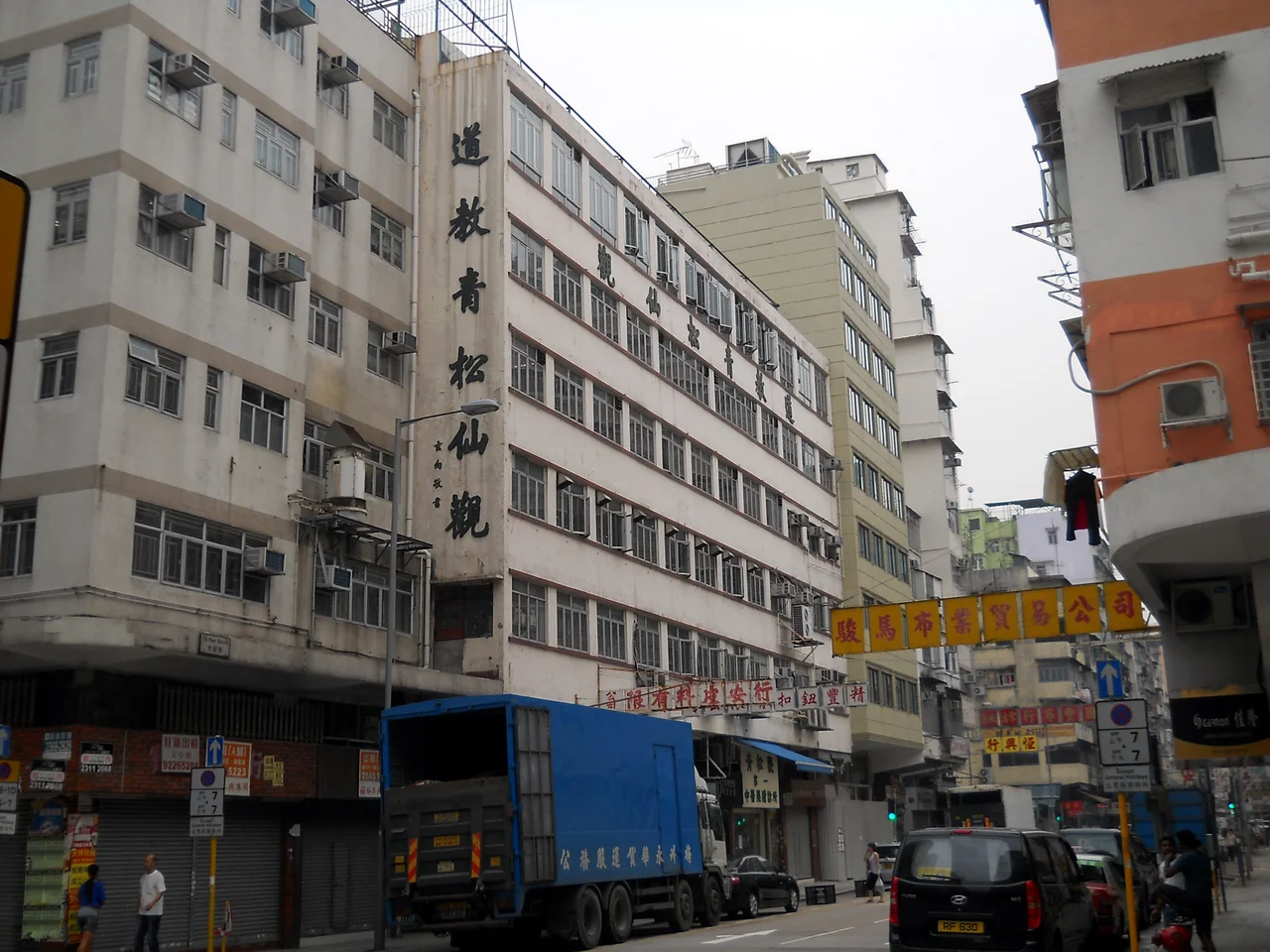
The temple came first, then the neighborhood built around it. Ching Chung Koon — the 'Green Pine Temple,' named for the evergreen tree associated with longevity in Chinese tradition — began in Kowloon in 1950, a Taoist place of worship established in the years when Hong Kong's population was surging with refugees from the mainland. A decade later, in 1960, a permanent home was built in Tuen Mun, in the northwestern New Territories, on land that then felt remote from the city's center of gravity. The remoteness didn't last. Tuen Mun grew, and the temple grew with it, becoming something that sprawling Hong Kong neighborhoods often lack: a fixed point, an institution with memory.
Treasures and the Departed
Inside Ching Chung Koon, imperial history mingles with neighborhood grief. Among the temple's treasures are lanterns from Beijing's Forbidden City — artifacts that made their way from the former imperial palace to this Taoist complex in the New Territories by a path that history has not fully preserved. They hang now among the incense smoke and the sound of Taoist chanting.
The temple also serves as a repository for the bone ashes of the dead. Its halls are divided into special apartments — columbarium niches — where photographs, names, dates of birth and death, and places of origin accompany each person's remains. During the Qingming Festival in spring and the Chung Yeung Festival in autumn, when Chinese tradition calls for honoring ancestors, the temple fills with families. They come not in grief exactly, but in maintenance of relationship — continuing to be present with people who are no longer present in any other way.
Gardens, Fishponds, and Bonsai
Beyond the incense halls and the columbarium, Ching Chung Koon extends into gardens. Classical Chinese-style landscaping shapes the grounds around the temple: a small artificial hill, fishponds stocked and tended, plantings arranged according to the Taoist aesthetic of balance between the built and the natural.
The bonsai exhibitions are a recurring feature, held periodically throughout the year. Bonsai — miniature trees trained over years or decades into forms that suggest ancient, weathered landscapes — align naturally with Taoist ideas about patience, cultivation, and the relationship between human intention and natural growth. The exhibitions draw collectors and enthusiasts from across Hong Kong. They are quiet events in a quiet setting, the trees displayed on stands against a backdrop of fishpond and garden wall, the artifice of cultivation made to look like accident.
Free Clinics and the Care of the Living
Ching Chung Koon began offering free traditional Chinese medicine services when it was established in the 1950s — a practical expression of the Taoist principle that religious institutions owe something to the bodies as well as the souls of the community around them. The temple's first western medical clinic opened in 1975, offering economical services to nearby residents; a second followed in 1977. Two additional free TCM clinics were established in 2003 and 2005.
This medical mission has run continuously across seven decades, absorbing the shifts from Kowloon to Tuen Mun, from a small community temple to a complex institution. The clinics don't require membership in the Taoist community or participation in religious life. They are simply there, available to whoever needs them — a form of service that predates Hong Kong's public health infrastructure and has outlasted several iterations of it.
Schools, a College, and Seven Institutions
Since the 1980s, Ching Chung Koon has operated an expanding network of educational institutions: two secondary schools, three primary schools, and two kindergartens across Hong Kong. Their names honor the temple's identity — Taoist Ching Chung Primary School, Ching Chung Hau Po Woon Secondary School — embedding the tradition into the daily school experience of thousands of children who may or may not practice Taoism at home.
In 1991, the temple established the Hong Kong Taoist College, an institution dedicated to Taoist education and scholarship — printing publications, organizing global Taoist conferences, and maintaining the intellectual dimensions of a tradition that risks becoming purely ceremonial without sustained thought and teaching. The college represents the temple's understanding of itself as something more than a place of worship: a living tradition that must be studied and transmitted, not merely practiced.
From Tuen Mun to San Francisco
In November 1981, Ching Chung Koon opened its first overseas branch temple in San Francisco — the beginning of a diaspora network that now includes temples in Canada and Australia as well. The overseas branches serve the same communities that built the original temple: Chinese emigrants who carried Taoist practice with them and needed places to perform ancestral rites, seek medical counsel, and mark the festivals that structure the Taoist year.
A Kowloon branch temple opened in 1974, closer to the urban density where many of the temple's original worshippers had lived. The network now spans three continents, linked to the Tuen Mun temple as a center — a single Taoist organization that grew from a rented space in 1950 to an institution with schools, clinics, columbaria, gardens, and an international presence, all rooted in a hillside in the New Territories.
From the Air
Ching Chung Koon sits at approximately 22.4062°N, 113.9734°E in Tuen Mun, in the northwestern New Territories near the mouth of the Pearl River estuary. From 2,000–3,000 feet, Tuen Mun's high-rise clusters and the Castle Peak (Tsing Shan) ridge behind the town provide clear orientation. The temple grounds appear as a green enclave within the urban fabric. Castle Peak Bay and the Pearl River Delta waters are visible to the west and south. The deep-water container terminals at Kwai Chung are visible to the southeast. Nearest airport: VHHH (Hong Kong International Airport) at Lantau Island, approximately 18 km to the south-southeast across the Pearl River estuary mouth. The Tuen Mun Road and Western Corridor provide distinctive linear landmarks from the air.
Nearby Stories
- Chapel of St. Francis Xavier 3.5 km away
- Cuiheng 4.1 km away
- 2015 Shenzhen Landslide 16 km away
- Shunde 31 km away
- Wanshan Archipelago 37 km away
- Nanxiong Formation 96 km away
- Heyuan 149 km away
- Checheng Fu'an Temple 629 km away