
Chislehurst Caves
They are called caves, but they are not. The 22 miles of intersecting tunnels and caverns beneath Chislehurst are entirely human-made - chalk and flint mines, dug by hand over six or seven centuries. Pickaxe and shovel and lantern, generation after generation. The earliest documented evidence for a chalk cave here is from 1737, though a 9th-century Saxon charter mentions lime-burning kilns above. Whatever the start date, the underground city beneath this quiet stretch of suburban south London is one of the strangest spaces in the country - and the list of things it has been used for, since the last commercial mining stopped in the 1840s, may be the most varied of any structure in Britain.
The Chalk Beneath Bromley
From the mid-13th century to the early 19th, miners worked the chalk and flint here. Chalk was for lime-burning - turn it into quicklime in the kilns above, then use it to bind stone or fertilise fields. Flint was for tools and, later, for building. The 25-inch Ordnance Survey map of 1862-63 describes the place as a chalk pit and marks an engine house and two remaining kilns. The lime production ran from 1830 to the 1860s. In 1903, William Nichols of the British Archaeological Association proposed a theory that the mines had been excavated by Druids, Romans, and Saxons - and the three sections of the caves still bear those names on the tour. The theory has not been verified. An opposing article in the next issue of the journal pointed out the similarity to coal mine workings in the Newcastle area, and argued that most of the excavation had been made in just the previous two centuries. The truth is probably that Nichols saw drama where there was mostly steady, unglamorous labour - the dene-hole near the middle section being the one piece of genuinely ancient digging in the place.
Ammunition, Mushrooms, and an Underground City
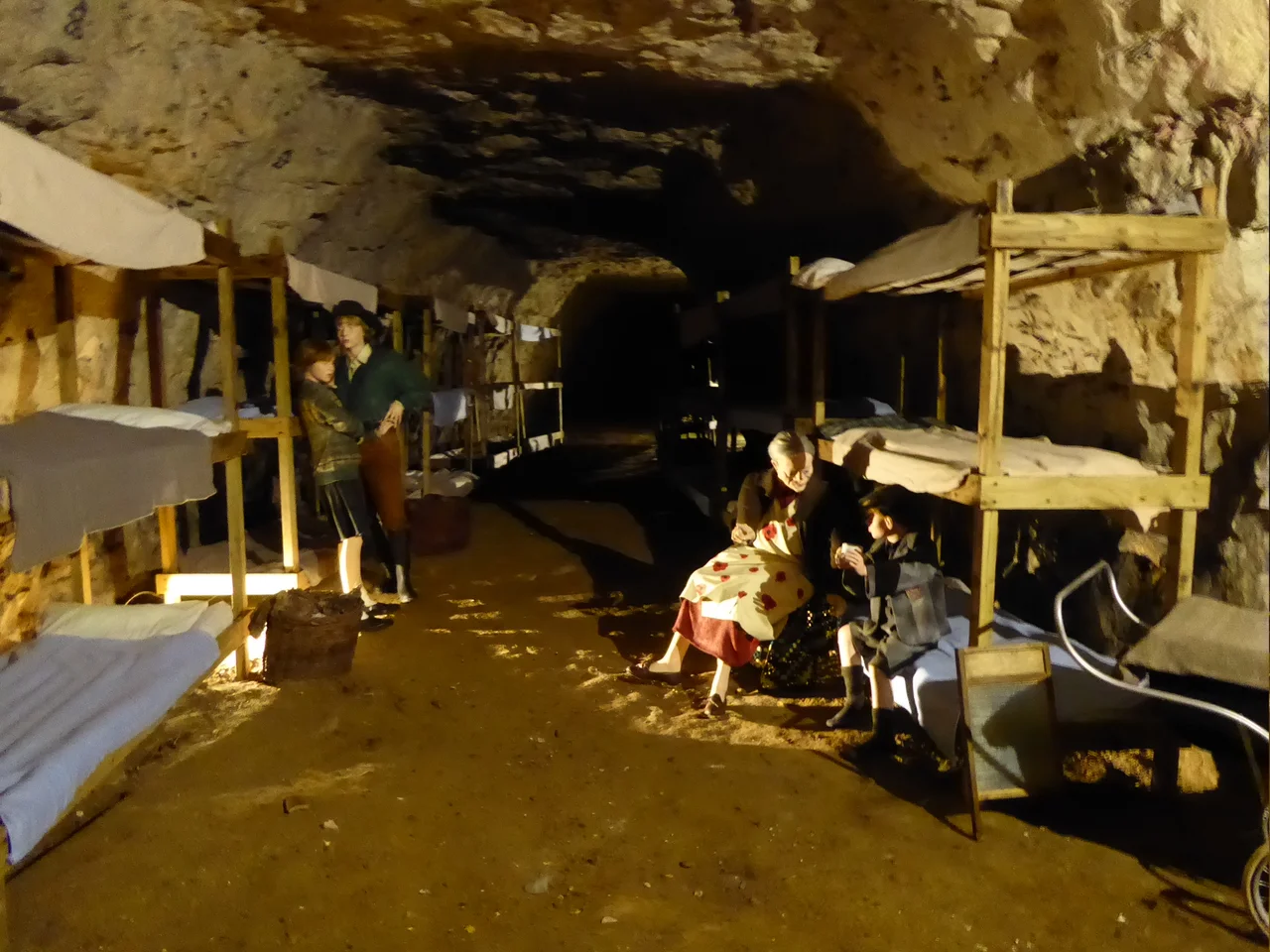
During the First World War the caves became an ammunition storage dump associated with the Royal Arsenal at Woolwich. After that came an interlude in the 1930s when commercial growers cultivated mushrooms in the constant cool darkness. Then in September 1940 the aerial bombardment of London began, and a different use emerged. The caves became an air-raid shelter on a scale rarely matched anywhere. At their peak, they accommodated up to 15,000 people, each paying a penny to enter. The tunnels were fitted with electric lighting, toilets, and washing facilities. A chapel was built underground. So was a hospital. People arrived at the nearby Chislehurst railway station and walked down into the shelter at night, where they slept on bunks deep beneath the chalk. One child was born in the caves during the war - christened in the cave chapel as Cavena Wakeman. She kept the name until she turned 18, when she legally changed her first name to Rose and used Cavena as her middle name. The shelter was officially closed shortly after VE Day.
Bowie, Bond, and the Beat
In the 1950s and 1960s the caves transformed again, this time into a music venue. The acoustics were peculiar; the location was unusual. From the mid-1950s into the early 1960s, Lonnie Donegan played skiffle here. Adam Faith and Marty Wilde performed. American rockers Gene Vincent and Eddie Cochran played during their British tours. And then, in June 1962, a fifteen-year-old David Bowie performed - the earliest of four recorded Bowie appearances at the venue (June 1962, 17 November 1962, sometime in 1964, and 4 March 1966). The Yardbirds played on 1 July 1966. Jimi Hendrix played twice: 16 December 1966 and 27 January 1967. Pink Floyd appeared on 8 December 1967. Radio Caroline broadcast performances on Saturday nights with DJs Dave Lee Travis, Johnnie Walker, Tony Blackburn, and Simon Dee, bringing down acts like Muddy Waters.
TV Crews and Cradle of Filth
Television and film discovered the caves too. Doctor Who shot the 1972 serial The Mutants in the tunnels. The films Beat Girl, The Tribe, and Inseminoid used them as locations. Iron Maiden filmed the video for Can I Play With Madness here, and Cradle of Filth shot here as well. Bill Oddie presented the caves on Seven Natural Wonders as one of the wonders of the London area. James Braxton visited on Antiques Road Trip. Most Haunted produced two episodes investigating the alleged hauntings; author James Wilkinson's 2011 book The Ghosts of Chislehurst Caves collected fifty years of testimonies from guides and owners. Today the caves are run as a tourist attraction. You walk down with a guide, who lights an oil lamp and points out the supposed Druid altar and Roman features that the 1903 theory bequeathed, even though everyone knows the dating is suspect. You stand in the underground chapel where Cavena Wakeman was christened during the bombing. You see the bunk beds, still in place. You imagine David Bowie at sixteen, playing for a few dozen people in a London cave. Twenty-two miles of tunnel runs into the dark beneath your feet. Most of it, you don't see.
From the Air
Located at 51.407°N, 0.058°E in Chislehurst, in the London Borough of Bromley, about 11nm southeast of Central London. The closest airports are Biggin Hill (EGKB) about 4nm south and London City (EGLC) about 9nm north-northwest. Recommended viewing altitude is 1,500 to 2,500 feet AGL. The caves are entirely underground - there is nothing visible from above except the modest entrance building on Old Hill, beside Chislehurst railway station. The 22 miles of tunnels lie beneath ordinary suburban Bromley streets. Use Chislehurst railway station as your nearest above-ground reference point; the caves entrance is immediately adjacent.
Nearby Stories
- Hampton, London 1.1 km away
- Queenborough Castle 3.2 km away
- Groombridge Place 4 km away
- North Weald Airfield 4.9 km away
- Kings Langley Palace 8.3 km away
- White House Farm murders 11 km away
- Port Lympne Mansion 22 km away
- Amberley Museum & Heritage Centre 31 km away