
Chiswick House Gardens
Lord Burlington came back to London from his second Grand Tour in 1719 with two souvenirs: a head full of ideas about Roman architecture, and a thirtysomething painter named William Kent. He installed both at his villa in Chiswick, then a quiet hamlet four miles west of the city. The villa, finished in 1729, was Britain's first true Palladian house, modelled on the temple-like country residences Andrea Palladio had built for the Venetian nobility two centuries earlier. The gardens, laid out alongside, were stranger and more important. Burlington wanted to recreate a Roman garden as described by Pliny and Horace. He had no idea what one actually looked like. So he and Kent made it up, and in doing so invented an entirely new way of arranging the English countryside that would reshape gardens on every continent.
A Garden of Ancient Rome
The gardens at Chiswick started, in the 1720s, as a standard Jacobean affair: straight paths, parterres, neat geometry. Burlington and Kent began ripping that up almost immediately. They added a Ha-ha (a sunken fence that lets a garden flow into the surrounding pasture without a visible wall) and started filling the grounds with what they called fabriques, decorative garden buildings meant to evoke Rome. An Ionic Temple, circular, modelled on either the Pantheon or the Temple of Romulus, sits beyond the exedra in the Orange Tree Garden. In front of it, a circular pool with a small obelisk at its centre. Three concentric rings of raised grass surround the pool in a 3:4:5 ratio that echoes the proportions of the villa's Red and Green Velvet Rooms. Kent had studied Inigo Jones's theatre designs for the Stuart court, and a theatrical sense of staging runs through every sightline in the place.
The Cast of Statues
A semicircular hedge theatre, the exedra, originally held statues of Caesar and Pompey, the men Daniel Defoe blamed for the decline of the Roman republic, facing a statue of Cicero, the republic's defender. The arrangement was a political message in stone. In 1733, the same year Burlington resigned his government positions and went into active opposition against Prime Minister Robert Walpole, the line-up shifted to feature poets and philosophers (Horace, Homer, Virgil, Socrates) and statesmen associated with anti-tyranny. Walpole's friends understood the message. Other statues scattered around the grounds included Hercules, Cain and Abel, a gladiator, Mercury, a wolf, a boar, a goat, a lion and a lioness. A Doric column carried a statue of Venus de Medici (now replaced with a Portland stone copy commissioned by the Chiswick House Friends in 2009), because in the eighteenth century everyone knew Venus was the protector of gardens. The whole place was a layered argument about politics, mythology, and what the ancients had really meant.
Kent's Cascade and the Birth of Landscape Gardening
William Kent's most influential contribution at Chiswick was what he chose to do with the natural landscape rather than the architecture. He added a cascade (a waterfall and symbolic grotto) inspired by the upper cascade at the Villa Aldobrandini in Italy. He widened the Bollo Brook into a curving lake around 1727 and heaped the excess earth up behind the cascade to create an elevated walkway with views to the Thames. He planted flower gardens and an orchard and an aviary that included an owl. He arranged Cedar of Lebanon trees in formal alternation with stone funerary urns of his own design, and set three sphinxes between them facing east towards the sunrise. The result was something Britain had not seen before: a garden that looked natural but was rigorously composed, like the landscape paintings of Claude Lorrain and Nicolas Poussin that Kent loved. Stourhead, Stowe, West Wycombe, Holkham, Rousham, all followed. The English Landscape Garden was born here.
Conservatory, Camellias, and a Queen's Garden Party
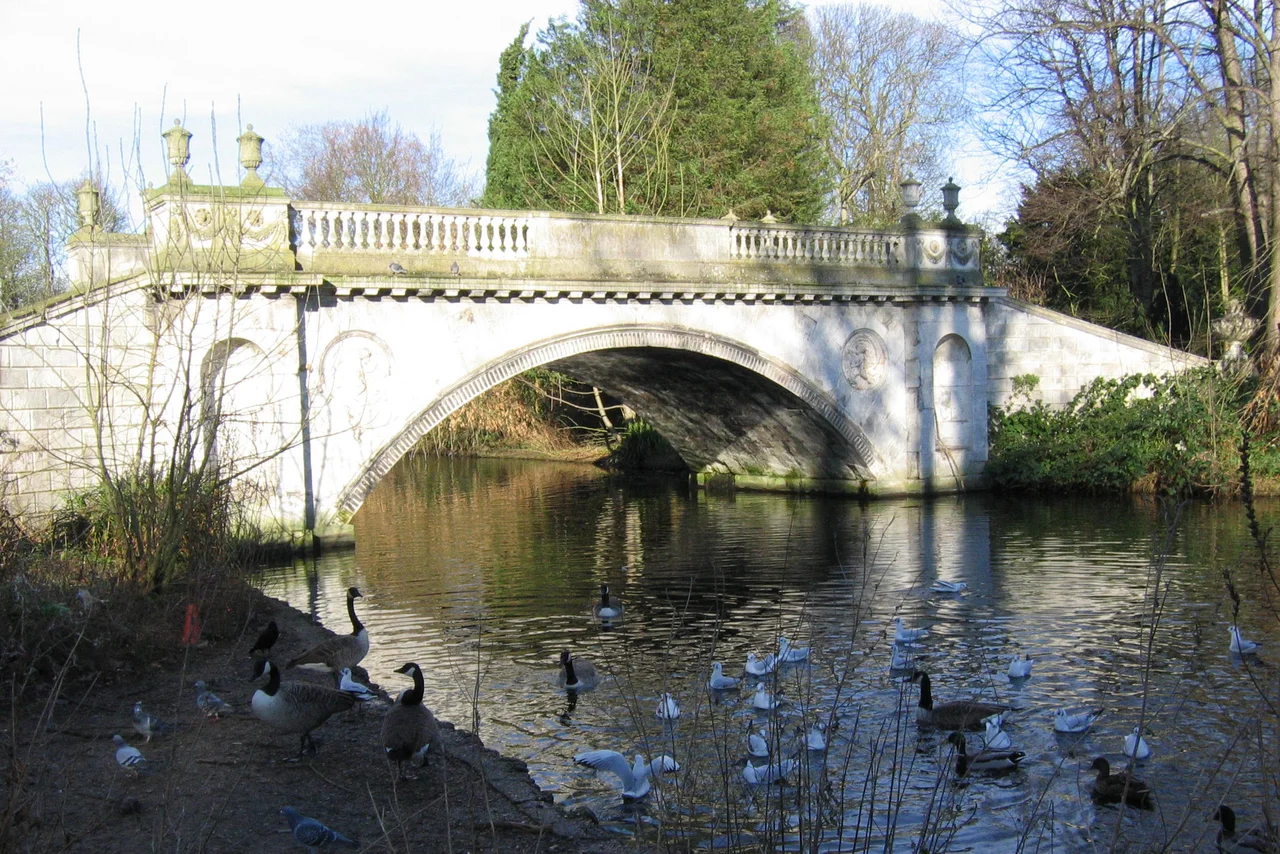
The gardens kept growing. In 1738 Burlington bought a gateway designed by Inigo Jones in 1621 from the grounds of Beaufort House in Chelsea (then the home of Sir Hans Sloane, whose collection later seeded the British Museum) and had it dismantled and rebuilt at Chiswick. In 1774 a Classic Bridge by James Wyatt was added for Georgiana Spencer, the future Duchess of Devonshire. Joseph Paxton, who would later design the Crystal Palace for the 1851 Great Exhibition, began his career as a young gardener here, working for the Royal Horticultural Society at Chiswick before William Cavendish, the 6th Duke of Devonshire, noticed him and took him north to Chatsworth. In 1813 the conservatory was completed alongside the Italian Garden; at 96 metres it was the longest conservatory in Britain at the time. A collection of camellias planted there in 1828 still survives. Queen Victoria hosted a garden party for 300 guests at Chiswick in 1875.
Decay and Recovery
Burlington had no son. The estate passed to his daughter Charlotte, who had married the Duke of Devonshire, and from there to the Cavendish family who owned it for two centuries. By the early twentieth century the gardens had become tired. A restoration was attempted in the 1950s. A more thorough programme, run by the Chiswick House and Gardens Trust with help from the National Lottery Heritage Fund and English Heritage, began in 1988 and continues today. The walled kitchen garden, founded in 1682 and let go to ruin over a century of neglect, was rescued in 2005 by local volunteers and is now growing currants, pleached apple trees, and rows of tulips again. Walking the grounds today you can still trace the original 3:4:5 geometry around the Ionic Temple, find the place where the statues of Caesar and Pompey once stood, and look up at the sphinxes facing the rising sun. The argument about how to make a garden is still going on. Burlington started it.
From the Air
Chiswick House sits in the western suburbs of London, tucked between the Great West Road (A4) and the Hogarth roundabout, about a mile north of the Thames at Hammersmith. The villa's pale Palladian façade and the formal garden geometry are clearly visible from the air. Heathrow's eastern departures pass over Chiswick at 3,000 to 5,000 feet; the M4 runs along the northern edge of the estate.
From the Air
Located at 51.4844 N, 0.2603 W in Chiswick, west London. Heathrow (EGLL) is approximately seven miles west; commercial aircraft on the eastern Heathrow departures pass overhead at 3,000 to 5,000 feet. London City Airport (EGLC) is around 12 miles east. View from commercial overflights or from approved helicopter routes. The Thames at Hammersmith and the Hogarth roundabout are useful visual markers.
Nearby Stories
- Battle of Britain, Northfleet 1.1 km away
- Bayham Old Abbey 5.4 km away
- Catharine Macaulay 6.4 km away
- Hatfield rail crash 8.8 km away
- Chequers 8.9 km away
- Chelmsford Cathedral 10 km away
- Queen Victoria Hospital 13 km away
- Fishbourne Roman Palace 36 km away