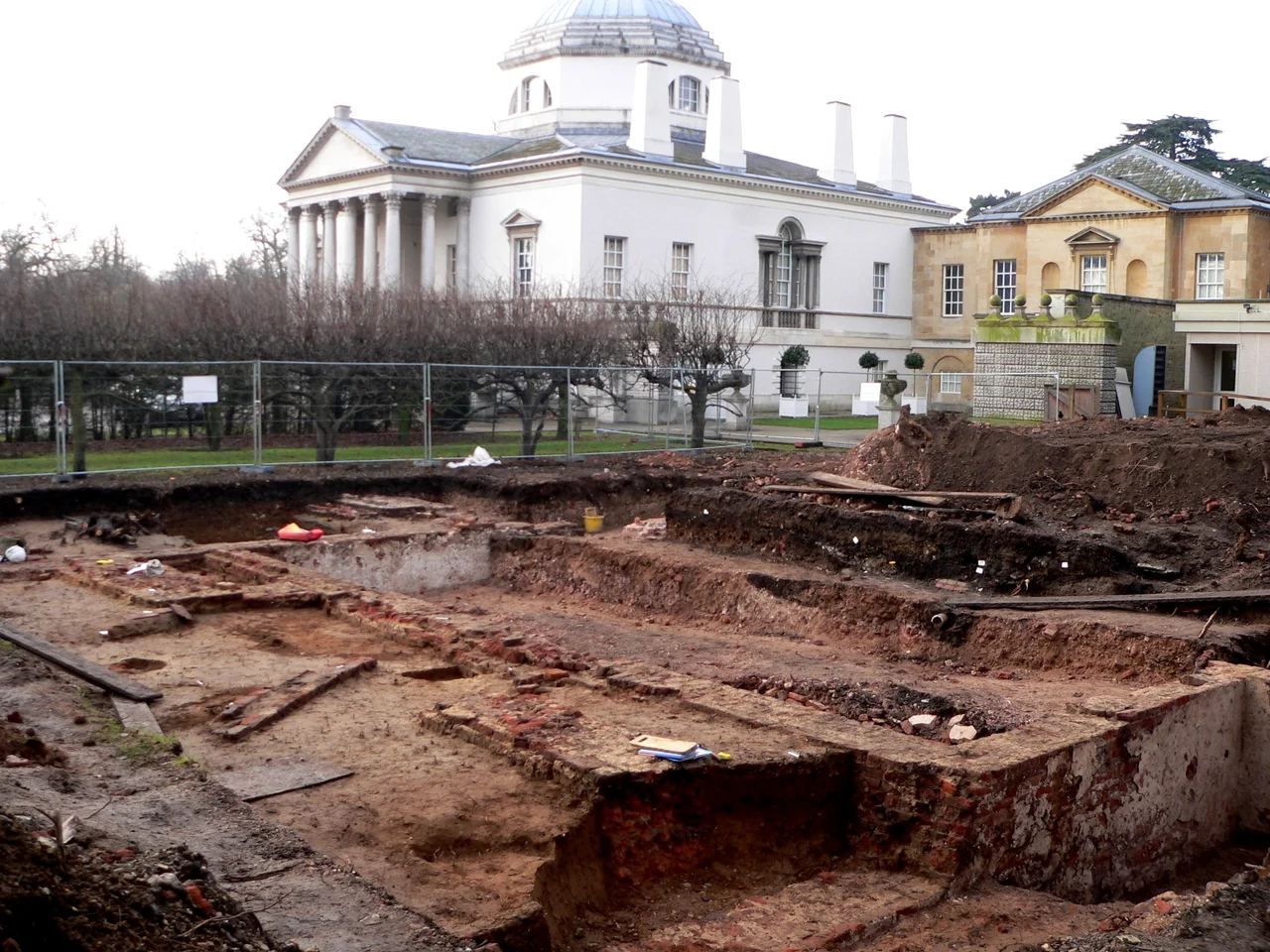

Chiswick House
John, Lord Hervey took one look at the new villa rising in the Chiswick fields and delivered a verdict for the ages: "Too small to live in, and too big to hang to a watch." Richard Boyle, 3rd Earl of Burlington, did not care. He had come back from Italy in 1719 burning with a vision of Roman architecture as Andrea Palladio had reinterpreted it, and he was going to build his own translation in the suburbs of London no matter what the wits at court thought of it. Completed in 1729, his half-cube of brick and Portland stone is one of the strangest small buildings in England: a temple, a study, a manifesto. Horace Walpole simply called it "the beautiful model."
Apollo of the Arts
Walpole's nickname for Burlington was "Apollo of the Arts," and the villa was his offering. He had bought drawings by Palladio himself on his second Grand Tour, including reconstructions of lost Roman buildings that almost no one in Europe had seen. Those sheets, kept in his Blue Velvet Room, gave him octagons and apses and a dome derived from the Pantheon in Rome. The Corinthian capitals on the six-column portico, carved by John Boson, copy those of the Temple of Castor and Pollux. The rusticated stonework around the door echoes the base of Trajan's Column. Burlington was not decorating; he was citing. He worked alongside William Kent, the painter-turned-architect who would also lay out the gardens, and together they produced a building that broke completely with the stucco-fronted fashion of the day.
An Earthly Paradise
After Burlington's death in 1753, the villa passed by marriage to the Dukes of Devonshire. In 1774 the young 5th Duke married Lady Georgiana Spencer, the Duchess of Devonshire, who became one of the most photographed-before-photography women of the age: a fashion icon, a Whig political organiser, a gambler, the subject of scandal sheets across Europe. She called Chiswick her "earthly paradise" and used it as a country headquarters for the Whig party, hosting tea parties on the lawns and political conspiracies in the rooms upstairs. Charles James Fox, the great Whig orator, died here in 1806. So, twenty-one years later, did the Prime Minister George Canning, in a bedroom in the wings the Cavendishes had bolted onto the side of Burlington's original villa to make it more habitable.
Kent's First English Garden
Step out the back doors and the building's argument continues. The gardens at Chiswick are usually cited as one of the earliest examples of the English landscape garden, the style that would conquer Europe over the next century and replace formal parterres with curving lawns, serpentine water, and apparently artless groves. William Kent designed an exedra, a theatre of clipped hedges originally peopled with three Roman statues. He shaped a lake by widening the Bollo Brook in around 1727, piled the spoil into a viewing terrace, and ran cascades through it. An Inigo Jones gateway from 1621 was bought from Chelsea and rebuilt here in 1738, a piece of architectural collage. Cedars of Lebanon alternate with funerary urns. Sphinxes face the rising sun. The whole design is meant to read as a Roman garden, the kind Hadrian might have laid out at Tivoli.
Asylum, Fire Station, V-2
The villa's history is studded with strange afterlives. Between 1892 and 1928 the Cavendishes rented it to the Tuke brothers, who ran it as the Chiswick Asylum for wealthy private patients of both sexes. The institution was praised in its day for relatively humane treatment of its residents, but the patients themselves left almost no trace; they were people in genuine distress, paying to be cared for in Burlington's temple to reason, and the wings they lived in were demolished in the 1950s. The 9th Duke sold the property in 1929 to Middlesex County Council, with King George V among the public subscribers chipping in to keep it. It briefly became a fire station. Then on 8 September 1944 a German V-2 rocket struck one of the John White wings, the same wing where Canning had died. The wings came down for good in 1956.
Paperback Writer
On 20 May 1966, the Beatles arrived at Chiswick House to film promotional clips for their new single. They wandered through the conservatory and the walled garden, mugged for the camera near Kent's exedra, and shot the footage that would carry "Paperback Writer" and "Rain" onto televisions around the world. It is one of the building's quieter ironies: a Roman villa built to display Italian Renaissance theory, surrounded by an English landscape garden invented to look natural, used to launch two of the most artificial three-minute pop songs ever recorded. Today the house is Grade I listed, managed by English Heritage and the Chiswick House and Gardens Trust, with the gardens restored after a Heritage Lottery grant and roughly four million pounds of other funding in 2007. The gardens are open from dawn to dusk, free of charge, and the kitchen garden first laid out in 1682 is back in production thanks to local volunteers.
From the Air
Chiswick House sits at 51.4836 N, 0.2586 W on the north bank of the Thames in west London, roughly seven miles west of Charing Cross and just inside the Heathrow approach corridor. From cruise altitude on final to EGLL (Heathrow) runways 27L and 27R, look for the green rectangle of the grounds between Hogarth Lane and the river, with the white domed villa unmistakable at the heart of the gardens. Nearest airports: London Heathrow (EGLL) about 8 nm west, London City (EGLC) about 11 nm east. Best viewed at 2,000 to 4,000 feet on a clear London day; expect haze and busy controlled airspace.
Nearby Stories
- Battle of Britain, Northfleet 1.1 km away
- Bayham Old Abbey 5.4 km away
- Catharine Macaulay 6.4 km away
- Hatfield rail crash 8.8 km away
- Chequers 8.9 km away
- Chelmsford Cathedral 10 km away
- Queen Victoria Hospital 13 km away
- Fishbourne Roman Palace 36 km away