
Choi Hung Estate
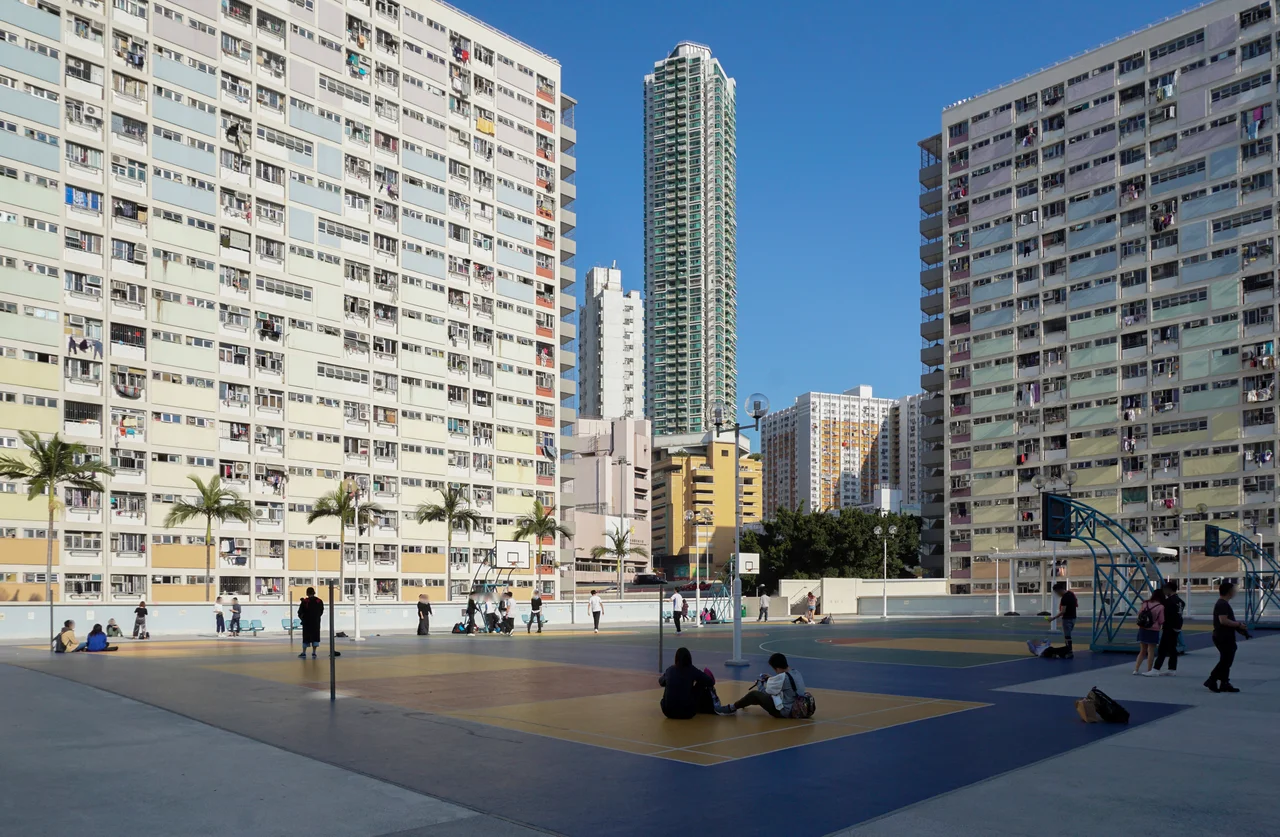
Before K-pop made it famous, before the Instagram accounts and the selfie tripods, a basketball court sat quietly on the rooftop of a car park in eastern Kowloon, framed by eleven residential blocks painted in alternating bands of colour — pink, yellow, green, blue, orange, red. The residents of Choi Hung Estate had been playing there for decades. Then the internet arrived, and the world noticed.
Built for Forty-Three Thousand
The Hong Kong government granted the land in 1958, when the colony was still absorbing wave after wave of refugees from the mainland. Construction moved quickly: the blocks rose between 1962 and 1964, and an opening ceremony in 1963 brought the Governor of Hong Kong, Sir Robert Brown Black, to Ngau Chi Wan to mark what was, at the time, the largest public housing estate in the world. Accommodating nearly 43,000 people, Choi Hung was not just a building project — it was a statement that the government could house a population growing faster than the city could build.
The estate's ambition attracted notice. Richard Nixon came through in 1964, years before he became President of the United States. Britain's Princess Margaret visited in 1966, followed by Princess Alexandra in 1967. These were not routine inspections. Choi Hung was regarded as a model of what mass social housing could look like. The Hong Kong Institute of Architects agreed, awarding it a Silver Medal in 1965.
What "Rainbow" Actually Means
Choi Hung (彩虹) means rainbow in Cantonese. The name came first, the colours followed — designed to give each block a visual identity in a development where eleven identical towers might otherwise blur together. What began as practical colour-coding became, over decades, something richer: a visual identity for a whole community.
By the 2016 census, Choi Hung Estate housed 18,435 people. The median age was 48, and 93 percent spoke Cantonese as their usual language. The median monthly household income across all households was HK$15,290. These are the numbers behind the photographs — real people with deep roots in a place they have shaped and been shaped by.
The Court at the Centre of It All
The rooftop basketball court above the estate's car park has been played on for generations. Then Korean boyband Seventeen filmed a music video there, and the Hong Kong tourist office began promoting the image globally. Photographs of the court — shot from below to catch the rainbow blocks behind — multiplied across social media. In 2017, one architectural photograph of the estate was shortlisted for the Arcaid Award.
The attention has not been simple to absorb. Journalists and researchers noted that the flood of visitors treated the estate as a backdrop rather than a home, crowding out the residents who came to play, not to pose. Some locals adapted — selling photographs to tourists who had come to take their own. The tension is unresolved: genuine architectural beauty, genuine community displacement, and the question of what it means when your neighbourhood becomes someone else's content.
The Long Goodbye
In December 2023, the Hong Kong Housing Authority confirmed what many residents had feared: Choi Hung Estate was earmarked for redevelopment. By October 2024, the Wong Tai Sin District Council had received detailed phasing plans. The first blocks — Tan Fung House, Pik Hoi House, and Kam Pik House — are scheduled for demolition between 2028 and 2029, with residents moved to the new blocks in Mei Tung Estate. The final phase is not expected to conclude until 2048 or 2049.
When it is complete, 9,200 units will replace the original blocks. Whether the new buildings will carry the colours, and what that would mean if they did, remains an open question. Choi Hung is a place where housing policy, popular culture, and community memory have become inseparable — and its gradual dismantling will be one of the slowest farewells in Hong Kong's housing history.
From the Air
Choi Hung Estate sits at 22.335°N, 114.207°E in Ngau Chi Wan, eastern Kowloon. From the air at 3,000–5,000 feet, the estate's colour-banded blocks are visually distinct against the dense urban grid. The nearest major airport is Hong Kong International Airport (VHHH) on Lantau Island, approximately 28 km to the west-southwest. Approach and departure paths for VHHH do not pass directly overhead, but the Kowloon skyline — and Choi Hung's distinctive rooftop — is visible on clear days from aircraft transiting the harbour corridor.
Nearby Stories
- Chapel of St. Francis Xavier 3.5 km away
- Cuiheng 4.1 km away
- 2015 Shenzhen Landslide 16 km away
- Shunde 31 km away
- Wanshan Archipelago 37 km away
- Nanxiong Formation 96 km away
- Heyuan 149 km away
- Checheng Fu'an Temple 629 km away