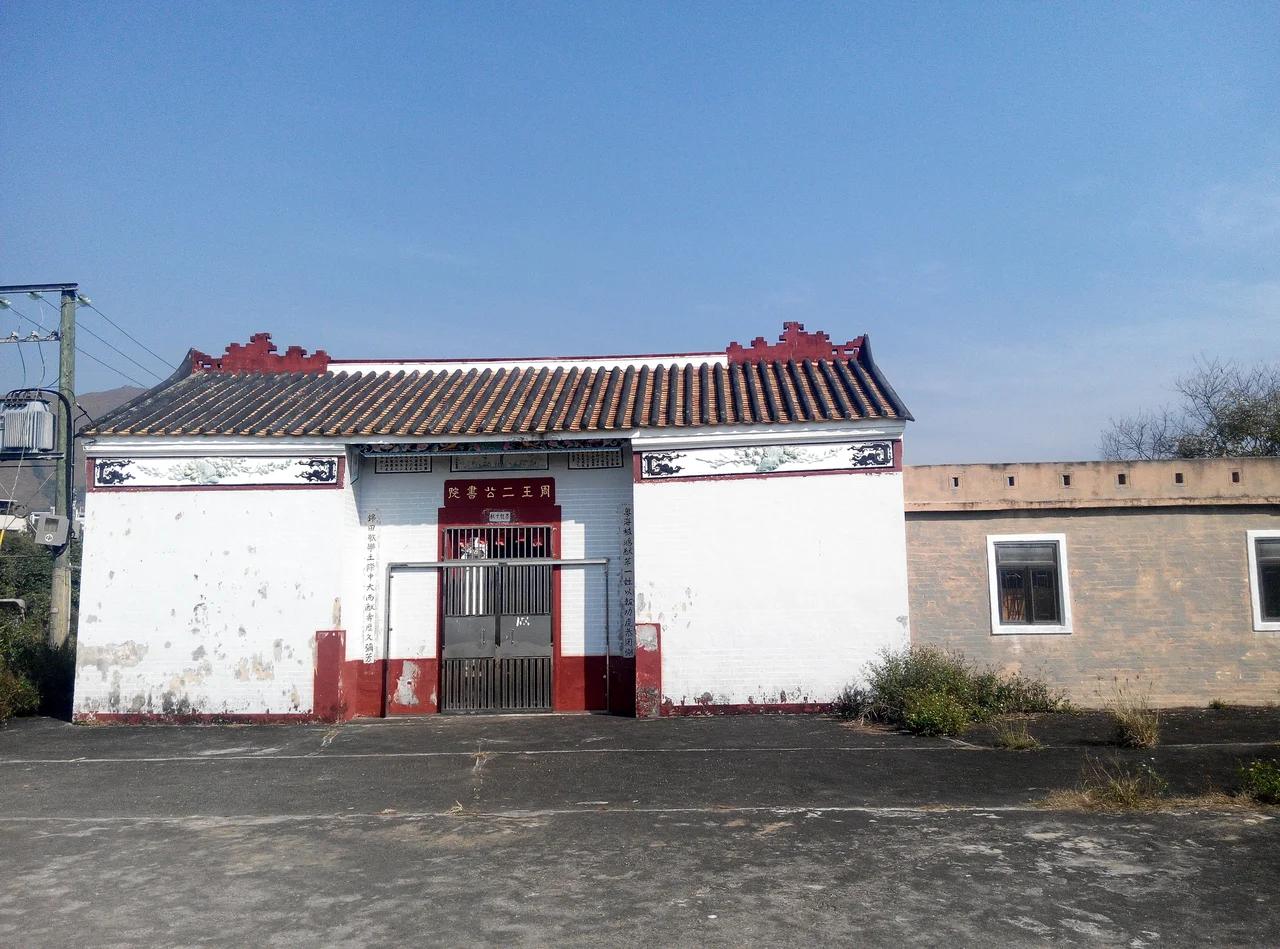

Chou Wong Yi Kung Study Hall
In 1662, the Qing Emperor issued an order that emptied the coasts. Every village within fifty li of the shore — across Guangdong, Fujian, and into the New Territories — was to be abandoned. The Great Clearance, as it became known, was designed to starve out the Ming loyalist fleet of Koxinga by denying it any supply from shore. For the villagers of what is now Yuen Long, it meant abandoning homes their families had built over generations. They would not return for seven years.
The Officials Who Pleaded
When the evacuation order finally lifted in 1669, it was not through patience alone. Two imperial officials — among them Zhou Youde — had pressed the Emperor to allow the coastal populations to return. Their intervention was not a small act. Arguing against an imperial edict required both standing and courage, and for the Tang Clan of Shui Tau Tsuen, the result was the recovery of their homeland.
Gratitude, in the Tang Clan's tradition, took architectural form. Sixteen years after their return, in 1685, the clan erected a study hall in the village — not a temple, not a memorial stone, but a place of learning and ceremony dedicated to those who had spoken for them. The hall's name, Chou Wong Yi Kung (周王二公), honours the two officials whose pleading made the homecoming possible.
A Hall Built in the Qing Style
The Chou Wong Yi Kung Study Hall follows the architectural conventions of the early Qing dynasty with careful precision. The plan is symmetrical: two halls flank a central courtyard open to the sky, and an altar occupies the structural and ceremonial centre. The arrangement is both practical and symbolic — the courtyard draws light into what would otherwise be a closed space, while the symmetry reflects the Confucian ordering that governed scholarly and ritual life.
Study halls of this type served multiple purposes in village life. They were places where clan boys prepared for the imperial examinations; they were also spaces for ancestral veneration and communal ceremony. The fact that this particular hall was built to honour specific individuals, rather than simply the clan's ancestors in the abstract, makes it unusual — and historically legible in a way that purely generic buildings are not.
What Remains in Shui Tau Tsuen
Shui Tau Tsuen sits in the northwestern New Territories, in a part of Yuen Long that has retained more of its traditional village character than much of the surrounding district. The Tang Clan has been present in this area for centuries, and the study hall is one of several historic clan buildings that survive in the vicinity.
In 2010, the Antiquities Advisory Board assessed the Chou Wong Yi Kung Study Hall and accorded it Grade II historic building status — a recognition that the structure, while not at the highest level of rarity or threat, holds significant historical and architectural value. Grade II designation in Hong Kong signals that a building merits preservation and careful consideration before any alteration. The study hall has stood for more than three centuries. The designation formalises what the Tang Clan's own act of construction already expressed: that some things are worth keeping.
The Memory the Building Carries
The story the Chou Wong Yi Kung Study Hall tells is, at its core, a story about displacement and return. The Great Clearance forced tens of thousands of people off the South China coast. Many never came back. Those who did faced the work of rebuilding not just homes but the fabric of community life — its ceremonies, its institutions, its physical markers of belonging.
To build a study hall within sixteen years of returning was to assert that the community's intellectual and ceremonial life had survived the interruption. To name it after the officials who secured the return was to insist that the act of advocacy — of speaking for the vulnerable before power — deserved to be remembered. That memory is still housed in the symmetrical courtyard and the altar at the centre of the hall, in a village in Yuen Long.
From the Air
The Chou Wong Yi Kung Study Hall is located at 22.4454°N, 114.0633°E in Shui Tau Tsuen, Yuen Long. From the air at 2,000–4,000 feet, the traditional village cluster is visible against the patchwork of low-rise developments and wetland ponds characteristic of northwestern New Territories. Hong Kong International Airport (VHHH) is approximately 18 km to the southwest on Lantau Island. The surrounding Yuen Long plain, once an agricultural landscape, remains partially open at this elevation, making traditional village layouts visible in clear conditions.
Nearby Stories
- Chapel of St. Francis Xavier 3.5 km away
- Cuiheng 4.1 km away
- 2015 Shenzhen Landslide 16 km away
- Shunde 31 km away
- Wanshan Archipelago 37 km away
- Nanxiong Formation 96 km away
- Heyuan 149 km away
- Checheng Fu'an Temple 629 km away