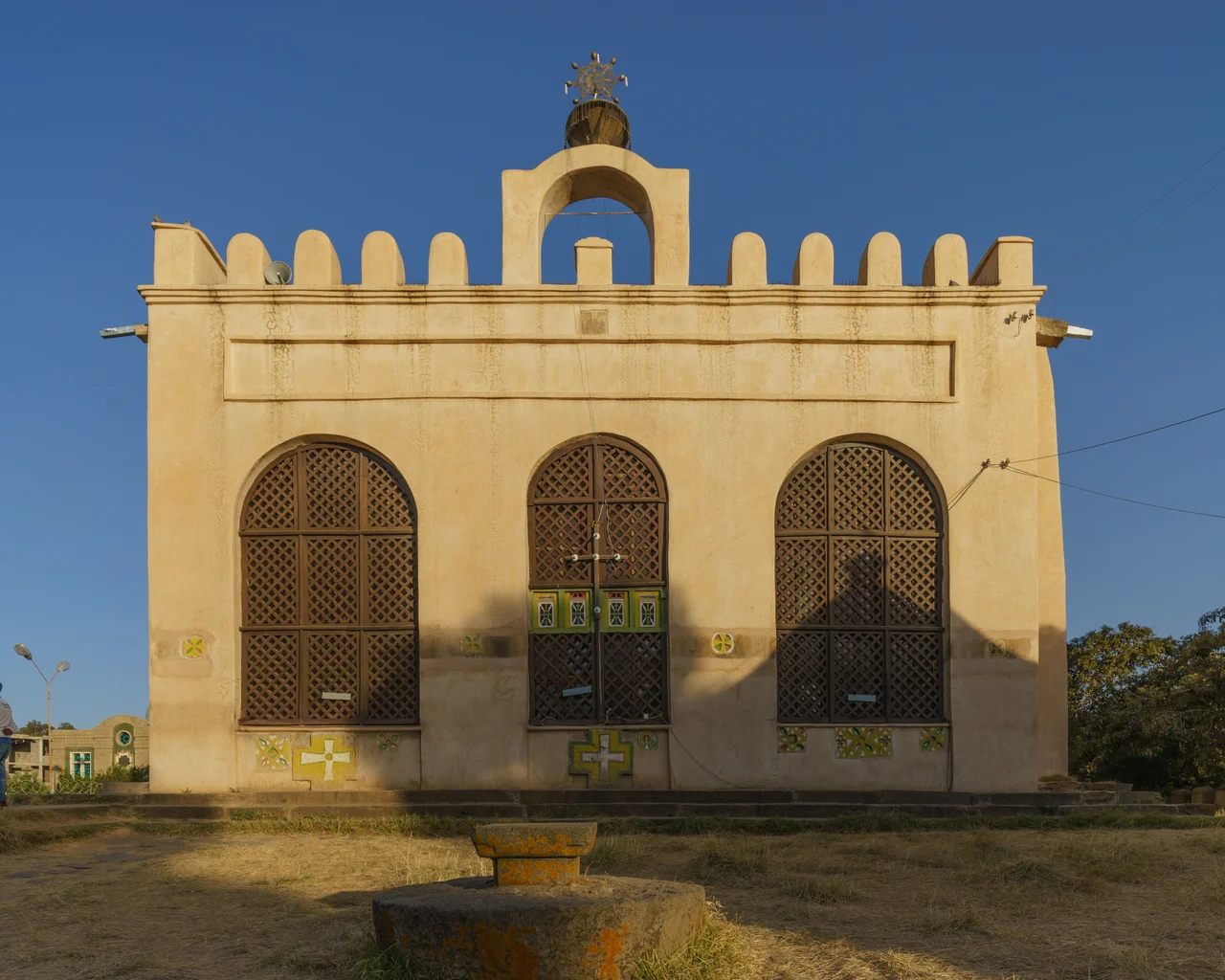

Church of Our Lady Mary of Zion
Only one man alive has seen it. A monk appointed for life, confined to a chapel on the grounds of the Church of Our Lady Mary of Zion in the town of Axum, spends his days praying before what the Ethiopian Orthodox Tewahedo Church holds to be the Ark of the Covenant - the chest described in Exodus, the one that held the tablets of the Ten Commandments. The guardian monk may not leave. He will appoint his successor before he dies. If he fails to, the monks of the monastery will elect a new one. This is how it has been done for generations.
Menelik and Solomon
The Ethiopian tradition is specific. According to the Kebra Nagast - the Book of the Glory of Kings, Ethiopia's national epic, compiled in the 14th century - the Queen of Sheba travelled to Jerusalem to meet King Solomon. Their son Menelik I, later returning to Ethiopia, brought the Ark with him. The first church on this site at Axum, in the heart of what was then the Kingdom of Axum, is believed to have been built in the 4th century AD by Ezana - Axum's first Christian king - on the advice of the Syrian missionary Frumentius, whom the Ethiopian Church calls Abune Selama Kesatie Birhan, Our Father of Peace the Revealer of Light. The current Chapel of the Tablet, which houses the Ark, was funded by the Empress Menen, wife of Emperor Haile Selassie, in the 1950s.
Destruction and Rebuilding
The church has been destroyed at least once. Tradition claims an earlier destruction under Queen Gudit in the 10th century, though historians are uncertain. The confirmed destruction came in the 16th century at the hands of Ahmad ibn Ibrahim al-Ghazi - Gragn the Left-Handed - during his near-conquest of Christian Ethiopia. The Emperor Gelawdewos rebuilt it. The Emperor Fasilides enlarged it again in the 17th century. The Portuguese friar Francisco Alvares, who visited Ethiopia in the 1520s before al-Ghazi's invasion, described the old Church of Saint Mary of Zion as one of the most magnificent buildings in the country. By the time of the coronations, every Ethiopian emperor had to be crowned or have his coronation ratified here. Without it, he could not legitimately use the title 'Atse.'
Ullendorff's Account
On 9 June 1992 Edward Ullendorff, a former professor of Ethiopian Studies at the University of London, made a public statement in Tel Aviv. In 1941, while serving as a British Army officer during the East African Campaign, he said, he had personally examined the ark inside the church. It was empty, he said - a medieval construction, 'from when these were fabricated ad hoc.' His account contradicted Ethiopian tradition. Ethiopian scholars and Orthodox faithful rejected it. The Ethiopian Church responds that the Ark now shown to visitors is a replica; the real Ark is in a separate, sealed chamber that Ullendorff did not enter. The theological claim remains what it has been for centuries: unfalsifiable, protected, central to Ethiopian Orthodox identity.
Festival of Zion Mariam
On 30 November - 21 Hidar in the Ethiopian calendar - the Festival of Zion Mariam draws pilgrims to Axum from across the country. They come on foot, by bus, in ancient coaches painted with saints. The liturgical language is Ge'ez, the ancient Semitic language of Ethiopia's Orthodox Church. Priests chant. The haile (liturgical umbrellas) are paraded. Women may not enter the Old Church - the only place in the compound permitted to them is a building dedicated to the Blessed Virgin Mary, considered in Ethiopian theology the archetype of the Ark. The rule is old, and disputed within the Ethiopian Church itself, and respected. At the end of the Festival pilgrims carry away what they came for: a blessing from the holiest place in Ethiopian Christianity.
December 2020
In mid-December 2020, during the Tigray War between the Ethiopian federal government and the Tigray People's Liberation Front, 750 people who had taken shelter in the Church of Our Lady Mary of Zion were taken out and killed by soldiers. The account is from the Europe External Programme with Africa (EEPA), corroborated in part by Amnesty International's subsequent investigation of a broader Aksum massacre carried out by Eritrean troops. Locals believed the soldiers were looking for the Ark of the Covenant. No evidence of that has been established. The Ethiopian government has blocked forensic investigators, the UN International Commission of Human Rights Experts on Ethiopia, and independent media from accessing the church grounds to investigate what happened. The 750 people are not abstractions; they were priests, families, and townspeople who ran to the church because they believed it would protect them. The church had survived Queen Gudit and Gragn the Left-Handed. It did not protect the people who sheltered there in December 2020 from the soldiers of their own country.
From the Air
The Church of Our Lady Mary of Zion is in Axum, Tigray Region, Ethiopia at 14.13N, 38.72E, elevation about 2,100m. Axum Airport (HAAX/AXU) is 8 km east of the town. The Tigray Region has seen severe conflict since 2020 and remains sensitive; flight operations require careful review of current NOTAMs and security conditions. Recommended viewing altitude 8,000-10,000 ft AGL to appreciate the Axumite archaeological landscape, including the Obelisks of Axum that stand near the church compound. Gondar (HAGN/GDQ) lies about 250 km west; Mekele (HAMK/MQX) about 190 km east.
Nearby Stories
- Dedebit Elementary School airstrike 42 km away
- Tigray Region 43 km away
- Mekelle 45 km away
- Southern region (Eritrea) 46 km away
- Eritrean-Ethiopian War 57 km away
- Simien National Park 84 km away
- Battle of Amba Aradam 92 km away
- Adulis 99 km away