.jpg)
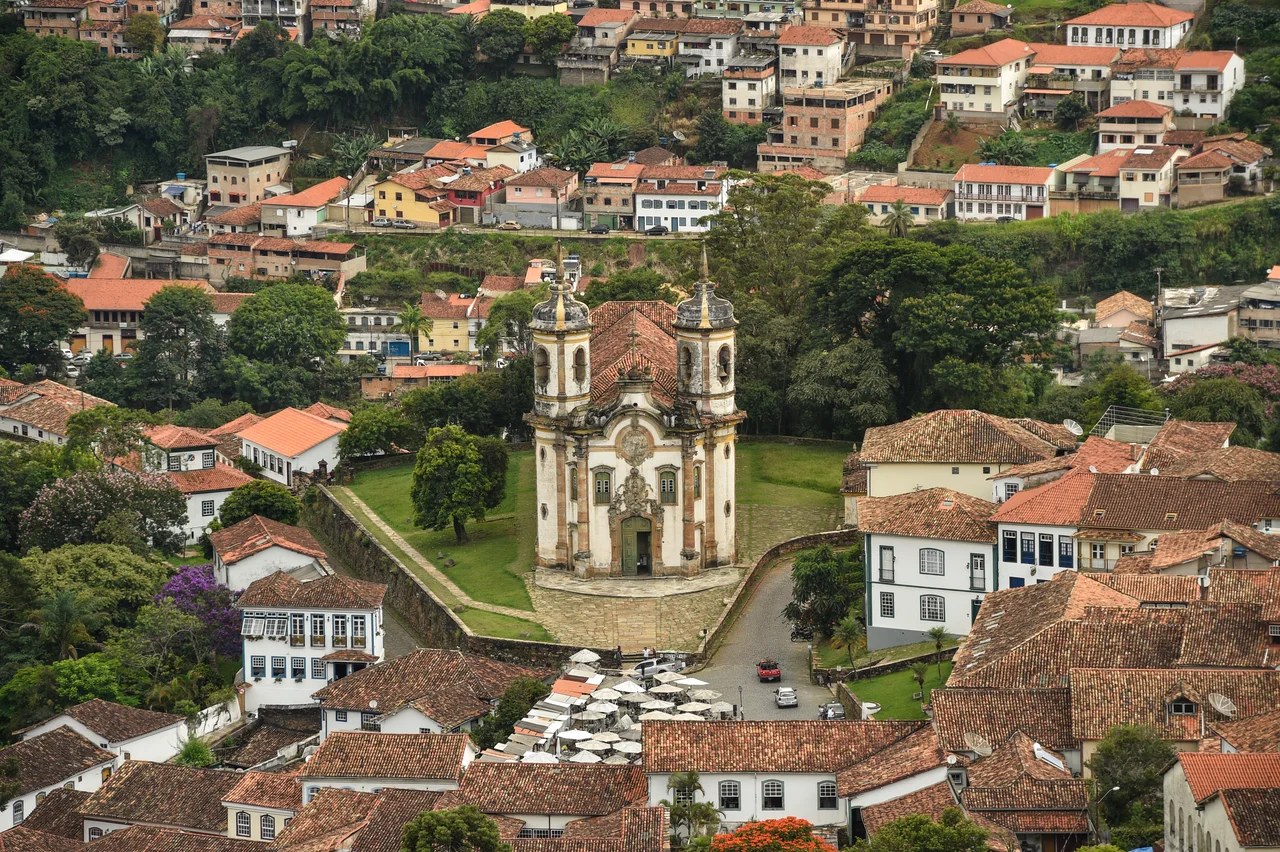
Church of Saint Francis of Assisi (Ouro Preto)
Antonio Francisco Lisboa was born in Vila Rica in 1738, the son of a Portuguese architect and an enslaved African woman. He grew up learning how to draw, carve, and build from his father's workshop, and by the time he started designing the Church of Saint Francis of Assisi in 1766, he was already recognized as one of the most talented artists in the Portuguese colonial world. A degenerative illness - most historians believe it was leprosy rather than the syphilis once speculated - gradually took his toes and fingers as he worked. He strapped tools to what remained of his hands and kept carving. In Brazil he is known simply as Aleijadinho, the little cripple. The church he designed at Ouro Preto is considered one of the Seven Wonders of Portuguese Origin in the World.
The Facade You Cannot Forget
Above the single entrance door a circular medallion in soapstone shows Saint Francis receiving the stigmata - the five wounds of Christ impressing themselves on his hands, feet, and side. Aleijadinho carved that panel himself. Below it a curved frontispiece in the same green-gray stone holds the eye, and two circular bell towers flank the composition. Circular bell towers were rare in Brazilian religious architecture of the 1760s - most churches had square ones. So were the oculus windows closed with decorative reliefs rather than glass. The whole facade plays with convention, pulling the building into the Rococo vocabulary of curves and movement while keeping a Brazilian weight and silhouette. Aleijadinho had studied European engravings of buildings he would never visit, and he made their grammar his own.
The Ceiling That Glows
Step inside and look up. The flat wooden ceiling of the nave bears a painting by Manuel da Costa Ataide, known as Mestre Ataide - the Glorification of Our Lady Among Musician Angels. The angels are Brazilian, painted with the faces and skin tones Ataide saw around him, not the pale European cherubim of baroque convention. The composition lifts the eye into an illusion of clouds and sky, a trompe-l'oeil heaven painted on a ceiling in a hill town halfway around the world from the Sistine Chapel it distantly echoes. Gold glows on the woodwork below. Sculpted angels hold the cornices. The interior decoration continued for more than a century after construction began in 1766 - the gilding and the altars were not finished until the late 1800s.
The Gold That Built Everything
Ouro Preto - the name means Black Gold, for the dark iron oxide that coated the metal here - was the richest mining town in the Portuguese empire in the 1700s. Gold discovered in Minas Gerais at the end of the 17th century poured through Vila Rica on its way to Lisbon, Rio, and the wider Atlantic economy. The Church supported and benefited from the boom: lay brotherhoods of different social classes each commissioned their own elaborately decorated churches, competing in ostentation. Saint Francis was built by the Third Order of Saint Francis, a lay brotherhood of white devotees. Baroque here was religion and wealth at the same time - a theology of abundance that, as one art historian put it, let 'ornamentation run riot on interior walls, retablos, and facades.' The town's wealth came from the labor of enslaved Africans who extracted the gold. Aleijadinho's own mother was among those enslaved people. That contradiction sits permanently inside the building he designed.
The Artist Who Worked Through Pain
Aleijadinho's illness progressed through the second half of his life. Contemporary accounts describe him losing toes, then fingers, then mobility itself. He was said to work from a wheeled cart, his tools bound to the stumps of his hands, sometimes carving facing away from the work because he could not bear for his assistants to see him. He kept producing sculptures, altars, and church designs until he was nearly seventy, and his soapstone prophets at the Sanctuary of Bom Jesus de Matosinhos in Congonhas - made in his final working years - are considered the summit of Brazilian colonial sculpture. His mixed-race status in a racialized society was complicated: his professional standing placed him above the enslaved people around him, but he never enjoyed the social position of full-blooded Portuguese artists. He lived in a liminal space, and the buildings he designed reflect it.
A Living Church
Ouro Preto's historic center became a UNESCO World Heritage Site in 1980, and Saint Francis of Assisi is its most photographed building. The church is still in use, not just a museum. During Holy Week, thousands of participants fill the streets for processions that have continued for two and a half centuries, with music and ceremonial masses. As one ethnomusicologist observed, these celebrations renew local memory of the baroque era and the city's vanished prosperity. The gold is gone. The empire is gone. What remains is the architecture Aleijadinho and his mentors and his assistants and the anonymous enslaved builders left behind - a green-stone facade, a painted ceiling, and a saint receiving the stigmata over a door in a little town that once made the world's wealth.
From the Air
Located at 20.39 degrees S, 43.50 degrees W in the historic core of Ouro Preto, Minas Gerais. Best viewed from 2,500 to 3,500 feet AGL where the twin circular bell towers and curved facade distinguish Saint Francis from the dozen other colonial churches on nearby hilltops. The town sits at about 1,100 meters elevation in rugged terrain. Nearest airport is Belo Horizonte/Confins (SBCF), roughly 55 nm northwest. Morning valley fog is common in winter; afternoon light brings out the green-gray soapstone carvings. Look for the cluster of churches - Carmo, Pilar, and Rosario are all within a few hundred meters, each commissioned by a different colonial-era brotherhood.
Nearby Stories
- Santa Bárbara, Minas Gerais 8.9 km away
- Legislative Assembly of Minas Gerais 12 km away
- Viçosa, Minas Gerais 21 km away
- Robert Quayle (1814 ship) 28 km away
- Serra do Rola-Moça State Park 30 km away
- Rio Doce State Park 57 km away
- Tiradentes 65 km away
- Ubá 79 km away