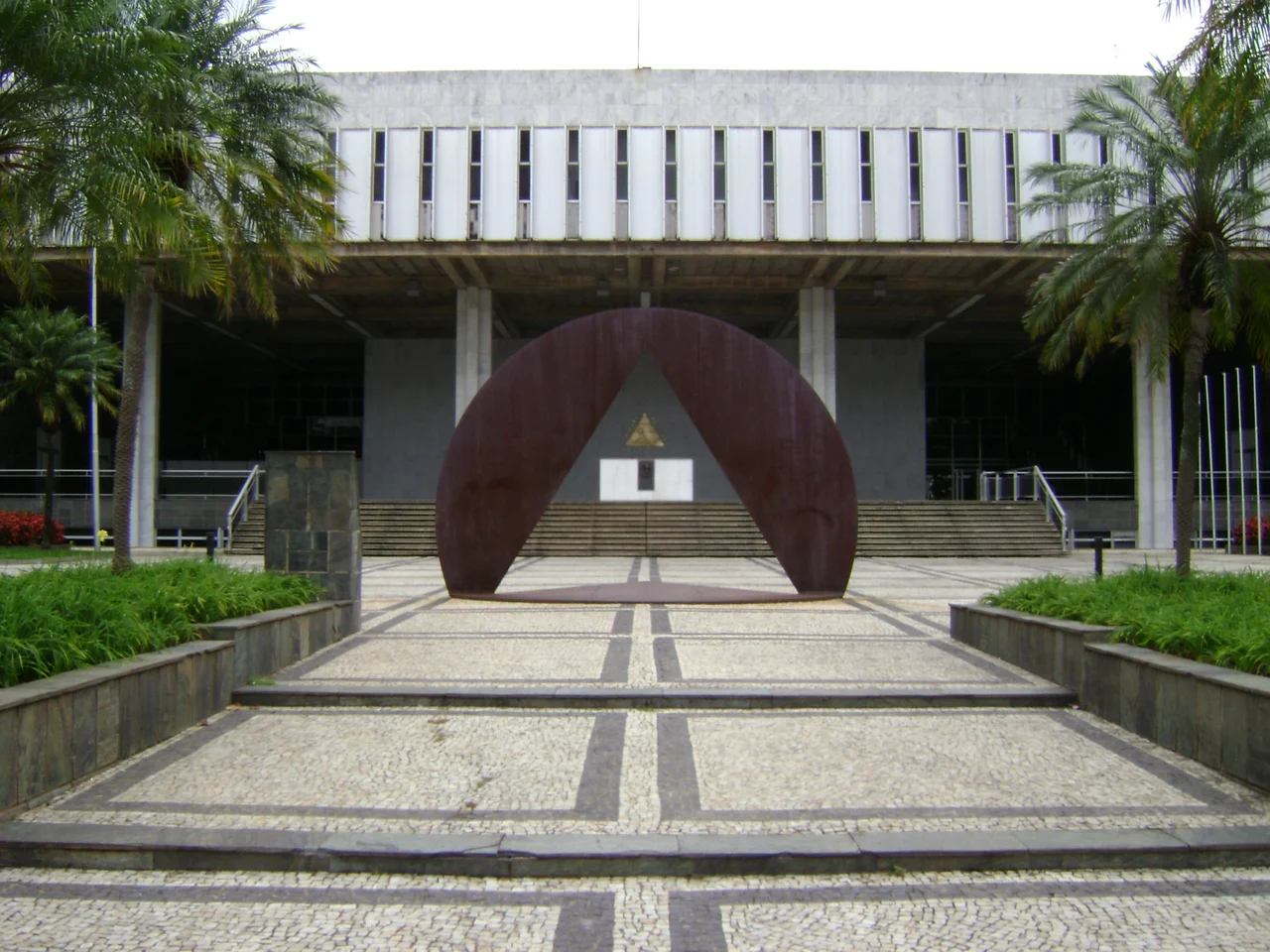

Legislative Assembly of Minas Gerais
Seventy-seven deputies. That is the number Minas Gerais has settled on for its state legislature after two centuries of experimentation, dictatorship, and constitutional revision. They meet on Avenida Afonso Pena in Belo Horizonte, in a building that has housed the assembly since the state capital moved there from Ouro Preto in 1897, and they vote on everything from the state budget to the military police to the question of whether any given governor should be allowed to face trial. The Assembleia Legislativa de Minas Gerais, ALMG for short, has outlasted an empire, a republic, two dictatorships, and a military junta. It keeps meeting.
Before There Was a Capital
The story begins in Ouro Preto. In 1824, two years after Brazil declared independence from Portugal, the first Brazilian Constitution designated Ouro Preto as the administrative hub of the province of Minas Gerais. Ten years later an amendment to that constitution allowed the provinces to establish their own legislative bodies, and Minas Gerais - then the largest and wealthiest province in Brazil, and the province with the greatest number of enslaved people - created a provincial legislature. The men who sat in it were wealthy landowners whose fortunes had been built, in part, on slavery. When the imperial constitution fell in 1889 and a federalist republic replaced it, those same elite factions in Minas Gerais and São Paulo led the political maneuvering that produced the new Brazilian Republic.
The Capital Moves, the Library Follows
In 1891 the new republic produced a new Minas Gerais state constitution, which would stand with amendments for nearly a century. The legislature became a bicameral Congress, a Chamber of Deputies and a Senate. Then, in 1897, the state capital itself moved. A new city was being built from scratch at Cidade de Minas, later renamed Belo Horizonte, as a planned capital to symbolize progress and to escape Ouro Preto's older associations. The Assembly moved into a building on Avenida Afonso Pena. Its library settled at Praça da República - since renamed Praça Afonso Arinos. Over the decades the Assembly would change shape, but its street address stayed.
The Authoritarian Interruptions
The Assembly's 20th century was repeatedly interrupted by the reach of central power. After Getúlio Vargas seized national leadership in the 1930 revolution, state legislatures were dissolved. A 1935 state constitution revived Minas Gerais' assembly as a unicameral body of 48 deputies, with diminished authority. Two years later Vargas seized absolute power in the Estado Novo - Brazil's first full dictatorship - and pushed through a national constitution that modeled itself on Poland's 1935 authoritarian constitution, dissolving political parties and reducing state legislatures to 'administrative divisions of a unitary state.' When Vargas was deposed in 1945 and democracy briefly returned, the 1947 Constituent Assembly of Minas Gerais was revived again, this time with 72 deputies. Then came the 1964 military coup, and another two decades of weakened state power followed.
How a Bill Becomes a Law in Minas
The current ALMG has three government blocks and one opposition block, with deputies distributed across more than a dozen parties. A bench is any party with at least five deputies; a block is a coalition of at least sixteen. Both benches and blocks have leaders and vice-leaders. The plenary - the deliberative chamber where all 77 deputies meet - is the highest authority, with administrative power over committees, party leaders, and the assembly's own cabinet. Twenty-three permanent committees handle the substance: Agriculture and Agroindustry, Constitution and Justice, Public Security, Health, Mines and Energy, Education, Environment and Sustainable Development, and more. Each committee debates bills within its domain before propositions return to the plenary for a final vote.
What the 77 Decide
The Assembly's powers are broad. It plans the state budget, authorizes state borrowing, creates or eliminates civil service positions, oversees the military and civil police, approves urban development plans, and organizes the state's public ministry, public defender's office, and court of auditors. It elects its own board, swears in each incoming governor, and can authorize legal action against that governor, the vice-governor, or any secretary of state. It has installed five of the seven councillors on the Court of Auditors; it elects four members of the state governing council; it can authorize referendums and approve agreements between municipalities. Members of this Assembly have gone on to become governors, senators, and one president - including Rondon Pacheco, Aureliano Chaves, and many others who began their careers in the rooms on Avenida Afonso Pena, making decisions for a state the size of France.
From the Air
Located at 19.93°S, 43.95°W in central Belo Horizonte, Minas Gerais, Brazil. The ALMG building stands on Avenida Afonso Pena, the city's principal boulevard, within the planned grid of Belo Horizonte's historic center. Best viewed from 2,000-3,500 ft AGL to pick out the distinctive straight avenues of the original city plan. Nearest airport is Pampulha Airport (SBBH), about 7 km north, or Tancredo Neves International Airport (SBCF), about 40 km north. The building sits near other historic government structures and major museums of the state capital.
Nearby Stories
- Iron Quadrangle 11 km away
- Morro Velho 14 km away
- Santa Bárbara, Minas Gerais 19 km away
- São Gonçalo do Pará 22 km away
- Sumidouro State Park 24 km away
- Crucilandia 29 km away
- Our Lady of the Rosary Church, Lavras 120 km away
- Paranaíba River 168 km away