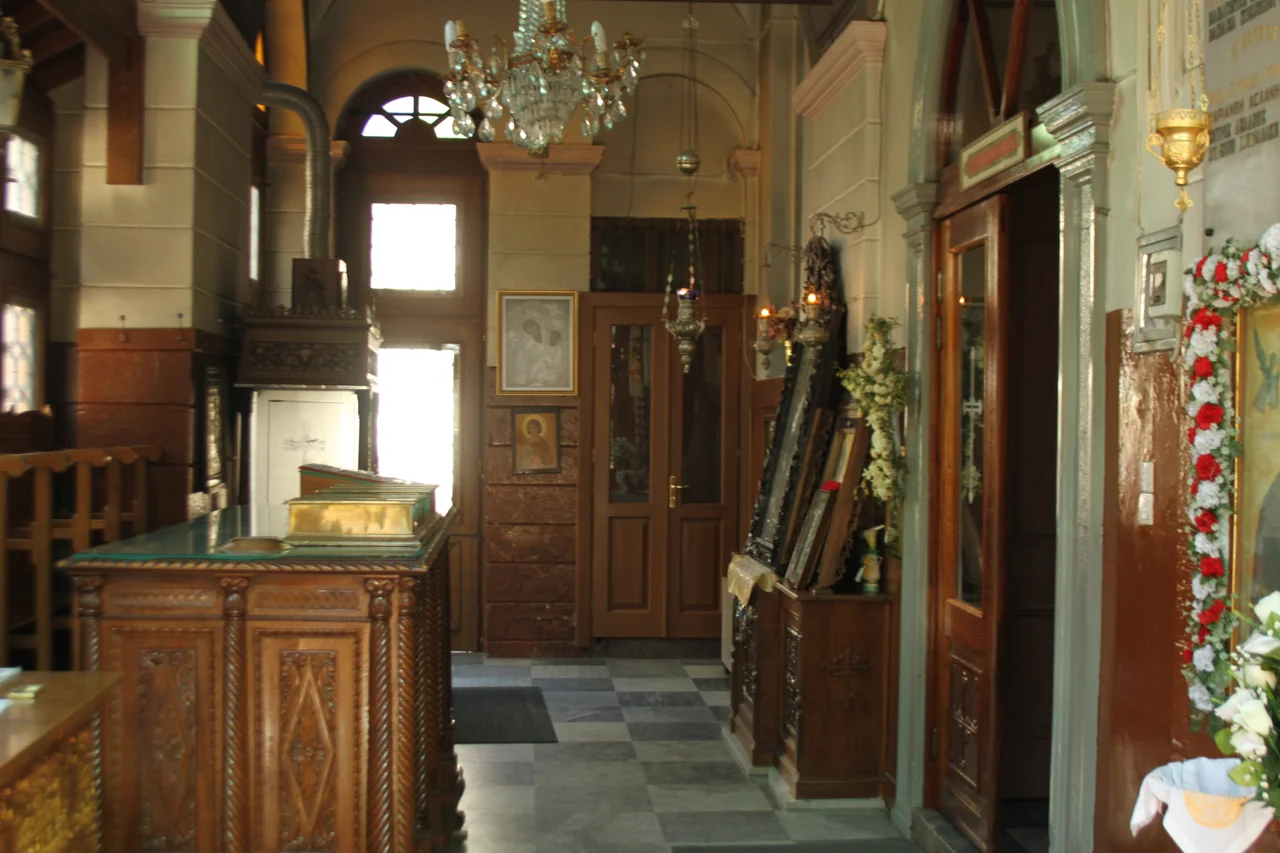

Church of St. Symeon, Mytilene
Strip away the painting and you find another painting underneath. In 1975, conservators cleaning an icon of Saint Simeon Stylites at this church in Mytilene discovered, hidden beneath the surface, an older Byzantine image dating from the era of the Palaiologos dynasty. It is the kind of layered surprise this church specializes in. Tucked into a small neighborhood near the old market on the island of Lesbos, with a huge backyard and a Byzantine museum of its own, the Church of Saint Symeon stands on ground that has been sacred, in one form or another, for some fourteen centuries.
Layers of Worship
The land here held the dead long before it held this building. A necropolis was in use near the site in the sixth and seventh centuries, ancient burials beneath what would become a place of worship. The written record of a church on this spot begins around 1700, when it appears in the archive of the Metropolitan Church of Mytilene; the present sanctuary may date its earliest form to that year. The building you see now is younger. An earthquake in 1867 left the older, smaller church ready to be torn down, and between roughly 1885 and 1891 a far larger church rose in its place. Architectural plans hint that a sizable church had stood here even before 1885. The church honors three saints who share a name: Saint Simeon Stylites of Syria, the pillar-dwelling ascetic; Saint Symeon Stylites of Lesbos; and the Simeon of the Gospel of Luke who held the infant Christ in the Temple.
A Church Built Like an Argument in Stone
The architecture borrows from across the Christian world. Built as a basilica in the shape of a cross, the church carries a circular dome crowned by an icon of Christ, resting on pendentive arches in the manner of Middle Byzantine churches, the same device that lifts the dome of Hagia Sophia. The outer dome bears a painted timeline of stories from the Hebrew Old Testament. The nave vaults echo the Romanesque manner found across Byzantine-era Europe, recalling the interior of Speyer Cathedral in Germany around 1030, while the columns reach back further still, toward the early Christian forms of Santa Costanza in Rome. Even the stone came across the water: it was quarried at Sarmusak, near the entrance to the bay of Ayvalik on the Turkish coast opposite. The interior, stamped with crosses and iconographic panels, was the work of a local artist named P. Polichroni.
Treasures Saved and Hidden
The church's oldest treasures now rest for safekeeping in its own Byzantine museum. The iconostasis, the carved screen before the altar, along with the holy altar, the ciborium, the bishop's throne, the pulpit, the side shrines, and the epitaph canopy, all belonged to the original church of the 1700s. The iconostasis and altar are wood-carved and may be more than three hundred years old, their surfaces worked with elaborate religious motifs, the woodwork itself evidence of how early the church was built. The bell tower may owe its funding to a priest named Sotirous Lekatsas Papasotiriou, who served here from 1917 to 1921. And then there is that hidden icon: the Saint Simeon Stylites painting that, cleaned in 1975, revealed an earlier Byzantine work from the Palaiologos age beneath it. The image on display today, from the 17th century, came from the church that stood here before this one.
A Living Sanctuary
For all its museum-piece treasures, this is a working parish, not a relic. People come from across Lesbos to worship here, and the church keeps every document that traces its building from inception. The rhythm of the year reaches its peak at Easter, when, in the words of those who know it, the church is bulging with people, the small neighborhood filled, the carved wood and painted dome surrounded by the living congregation the building was made to hold. It is a place that has weathered earthquakes and rebuildings and the slow accumulation of centuries, and still does the work a church is meant to do: gathering a community, generation after generation, beneath the same dome.
From the Air
The Church of Saint Symeon stands in Mytilene, the capital of Lesbos, near 39.11 degrees N, 26.56 degrees E, close to the old market in the city's interior streets. From the air Mytilene is marked by its harbor, the great Castle of Mytilene on the headland to the north, and the dense old town; the church sits among the city's tightly packed neighborhoods rather than on the waterfront. Mytilene International Airport (ICAO: LGMT) lies just south of the city. A viewing altitude of 2,000 to 4,000 feet shows the city, harbor, and castle together, with the Turkish coast close across the strait to the east.
Nearby Stories
- Eresos 9.6 km away
- Lyrnessus 15 km away
- Battle of the Oinousses Islands 17 km away
- Antandrus 31 km away
- Volissos 41 km away
- St. Helena Church 44 km away
- Akhisar Museum 70 km away
- Battle of Imbros 96 km away