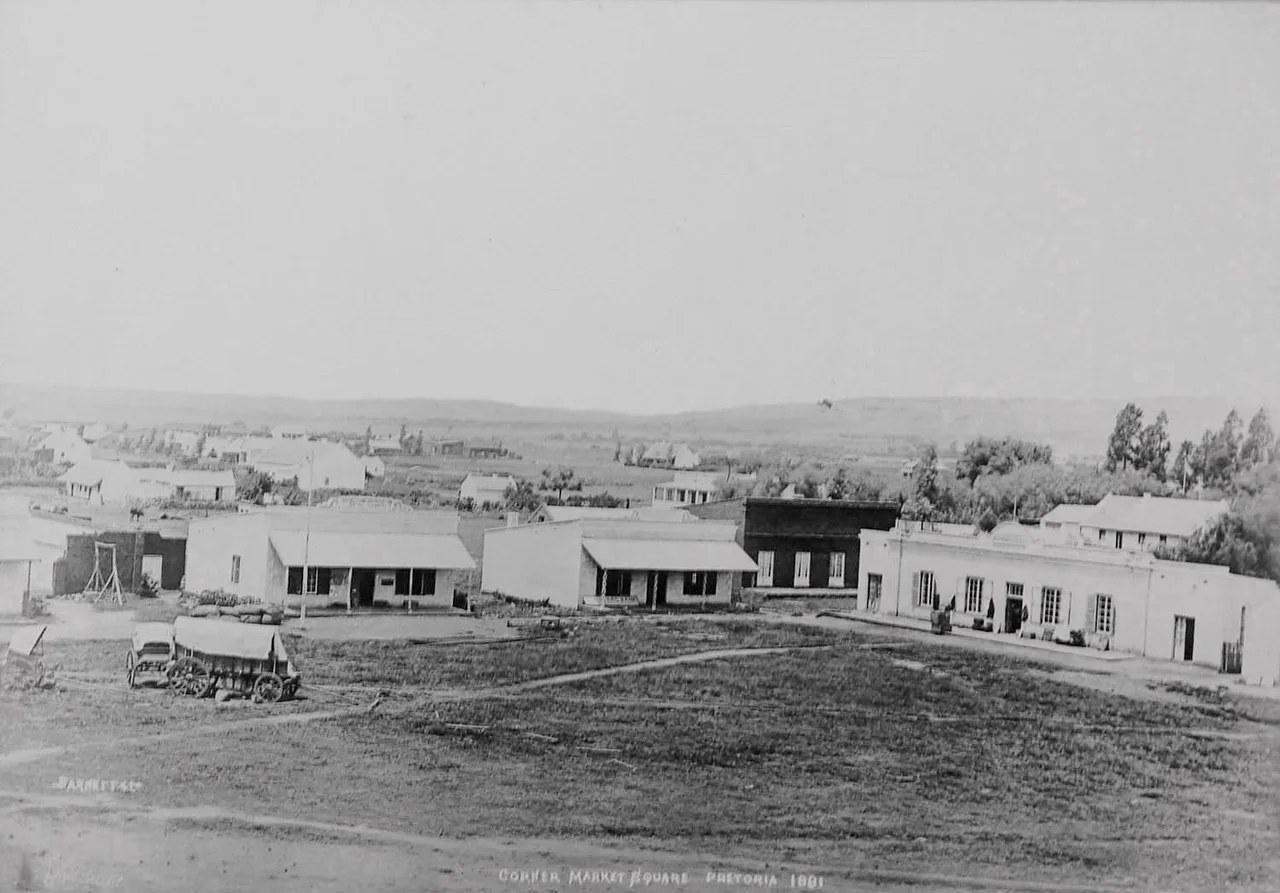

Church Square, Pretoria
Two men define this square, and they never met. At its center stands Paul Kruger in bronze, the bearded patriarch of the old Boer republic, hat in hand, gazing out over the city he governed. A short walk away rises the Palace of Justice, where in 1964 a judge sentenced Nelson Mandela to life imprisonment. Church Square holds both of them, and the century of conflict between what they represented. This is where Pretoria began, and where its hardest history was decided.
Where the City Started
When Marthinus Pretorius laid out Pretoria in the 1850s, he set aside this open ground as a market and a churchyard, the two institutions a frontier town could not do without. Three successive churches stood at its center over the following decades; the last, the Verenigde Kerk, hosted Kruger's state funeral before it was pulled down around 1905. The name stuck even after the buildings vanished. Around the square's edges, a remarkable ensemble of architecture accumulated: the turreted Palace of Justice, the gabled Ou Raadsaal where the republic's parliament once sat, the Old Capitol Theatre, and a grand General Post Office. To stand in the middle is to be surrounded by Pretoria's institutional memory in stone.
The Man on the Plinth
The statue of Kruger has its own complicated journey. It was commissioned in 1896 by Sammy Marks, a Jewish industrialist who admired the president, and modeled by the sculptor Anton van Wouw. War and politics kept it wandering for half a century, from a private park to a spot outside the railway station, before it finally settled here in 1954. Four anonymous Boer riflemen guard the lower plinth, citizen-soldiers of the kind who fought the British. In a democratic South Africa the monument has become a lightning rod, vandalized and fiercely debated, a symbol some want removed and others fiercely defend. The square absorbs that argument too. It has always been a place where the country quarrels with itself.
The Trial of the Century
In the north-west corner stands the Palace of Justice, and inside it the most consequential courtroom drama in the nation's history unfolded. The Rivonia Trial ran from late 1963 into June 1964, with Mandela, Walter Sisulu, Govan Mbeki, Ahmed Kathrada, and their co-accused charged with sabotage and facing the gallows. From the dock Mandela delivered the speech that closed with a willingness to die for a free society. The court spared their lives but handed down life sentences, and most were shipped to Robben Island. The same building had earlier been the stage where the National Party declared a republic in 1961. Few squares anywhere have witnessed a nation's fault lines so directly.
A Living Square
For all its weight of history, Church Square is no museum piece. Pretoria's first trams once clattered around it; today the A Re Yeng rapid-transit buses circle its edges, and a 2014 rejuvenation traded tar walkways for slate and planted trees for shade. People cross it on the way to work, eat lunch on its benches, and gather here when the city has something to say, in celebration or protest. The Kruger statue stays at the center, contested and immovable, while the country it watches over keeps changing around it. That tension, between what is fixed in bronze and what flows through a public space, is the square's enduring character.
From the Air
Located at 25.746 S, 28.188 E at the heart of Pretoria's central business district. From 2,000 to 4,000 feet AGL the square reads as a green-and-paved opening in the dense city grid, ringed by the distinctive turreted Palace of Justice and the gabled Ou Raadsaal; the Kruger House lies a few blocks west and Freedom Park rises on Salvokop to the south. Nearest airports: Wonderboom (FAWB) about 8 nm north, OR Tambo International (FAOR) roughly 30 nm southeast. At roughly 1,350 m on the Highveld, Pretoria offers clear, stable winter air and excellent visibility for low-level sightseeing.
Nearby Stories
- Little Foot 3.9 km away
- Hartebeesthoek Radio Astronomy Observatory 18 km away
- Boksburg explosion 23 km away
- Tswaing crater 24 km away
- Secunda CTL 69 km away
- Sun City 71 km away
- Bushveld Igneous Complex 87 km away
- Battle of Bergendal 127 km away