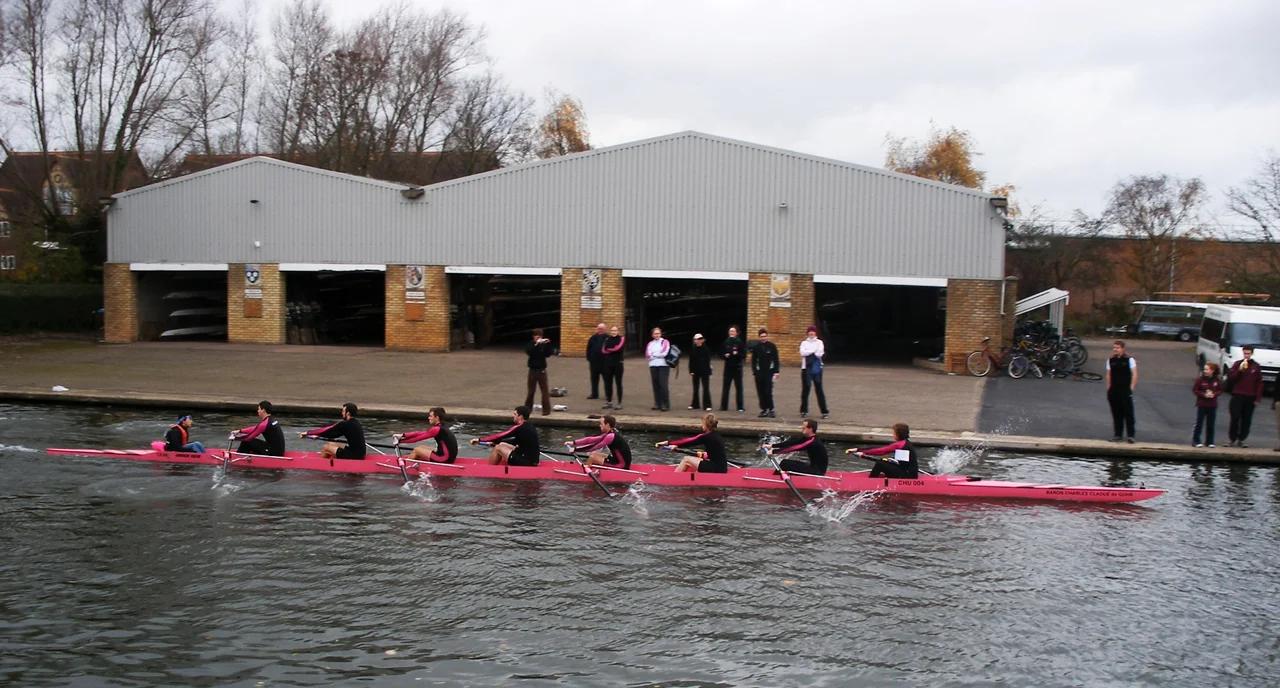

Churchill College, Cambridge
In 1955, shortly after resigning as Prime Minister for the second time, Winston Churchill was on holiday in Sicily when he raised an idea with two companions: Sir John Colville and Lord Cherwell. He had been impressed by the Massachusetts Institute of Technology in the United States and wanted a British equivalent — a science and technology institution that could produce the engineers and scientists Britain would need in the Cold War era. What emerged was more modest than MIT but, in its own way, more enduring: a new Cambridge college with science written into its founding statutes, on the largest area of grounds of any Cambridge college, bearing his name.
Built from Scratch
The site was purchased in 1958, previously undeveloped, on the western outskirts of Cambridge away from the ancient city centre. An architectural competition attracted 19 entrants. The firm of Richard Sheppard, Robson and Partners was selected from a shortlist of four, with Churchill himself sitting on the panel of judges. Sheppard's modernist campus — brown brick walls, pre-cast concrete lintels, teak-framed glazing, nine residential courts — was completed in 1968. It is resolutely of its moment: not trying to replicate the medieval courts of older colleges, but building something that looked like a research institution ought to look. The dining hall is the largest of any Cambridge college, seating up to 430 guests. In 1993, the central buildings and the chapel were separately granted Grade II listed heritage status.
The Chapel That Was Almost Not Built
Churchill College's relationship with religion was fraught from the start. When plans for the college were announced in 1958, the student newspaper Varsity declared the intended absence of a chapel "deplorable." The debate was public and heated. The eventual compromise is architecturally telling: an interdenominational chapel was built 500 yards from the main campus, funded and managed separately from the college itself, tactfully referred to as "the Chapel at Churchill College" rather than "the Chapel of Churchill College." Meanwhile, the heating system's chimney at the front of the college visually substitutes for the missing chapel tower that had appeared in Sheppard's original plans. The college motto is "Forward" — taken from the last words of Churchill's first speech to the House of Commons as Prime Minister: "Come, then, let us go forward together."
Science by Statute
Churchill's founding statutes require approximately 70 percent of students to study science, mathematics, or engineering. One third must be postgraduates. The college admits students in all subjects except land economy and theology, though switching to those subjects later is permitted. It was the first formerly all-male Cambridge college to admit women, welcoming female undergraduates in 1972 — one of three men's colleges to do so that year, with the rest following within fifteen years. The college has 16 hectares of grounds, including on-site sports facilities that most Cambridge colleges lack entirely. Churchill College Football Club was the first Cambridge college team to retain the University Amateur Football League Division 1 title, winning it in 2005–06 and 2006–07.
32 Nobel Prizes
Churchill College counts 32 Nobel Prize winners among its fellowship — nine in Physics, eight in Physiology and Medicine, seven in Economics, four in Chemistry, four in Literature. Among them: Francis Crick, co-discoverer of DNA's structure; Robert Edwards, who developed in-vitro fertilisation; Antony Hewish, who discovered pulsars; James Watson, also a DNA co-discoverer; Sir Winston Churchill himself, awarded the Nobel Prize in Literature in 1953. The Churchill Archives Centre on campus holds the official papers of former British Prime Ministers Winston Churchill and Margaret Thatcher. Bjarne Stroustrup, inventor of the programming language C++, studied here. Catherine Green, the biologist who worked on the Oxford-AstraZeneca COVID-19 vaccine, studied here. The list of people who have spent time at this campus, on these grounds, doing the work that was always the point, is quietly staggering.
From the Air
Churchill College occupies a 50-acre campus west of Cambridge city centre, at approximately 52.213°N, 0.104°E. From the air, it is distinguishable from older Cambridge colleges by its modernist brick-and-concrete layout with extensive green spaces between courts — quite different from the dense medieval fabric of central Cambridge. Cambridge Airport (EGSC) is about 3 miles to the east-northeast. At 2,000–3,000 feet the contrast between Churchill's open campus and the tightly woven historic city centre is clear. The Churchill Archives Centre building is identifiable on the western edge of the campus.
Nearby Stories
- Walden Abbey 4.6 km away
- Bury St Edmunds 5.5 km away
- RAF North Pickenham 8.1 km away
- Ampthill 9.5 km away
- RAF Wittering 10 km away
- Murder of Una Crown 12 km away
- Colchester Community Stadium 18 km away
- John Bunyan Museum 19 km away