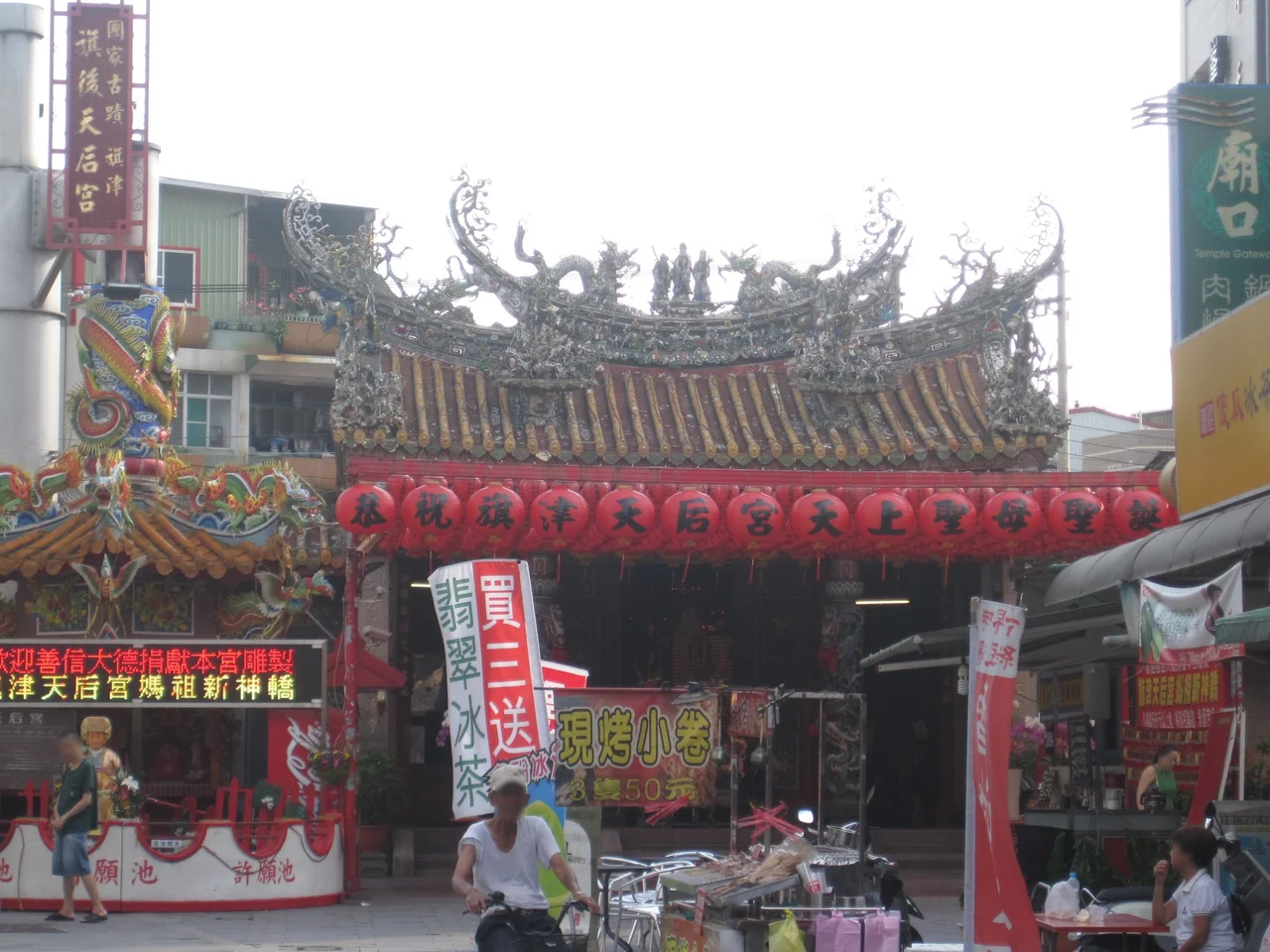

Cijin Tianhou Temple
The bell in the courtyard was cast in 1886. That fact alone gives some sense of the continuity this temple represents: the bell has been rung for morning prayers and evening closings across more than a century of Taiwanese history — through the Japanese colonial period, through World War II, through the transformation of Kaohsiung from a modest port to one of the largest container harbors in the world. The Cijin Tianhou Temple was already old when the bell was cast. It is Kaohsiung's oldest temple, established in the 17th century by Fujianese fishermen who brought with them, along with their nets and their boats, a statue of Mazu — the goddess who watches over those who work the sea.
The Fishermen's Goddess
Mazu — her formal name Lin Moniang — is the most widely venerated deity in the maritime communities of southern China and Taiwan. According to tradition she was born on Meizhou Island in Fujian Province in 960 CE and died young, after which she became a protective presence for sailors and fishermen who prayed to her in storms. Mazu worship traveled wherever Fujianese people settled along the coasts of Asia, and when fishermen under the leadership of Hsu Au-hua became among the earliest Chinese settlers on Cijin Island, they brought her with them. The temple they built to house her image was not an afterthought — it was the first thing, the anchor of a new community on an unfamiliar shore. For people who made their living from the sea, having the goddess of the sea properly housed and properly honored was as necessary as having good nets.
What the Building Tells You
The Cijin Tianhou Temple is built in the traditional southern Fujian style that defines classical religious architecture across Taiwan. Its roofline is the first thing to catch the eye: the swallow-tail ridges curve upward at their ends in a dramatic sweep, decorated with ceramic dragons arching over a figure of an immortal, flanked by representations of the Three Stars — the gods of Luck, Wealth, and Long Life. Two stone guardian lions, popularly called foo dogs, flank the entrance. Inside, the temple complex is connected by a pagoda, and the interior displays work completed by the master craftsman Chen Yu-feng, whose contributions gave much of the temple its current decorative character. The courtyard holds the 1886 bell. Every element of the building's design serves a purpose — spiritual, symbolic, and aesthetic — though the purposes have been accumulated across three centuries of renovation and embellishment.
The Island It Anchors
Cijin Island is a narrow strip of land running along the western edge of Kaohsiung Harbor. For most of its history it was a fishing community, its residents crossing the harbor channel daily to reach the city and returning by ferry in the evenings. The temple sat at the island's heart. As Kaohsiung grew — particularly after its port expanded dramatically in the 1960s and 1970s into one of Asia's major shipping hubs — Cijin's character began to shift, with seafood restaurants and tourist facilities joining the traditional fishing economy. The temple remained unchanged in that sense: a fixed point around which the island reorganized itself across the decades. It opens to visitors daily from 5:30 in the morning to 10 at night — hours that reflect its function for working people who pray before dawn and after dark.
Three and a Half Centuries
The Cijin Tianhou Temple dates to 1673, making it more than 350 years old. That span covers the Kingdom of Tungning under Koxinga's descendants, the Qing dynasty, Japanese rule from 1895 to 1945, and the Republic of China era to the present. Taiwanese temples often display remarkable continuity across these ruptures — their congregations rebuilding after damage, restoring after neglect, adapting festivals and practices without abandoning the core devotion. The Tianhou Temple has been renovated multiple times across its history, but the tradition it embodies is unbroken. Mazu has been honored on this spot by the fishing families of Cijin for longer than the United States has existed as a country.
A Living Place
To visit the Cijin Tianhou Temple is not to enter a museum. The incense burns. The gods receive daily attention. Worshippers come for personal petitions and community festivals, for the rituals that mark births, marriages, and deaths, for the Mazu processions that bring out the whole community. The smell of incense and the sound of chanting are immediate and present. Outside, the Cijin seafood street offers what the island has always offered visitors — fresh catches from the Taiwan Strait, grilled and fried and served at outdoor tables in the shadow of the temple district. The combination of ancient religious life and the ordinary pleasures of a coastal town is not a contradiction here. It is exactly what Cijin has always been.
From the Air
The Cijin Tianhou Temple is located at approximately 22.614°N, 120.269°E on Cijin Island (Cijin District), Kaohsiung. Cijin Island is the narrow strip running along the western side of Kaohsiung Harbor, clearly visible from the air. RCKH (Kaohsiung International Airport) lies approximately 7-8 kilometers to the northeast. At lower altitudes, the traditional temple rooflines with their curved swallow-tail ridges may be visible among the low-rise buildings of Cijin's historic core. The harbor channel separating Cijin from the mainland port facilities is a clear navigational reference.
Nearby Stories
- Taimali 7.2 km away
- Meinong East Gate Tower 15 km away
- Kunci Temple 20 km away
- Checheng Fu'an Temple 42 km away
- Dongji Island 49 km away
- Orchid Island 69 km away
- South Penghu Marine National Park 77 km away
- Hong Kong 12 549 km away