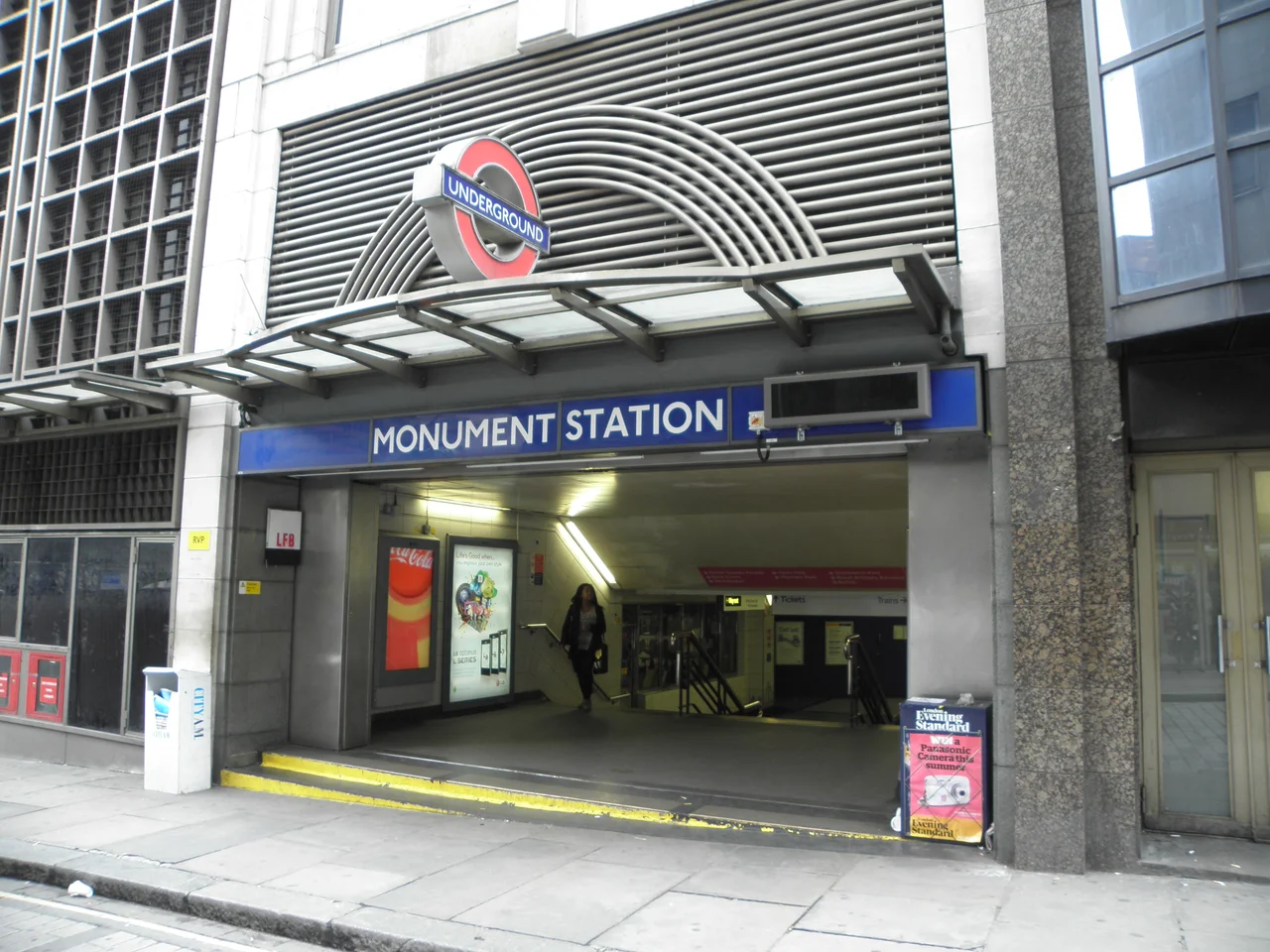

Circle line (London Underground)
For most of its life, the yellow line on the Tube map went round and round and round, never stopping, never beginning, an unbroken loop of central London stitched together from the wreckage of two warring railway companies. Then in December 2009, planners cut it. The Circle line stopped being a circle. Today it is a spiral, running from Hammersmith in west London out to Edgware Road, around the historic loop once, and back again. Most Londoners barely noticed the change. They were too busy doing what passengers have done on this railway since 10 January 1863: stepping out of the daylight, descending a few feet beneath the streets, and emerging somewhere else entirely.
The First Underground
The Circle line is the oldest underground railway in the world. When the Metropolitan Railway opened between Paddington and Farringdon on 10 January 1863, no city anywhere had tried this before. Wooden carriages pulled by steam locomotives ran through cut-and-cover tunnels just below the streets, connecting the Great Western terminus at Paddington with the financial heart of the City of London. The trip was sulphurous, smoky, terrifying, popular. Within months Parliament was looking at a select committee recommendation to extend the idea into an "inner circle" linking every London main-line station, and a second company, the Metropolitan District Railway, was formed to build the southern half. The route those two companies argued about, fought over, and finally completed on 6 October 1884 is the loop that still defines central London on the Tube map today.
Three Trains and a Chain
The relationship between the Metropolitan and the District Railways was less an alliance than a slow-motion fistfight. They shared track but loathed each other. Once the inner circle was finally joined up in 1884, the Metropolitan ran the clockwise "outer rail" trains and the District the anti-clockwise "inner rail," wearing the wheels and brakes asymmetrically and causing endless breakdowns. The petty rivalries got worse from there. In one famous incident the Metropolitan Railway dispatched three trains to forcibly remove District Railway carriages that the District had chained to a piece of disputed track. It took an act of Parliament to make the two of them cooperate enough to finish the route, and they were not properly united until 1933, when the Metropolitan, the District, and most of London's buses and trams were merged into the new London Passenger Transport Board.
Yerkes and the Electrification
The smoke could not last. By 1900, the new deep-level electric tubes were taking customers away from the sulphurous Circle, and the Metropolitan and District ran a joint experimental six-carriage electric train between Earl's Court and High Street Kensington. The arbitration that followed was won by an outsider: Charles Yerkes, an American financier who had electrified streetcars in Chicago and had come to London to do the same to its Underground. He formed the Underground Electric Railways of London and pushed direct current with third-rail pickup. On 24 September 1905, the Circle ran fully electric for the first time. The trains have been getting longer and quieter ever since: four cars, then five, then six in 1959, and finally the seven-car S7 Stock from Bombardier's Movia family that took over the line between 2012 and 2014.
7 July 2005
At 08:49 on 7 July 2005, a bomb detonated on a Circle line train as it pulled out of Liverpool Street toward Aldgate. Almost simultaneously, a second bomb exploded on another Circle line train at Edgware Road. A third blast struck a Piccadilly line train, and a fourth, an hour later, ripped apart a double-decker bus in Tavistock Square. Fifty-two people were killed in the four attacks, including thirteen on the two Circle line trains; the four suicide bombers also died. The Circle closed completely until 8 August. The trains came back. The commuters came back. A subdued memorial near King's Cross remembers the morning the most ordinary commute in London became the worst, and the names of the dead sit in plaques at the four blast sites. The Circle keeps running because, as the city decided that summer, the alternative is unthinkable.
Urban Myths
A line that runs in a closed loop attracts stories. Some Londoners still swear that a body once travelled the Circle for days before anyone noticed. Others claim that a small office or school once used the train itself as a kind of free conference room, riding round and round to save rent. The Independent newspaper once announced, on April Fool's Day, that the line was about to be repurposed as a circular particle accelerator coexisting with passenger services. None of these are true, but all of them feel like they could be, which is the test of a good London myth. The Circle today is a spiral, not a loop, the change made in December 2009 so trains could reverse at Edgware Road and improve reliability on the Hammersmith branch. Twenty-seven kilometres of track. Thirty-six stations. Over 141 million passenger journeys in 2019, shared with the Hammersmith and City line. A 162-year-old railway, still running.
From the Air
The Circle line traces a roughly oval loop through central London, with the loop centred near 51.50 N, 0.10 W. From the air, the line itself is invisible (almost all of it is cut-and-cover tunnel just below the streets), but the stations punctuate it: King's Cross St Pancras, Liverpool Street, Tower Hill, Westminster, Paddington. The Hammersmith spur runs on a 20-foot brick viaduct from Hammersmith to Westbourne Park, so from a westbound approach to EGLL (Heathrow) you can pick out the elevated track clearly. Nearest airports: London Heathrow (EGLL) about 12 nm west of central London, London City (EGLC) directly east. Best identified by the river bend, with the Thames Embankment loop running just inside the line.
Nearby Stories
- Battle of Britain, Northfleet 1.1 km away
- Bayham Old Abbey 5.4 km away
- Catharine Macaulay 6.4 km away
- Hatfield rail crash 8.8 km away
- Chequers 8.9 km away
- Chelmsford Cathedral 10 km away
- Queen Victoria Hospital 13 km away
- Fishbourne Roman Palace 36 km away