.jpg)
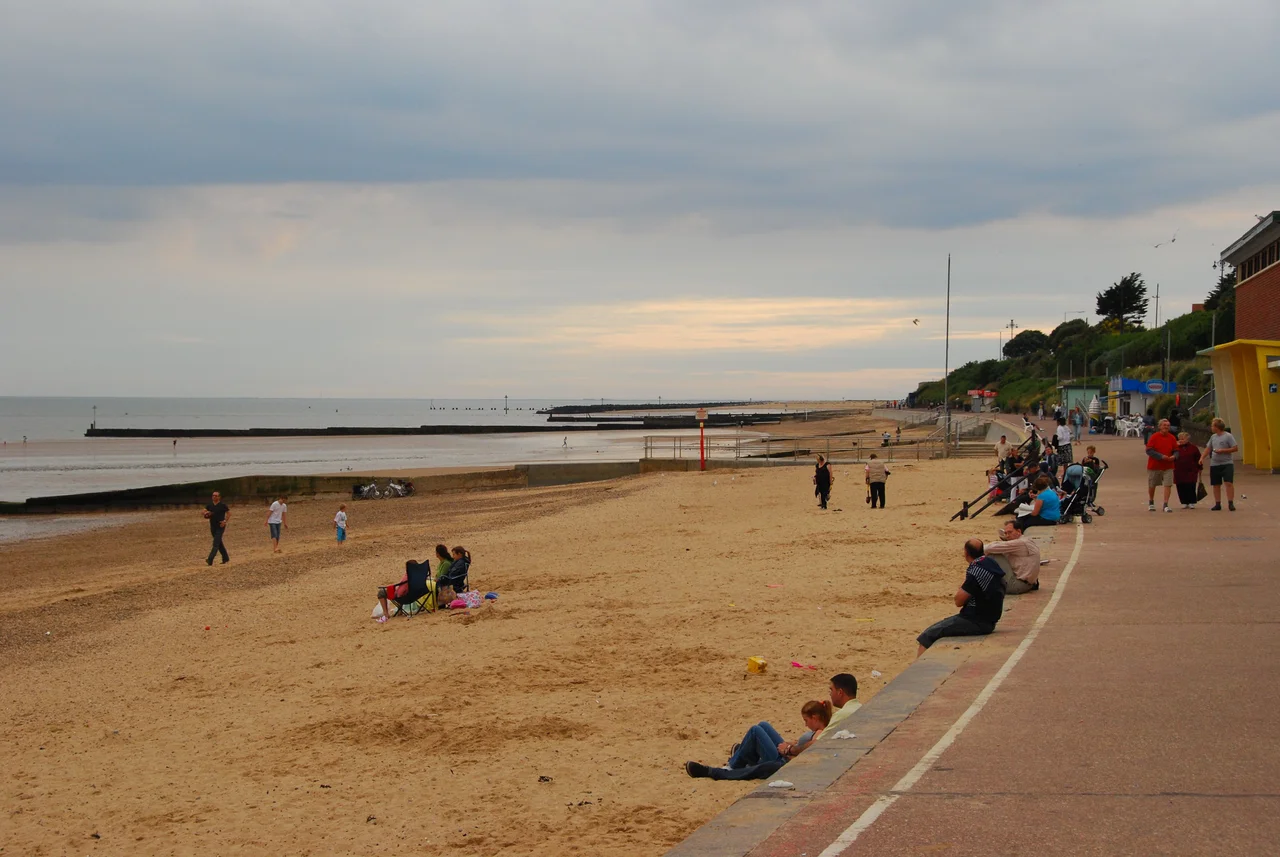
Clacton-on-Sea
In 1911, an amateur prehistorian named Samuel Hazzledine Warren, searching for stone tools at the cliff base, found a sharpened stick that everyone agreed had to be modern. It looked like a broken broom handle. It turned out to be around 420,000 years old - the world's oldest known wooden spear, carved from yew by Homo heidelbergensis when Britain still had a deciduous-forest climate and hippos in the Thames. The Clacton Spear is now in the Natural History Museum. Clacton sits, geologically and historically, on top of a deeper Britain than its candy-floss seafront suggests.
Bruff's Resort
The modern town began in 1865 when railway engineer Peter Bruff and a group of investors bought farmland on the gravelly low cliffs southeast of Great Clacton village and set out to build a new seaside resort from scratch. The pier came first, opening in 1871 - sixteen years before the railway arrived. Visitors stepped off steamships onto a wooden platform 160 yards long and walked into a town that did not yet exist. Streets were laid out piecemeal as plots were sold. Pier Avenue, originally called Electric Parade, became the grand boulevard. By 1882 the railway from Thorpe-le-Soken finally reached town, and Clacton was open for the working-class day-trippers of Essex and the East End. By 1914 there were 10,000 residents. By 1939, 20,000.
Bombs, Mines, and a V-2
Four wartime incidents stand out. Early in the war a German airman bailed out over the town and was, briefly, treated as a celebrity guest by the town council before being handed over to the military. On 30 April 1940 a Heinkel He 111 bomber crashed into Vista Road, one of its magnetic mines detonating on impact. The crew died. Two civilians died. Navy specialists defused the second mine. In 1941 bombs flattened Wagstaff Corner. Late in the war a V-2 rocket hit in front of the Tower Hotel, injuring dozens of troops billeted there. Clacton lay directly beneath the route taken by V-1 flying bombs and V-2s aimed at London - a flightpath of unwanted visitors at terminal velocity.
Butlin's, Mods, and Pirate Radio
Billy Butlin opened his second holiday camp here on 11 June 1938. The army took it over during the war for use as an internment and training camp, then handed it back, and Butlin's reopened. For three decades Clacton was the summer destination of choice for working-class Londoners. On Easter 1964, rival Mods and Rockers descended on the seafront and fought each other into the national press, sparking what sociologist Stanley Cohen would later call a moral panic. Offshore, the pirate radio ship MV Galaxy broadcast Wonderful Radio London from 1964 until forced closure in 1967. By the 1970s cheap flights to Spain drained the holiday trade. Butlin's closed in 1983. The town is now better known for its economic struggles - Jaywick, the chalet settlement at Clacton's western edge, is frequently named the most deprived ward in England.
The Cliff and the Sea
Clacton has comparatively few architecturally distinguished buildings. The Odeon Cinema, palatial art-deco, was demolished. So were the Warwick Castle Pub, the Waverley Hotel, and Barker House. What survives is more humble: St John's Church in Great Clacton with Norman work from the 12th century, three Martello Towers from 1809-1812 with the distinctive rounded-triangle plan designed to deflect cannon fire, the neo-Georgian railway station of 1929 with decorative fasces by the doors, and a 1400s house called Moot Hall that was dismantled in Suffolk and rebuilt here in 1911. The Blue Flag beach at Martello Bay remains popular. The pier is now a heavy-spinning amusement arcade with a 50-foot helter-skelter, and the Paddle Steamer Waverley still calls in summer.
Wind on the Sea, Politics on the Pier
Offshore, the 48-turbine Gunfleet Sands wind farm has been spinning since 2010, visible from the flat Essex hinterland on clear days. In 2024 Clacton elected Nigel Farage of Reform UK to Parliament. The town that voted heavily for Brexit, that has hosted Mods, Rockers, pirate broadcasters, V-2 rockets, and a 400,000-year-old yew spear, continues to send its strongest political signals from the same exposed coast. Stand at the end of the pier in winter and the North Sea stretches gray to the horizon, broken only by the slow turn of wind turbines and the lights of distant container ships heading for Felixstowe.
From the Air
Clacton-on-Sea lies at 51.79 N, 1.15 E on the Essex North Sea coast, about 77 miles northeast of London. Visual cues from altitude: the prominent pier extending into the sea, the Gunfleet Sands wind farm 3-7 nautical miles offshore to the south-east, and the cliffs of The Naze rising to the north. Nearest airports: Stansted (EGSS) 45 miles west, Southend (EGMC) 30 miles south-southwest, Cambridge (EGSC) 70 miles west-northwest. The Sunshine Coast Line terminates at Clacton-on-Sea railway station. Clacton Airfield (private) is north of town.
Nearby Stories
- Ipswich Transport Museum 2.5 km away
- Beeleigh Abbey 4.3 km away
- Clare Priory 9.7 km away
- Cooling Castle 14 km away
- Margate Surfboat 15 km away
- 1382 Dover Straits Earthquake 25 km away
- Four Days' Battle 44 km away
- Southern Bight 75 km away