
Clandeboye
The name in Irish is Clann Aodha Buí - 'family of Hugh the Blond' - and for two and a half centuries it belonged to a kingdom that doesn't appear on modern maps. Its territory ran from the Glens of Antrim down through what is now Belfast and on into north County Down, with a western enclave reaching into the Sperrins. It produced its own kings, fought its own wars, kept its own bishops, and was finally undone not by a battle but by a contract signed by a man so deep in his cups he may not have known what he was signing. The kingdom died. The name survives - in a Bangor electoral ward, in an estate, in the title 'Baron Dufferin and Claneboye,' and in the patient genealogies of a family still claiming the kingship from a villa near Lisbon.
How a Kingdom Begins
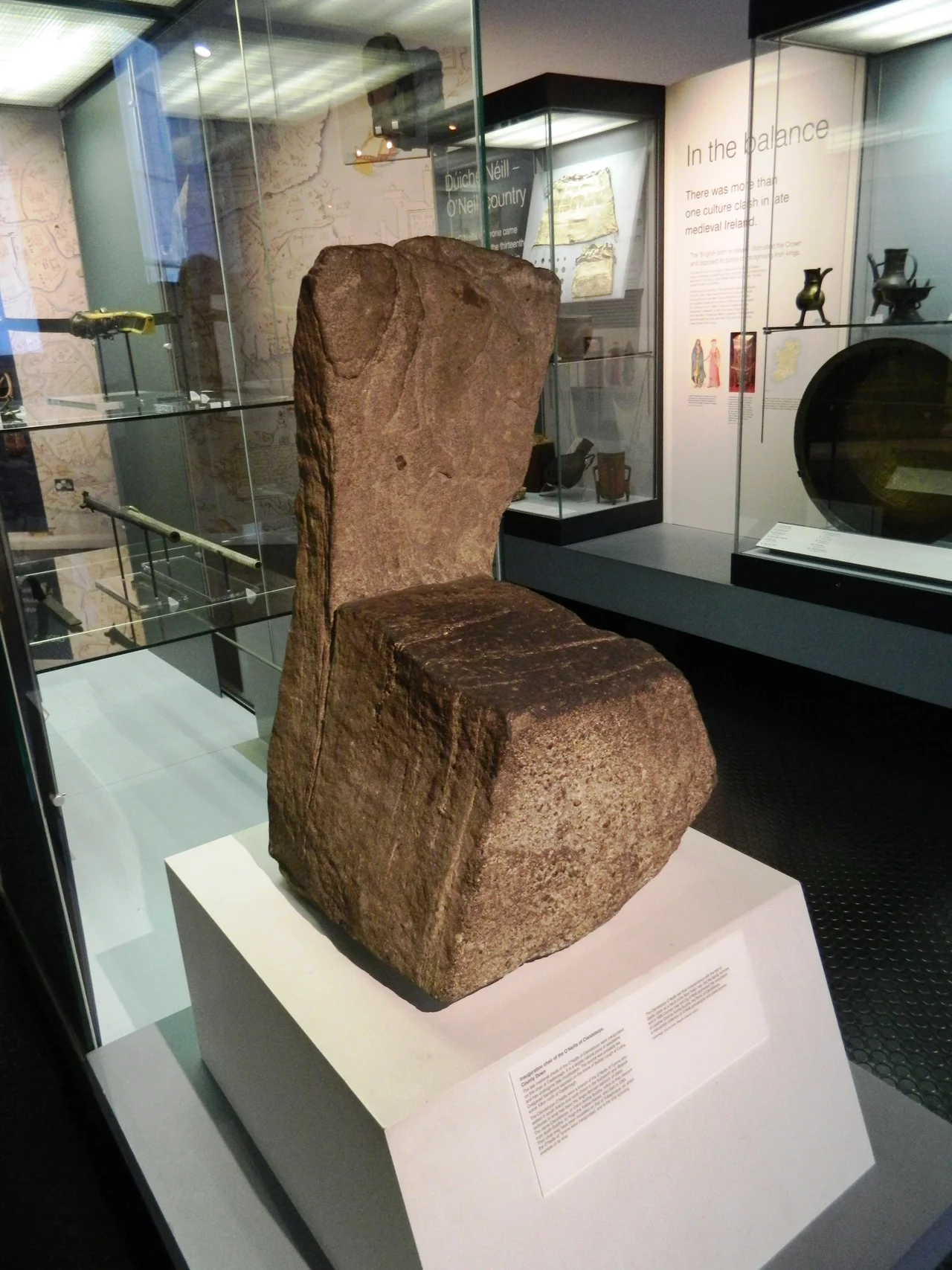
Clandeboye was a child of decline. In the late 14th century the Anglo-Norman Earldom of Ulster, which had occupied north-eastern Ireland for two centuries, was crumbling. A junior branch of the great O'Neill dynasty of Tyrone - descendants of Aodh Buidhe O'Neill, 'Hugh the Blond,' a 13th-century king of Tyrone - saw the vacuum and walked into it. By 1347 Muirchertach Ceannfada O'Neill held the title King of Clandeboye without holding the title King of Tyrone, the first time the two had been separated. Most of the new kingdom lay east of the River Bann, cattle country well suited to the wealth-on-the-hoof economy of medieval Gaelic Ireland. The seats of power were Castlereagh, on a hill overlooking modern Belfast, and Shane's Castle on the shore of Lough Neagh. The kings were inaugurated on a stone chair that still survives in the Ulster Museum.
The Long Decline
By the early 16th century the kingdom had divided in two - Upper Clandeboye and Lower Clandeboye - after the death of the last unified king, Murtagh Dulenagh O'Neill, and the squabbles of his nephews. Tudor pressure made things worse. Henry VIII offered Gaelic lords a deal called surrender and regrant: hand over your traditional title and you can have it back as an English peerage, provided you anglicise, attend the Anglican church, and swear loyalty to the Crown. Some O'Neills took the deal. Others fought it. In 1573 Queen Elizabeth I gave a chunk of Clandeboye to an English speculator named Thomas Smith, who shipped 800 colonists across from Liverpool - the first attempt at what would become the Plantation of Ulster. Smith's son was shot dead by an Irishman he had hired as a labourer within months of landing. The colony collapsed. But the precedent had been set.
Conn O'Neill's Bad Night
The end came not in a battle but at a tavern. Conn O'Neill, the last head of the Upper Clandeboye O'Neills, was arrested around 1602 after some of his men attacked English soldiers near Belfast - the immediate cause was, allegedly, his having sent servants to fetch wine. He was held in Carrickfergus Castle facing a treason charge. Two Scottish adventurers - James Hamilton and Hugh Montgomery - arranged his escape and a royal pardon from the new king, James VI of Scotland and I of England, on one condition: that Conn sign away two-thirds of his land to them. He signed. The pardon came through in 1605. Conn kept a third of what he had owned, was steadily relieved of that too, and died in poverty in 1618. Hamilton became the first Viscount Claneboye in 1622. Montgomery became the first Viscount Montgomery of the Great Ardes. Between them they began settling their new estates with Lowland Scots from Ayrshire, founding the community now known as the Ulster Scots.
The Princes in Exile
The senior O'Neill bloodline did not die out. Felix O'Neill, great-grandson of one of the last Clandeboye kings, fought in the Jacobite Irish Army and then in the Irish Brigade of the French Army - one of the Wild Geese, the Catholic Irish officers who served Catholic Europe after Williamite victory closed Ireland to them. Felix's grandson João emigrated to Portugal in the 18th century and settled near Almada, across the Tagus from Lisbon. The family prospered. One descendant became a Viscount of Portugal. In 1896 another, Jorge Torlades O'Neill II - a friend of Roger Casement and a quiet patron of the Gaelic League - filed his pedigree with the Somerset Herald in London, and the Office of Arms recognised him as the only living descendant of the Princes of Tyrone and Clanaboy. Pope Leo XIII, the King of Spain, and the King of Portugal all confirmed the claim. The current representative, Hugo Ricciardi O'Neill, was born in 1939 and still lives in Portugal.
What's Left to See
The kingdom is gone but its outline survives in the topography. Castlereagh, where the kings were inaugurated, is now a suburb of east Belfast - a hill, a council district, a name on signposts. Shane's Castle stands roofless and ivy-covered above Lough Neagh, still owned by the senior Lower Clandeboye descendants, the O'Neill barons of Shane's Castle. Bangor Abbey, the great Gaelic monastery that once lay within Clandeboye and trained missionaries who carried Christianity across post-Roman Europe, survives in fragments next to its medieval graveyard. The Clandeboye Estate near Bangor, gifted to the Hamilton heirs and still in their family, includes a private lake and one of Northern Ireland's finest woodlands. Driving the back roads of Antrim and Down, you cross and recross the lost kingdom without noticing. That, in its way, is the most Gaelic kind of ending: not erasure but absorption.
From the Air
Located at 54.64°N, 5.72°W, the historical Clandeboye Estate sits between Bangor and Newtownards in north County Down, roughly 8 miles east of Belfast. The wider kingdom once covered a sweep of south Antrim and north Down running from Lough Neagh in the west to the Ards Peninsula in the east. From the air, look for the wooded estate grounds of Clandeboye - a dark green block of mature deciduous woodland between Bangor and the A2 - and northward for Belfast Lough opening out toward the Irish Sea. Castlereagh, the old royal inauguration site, is the high ground south-east of central Belfast. Belfast City Airport (EGAC) is 6 nautical miles west; Belfast International (EGAA) is 17 nautical miles west-northwest. Recommended viewing altitude: 3,000-6,000 feet for the rolling drumlin landscape that defined the old kingdom.
Nearby Stories
- Larne 1.2 km away
- Ahoghill 3.5 km away
- Castleskreen 4.9 km away
- Lough Neagh 6.1 km away
- Kingsmill Massacre 14 km away
- Pasages (steam trawler) 23 km away
- Ballantrae Lifeboat Station 34 km away
- St Patrick's Isle 39 km away