
Cliffoney
In November 1915, a Catholic curate in a small County Sligo village walked his parishioners into the Irish Republican Brotherhood. Forty men joined what became the Cliffoney Company of the Irish Volunteers. They took over the old Boys' School Lord Palmerston had built and renamed it after their priest. The drill hall sat directly across the street from the Royal Irish Constabulary barracks. On Saint Patrick's Day 1916, fifty Volunteers in uniform paraded past the windows of the men who would soon be hunting them.
The Republican Priest
Father Michael O'Flanagan arrived in Cliffoney with strong nationalist, socialist, and republican ideals already burning. The Bishop of Elphin had likely sent him here as punishment for his support of the 1913 Sligo Dock Strike. The village turned out to be the wrong place to exile a troublemaker. O'Flanagan secured the old schoolhouse from Colonel Ashley of Classiebawn Castle as a community hall. He led villagers against the Congested Districts Board, demanding turf-cutting rights on the Cloonerco Bogs. The action began on 29 June 1915 and became known as the Cloonerco Bog Fight. Through that summer, villagers harvested turf in defiance and distributed it across the locality. Eventually the case was settled in their favour. When the Bishop tried to remove O'Flanagan later that year, the whole village united in protest, closing the church for ten weeks until Christmas Eve.
Easter Monday at Daybreak
The Cliffoney Volunteers had their orders: march on Sligo, capturing R.I.C. barracks along the route. In the early hours of Easter Monday 1916, sixty of them mobilized, including the Fianna boys. They waited at the break of day, ready to advance. A messenger arrived instead, carrying Eoin MacNeill's countermanding order from Dublin. Stand down. They held position for over a week, hoping the rising would continue. When the Dublin surrender came, the hope ended. On Sunday, April 30th, the day after the surrender, they paraded one more time in Cliffony. No arms were carried. Four years later, after the Moneygold ambush of 1920, the reprisals came. The Black and Tans burned ten cottages along the main road, all belonging to Sinn Féin members. They torched the Fr. O'Flanagan Sinn Féin Hall and painted across the front: 'Vacated Home of Murder Gang.'
Stones Older Than Empires
The longest history in Cliffoney has nothing to do with British prime ministers or Catholic curates. Five megalithic tombs cluster around the village in the townlands of Creevykeel, Creevymore, and Cartronplank. The Creevykeel Court Tomb, excavated by the Harvard Archaeological Mission in 1935, is considered one of the finest in Ireland. Older still, perhaps: Saint Brigit's Well sits within a forty-meter ringfort just outside the village. Beside the well, a cross-slab carved sometime in the eighth century carries a swastika at the top of the cross, an ancient solar symbol used long before the twentieth century corrupted it. An annual cattle fair was held here every February 1st until well into modern memory.
Palmerston's Inheritance
Henry John Temple, the future 3rd Viscount Palmerston and one of the most powerful prime ministers Britain would ever produce, first laid eyes on his County Sligo estates in 1808. He found ten thousand acres of destitution. His father had been an absentee landlord who, by one account, gave generously to local charities in Romsey but never invested a penny in his Irish tenants. The son was different, at least at first. He built schools, renovated the old Market House into the Cliffoney Inn, and started drainage projects. He also built the R.I.C. barracks in 1842, after surveyors in his employ were beaten up by locals angry about land reorganization. The barracks would still be there a lifetime later, watching Father O'Flanagan's volunteers drill across the road.
What Stays
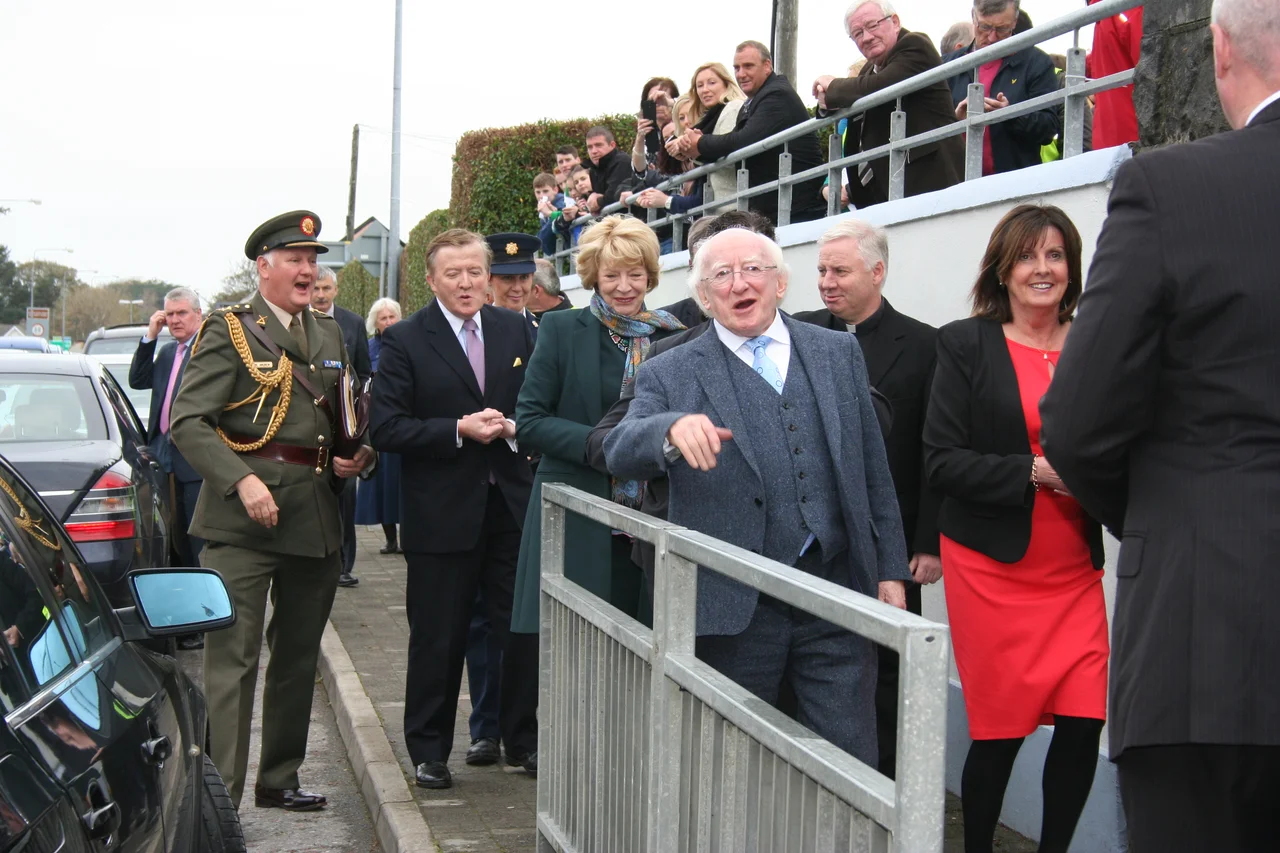
In October 2014, President Michael D. Higgins came to Cliffoney to mark the centenary of the National School. He spoke about Yeats, about Classiebawn Castle three kilometres up the road at Mullaghmore, about the school's century of children. The Garda station closed in 2013. The community took the building over the following year. In 2024, a men's shed opened on the site. Brigid MacGonigal, mother of the great stained glass artist Harry Clarke, was born here. So was the gunfire of a Republican parish and the cattle fair at Saint Brigit's well. Cliffoney holds layers, and most of them are still legible if you know where to look.
From the Air
Located at 54.43°N, 8.45°W on the N15 in North Sligo, three kilometres from Mullaghmore Peninsula. Best viewed at 2,500-4,000 feet to catch the coastal context: Atlantic to the west, Benbulben rising to the southeast. Nearest airport is Sligo (EISG), 25 km south; Donegal (EIDL) is 35 km northwest. Watch for Atlantic weather rolling in fast; visibility can collapse without warning along this coast.
Nearby Stories
- Roman Catholic Diocese of Killala 3.2 km away
- County Leitrim 6.2 km away
- Glencolmcille 8.3 km away
- Ballymote 8.5 km away
- Caves of the Tullybrack and Belmore Hills 15 km away
- Ballycastle, County Mayo 20 km away
- Castlederg 32 km away
- RMS Empress of Britain (1930) 80 km away