
Cloppenburg Museum Village
On 13 April 1945, artillery fire destroyed six houses inside the Cloppenburg Museum Village, including the Quatmannshof farm. The museum had only existed since 1934, but it was already the oldest museum village in Germany — a collection of historic farmhouses, windmills, and workshops painstakingly disassembled from their original sites across Lower Saxony and rebuilt on a single site as a living catalog of rural building traditions. The shells did not care. By 1962, the Quatmannshof had been rebuilt in faithful detail to its original construction. Restoration is, in some ways, what this museum has always done. Its purpose is to take buildings that no longer have a place in modern farming and give them somewhere to keep standing, so that the carpentry techniques, the brewing rooms, the horse mills, the wheelwrights' homes do not vanish entirely from local memory.
A Catalog of Old Country Crafts
The collection reads like a roll call of trades that have either disappeared or contracted to specialty status: a wheelwright's home from 1564 — once construction is complete, the oldest building on the museum site — plus a leather shoemaker's, a clog maker's, a joiner's workshop, a carpenter's, a brewery, a cooper's, a blue printing works, a saddlery, a pottery, a goldsmith's, and a silversmith's. Each building is not just a husk but an active demonstration space. Craftsmen on staff use the original tools, and the scientific team — three permanent researchers supported by volunteers and project partners — investigates each new acquisition as a historical document in its own right. The aim is to display as complete a range as possible of pre-industrial Lower Saxon country crafts and the tools and equipment they used. The catalog grows every few years.
Four Mills and Their Stories
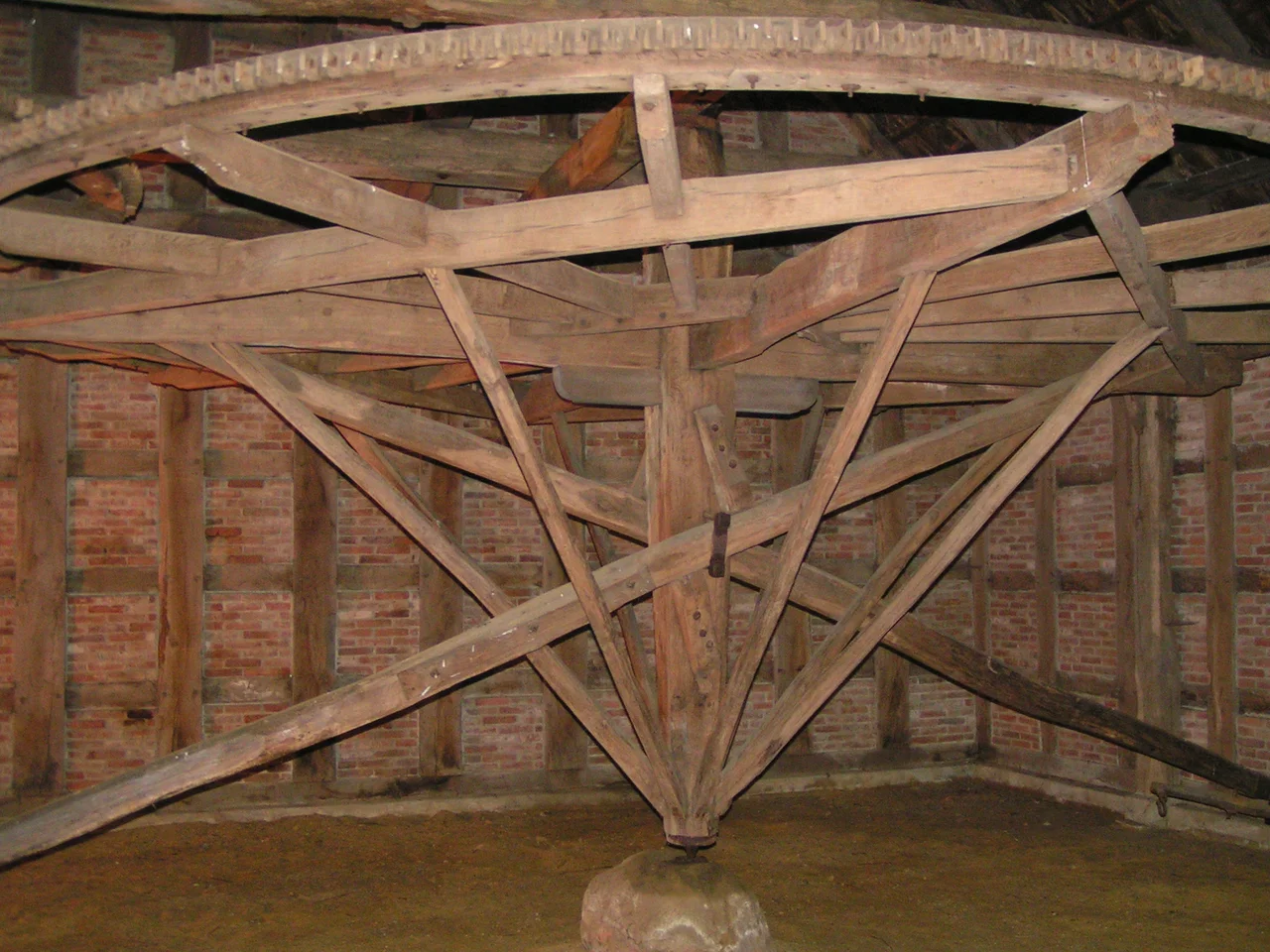
Since 2008 the museum has been a stop on the Lower Saxon Mill Road, and four working mills survive on the site. A post mill, the Bockwindmühle from Essern in the Nienburg district, was probably built around 1638. A smock mill from Bokel in the Cloppenburg district dates to 1764. A Koker windmill from Edewecht in the Ammerland district was built in 1879, originally designed as a water-scoop mill for draining low ground. And a horse mill from Mimmelage in the Osnabrück district, built sometime between 1850 and 1890, sits in the threshing barn of the Wehlburg farmstead from 1868. That horse mill — a wooden mill in which a horse walking in a circle turned the gears that ground the grain — is the last preserved horse gin of its kind in all of Lower Saxony. To stand next to it is to look at the energy economy of an entire region, just before electricity arrived to replace it.
The Meteorite and the Münchhausen Barn
Two unexpected exhibits anchor the collections. The Oldenburg meteorite — specifically the Bissel fragment, weighing 4.84 kilograms — is kept at the museum. It fell on 10 September 1930, breaking up over the villages of Bissel in the parish of Großenkneten and Beverbruch in the parish of Garrel, and is one of the relatively few documented meteorite falls in northern Germany. The Münchhausen Barn (Münchhausenscheune) and Arkenstede Castle (Burg Arkenstede), both on the museum grounds, host a rotating program of special exhibitions, which is where the museum stages its more focused historical work. Since 2002 the village has hosted an annual garden festival between Ascension and the Sunday before Pentecost, drawing visitors who come less for the artillery-rebuilt farmhouses than for the carefully kept old gardens between them.
The 1934 Question
The museum opened in 1934, and that date raises a fair question. Was the Cloppenburg Museum Village a Nazi blood-and-soil project, of a piece with the regime's mythology of peasant authenticity and racial rootedness? The honest answer is more complicated than yes or no. The misperception has been compounded by a confusing abbreviation — one educational website labeled museum staff under Cloppenburg Museum Village (NS), where NS stood for Niedersachsen, Lower Saxony, not Nationalsozialismus. The actual roots of the project lie in the German Heimat movement that began around 1880, a reaction to urbanization and the wish of many towns to preserve some memory of their agricultural origins. The Ammerland farmhouse in Bad Zwischenahn opened in 1910; the Rauchkate in Neuenburg followed in 1912; a local history museum opened in Cloppenburg itself in 1922. When the Nazi regime took power, it absolutely did try to ideologize folklore — but the Cloppenburg Museum Village never became a Nazi cult site like the Stedingsehre project at Bookholzberg, which had Gauleiter Carl Röver's active patronage. Staff today engage rather pointedly with the history. When visitors raise old Nazi-era theories — like the claim that the carved horses' heads on Lower Saxon hall houses are relics of pre-Christian horse sacrifices — the museum can explain why historians have rejected the idea, and why the regime found it convenient. The museum tells history honestly, including the parts about itself.
From the Air
The Cloppenburg Museum Village lies at 52.849 N, 8.051 E on the eastern edge of the town of Cloppenburg in the district of the same name. From altitude look for a wooded park-like enclosure of distinct buildings — windmills are the most identifiable from the air — set just southeast of Cloppenburg's town center. The surrounding country is the flat agricultural plain of the Oldenburger Münsterland. Nearest airports: Bremen (EDDW) about 60 km northeast, Münster Osnabrück (EDDG) about 75 km south, Oldenburg-Hatten (EDWH) about 40 km north. Light aircraft can use Damme (EDWC) about 30 km east. Best visibility is summer mornings; the windmill silhouettes are diagnostic.
Nearby Stories
- Meyer Werft 1.8 km away
- Siege of Lingen (1597) 5.9 km away
- Lathen train collision 6.2 km away
- Alfsee 9 km away
- Bad Zwischenahn 13 km away
- Valentin submarine pens 15 km away
- Alexander von Humboldt 37 km away
- Minden 44 km away