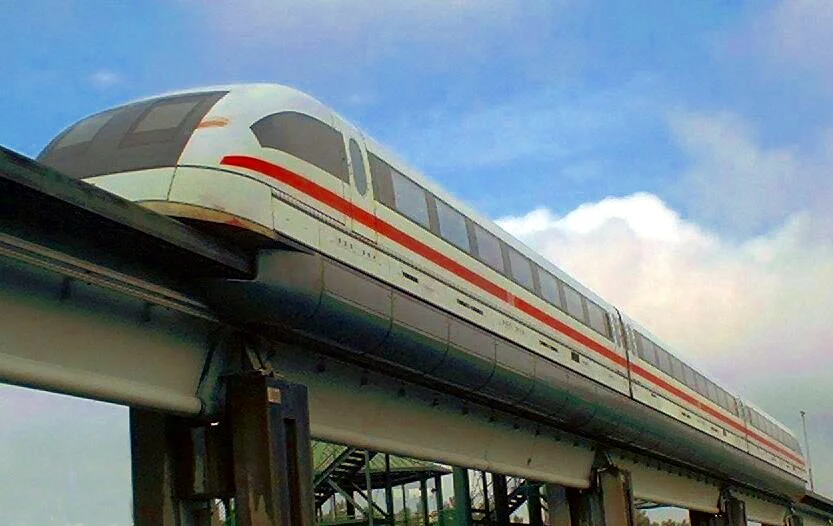

Lathen train collision
On the morning of 22 September 2006, two men in a diesel maintenance vehicle were finishing their round on the elevated guideway north of Lathen. Every morning they drove the length of the Emsland test track clearing off the leaves and grit that a night in this flat, wet corner of Lower Saxony leaves behind. When the work was done, they radioed for clearance to come off the line. Nothing came back. What they had no way of knowing was that the day's demonstration run had been brought forward by half an hour, that the control room had already energised the track, and that the Transrapid 08 - a train with no wheels, riding on a magnetic field, with a full load of guests aboard - was accelerating toward them.
The Line That Went Nowhere
West Germany built the Emsland test facility to prove a technology that felt, for three decades, permanently just about to arrive. Maglev trains float on magnetic fields and touch nothing; the Transrapid was Germany's entry, developed jointly by Siemens and ThyssenKrupp. The track ran 31.8 kilometres from Lathen north to Dörpen, with a turning loop at each end and a depot siding near the southern one, and it was designed for speeds up to 450 km/h.
Because it was a test line rather than a railway, it kept test-line habits. The Transrapid 08 was still on trial runs, but it regularly carried people: engineers, officials, and invited guests who wanted to feel what four hundred kilometres an hour feels like when nothing is touching the ground. It was, quite literally, a ride on the future, and Germany was proud to hand out the tickets.
Nine Fifty-Three
The maintenance vehicle weighed sixty tonnes and ran on rubber tyres along the top of the concrete beam. The Transrapid left the station at 09:43. At 09:52 the line dispatchers energised the track. At 09:53 the train began to move. At 09:53:57 emergency braking was applied - and roughly half a second and twenty-five metres later, the train reached the maintenance vehicle at 162 km/h.
A maglev has no wheels to lock and no friction brakes to stand on. The Transrapid's low, aerodynamic nose went under the maintenance vehicle, and the vehicle tore the roof off the passenger section as the train drove beneath it. The wreckage carried on for another three hundred metres along the beam before it stopped. Twenty-three people were killed. Eleven survived, ten of them severely hurt.
Four Metres Above the Fields
The guideway runs about four metres above the surrounding farmland, which made the rescue a problem of height before it was anything else. Firefighters arrived with turntable ladders and aerial platforms and worked from the tops of them.
Three people were found only because someone below heard knocking from inside the wreck; crews removed a floor panel and brought them out. Two engineers had been sitting in the rear section, which held its shape better than the front, and lived. Three more were cut free later from what was left of the carriage. The two men from the maintenance vehicle survived because they had been at the far end of it from the impact. Nobody who was on that stretch of guideway escaped unhurt.
Who Was on Board
The people who died were not commuters on a journey. They were there because somebody had thought they should see this. Among them were staff from the Transrapid programme itself, workers from a local nursing care company, employees of the utility RWE, and visitors from firms associated with the project - the kind of group a proud engineering organisation invites out on a Friday morning. The nursing home staff and the RWE workers were local Emsland people, on an outing to the thing their region was famous for.
Some of the dead had spent their working lives on magnetic levitation. Wu Xiangming, who ran the Shanghai maglev - the only Transrapid system anywhere in commercial service - travelled to the site. So did the German transport minister, Wolfgang Tiefensee, who called the failings major and asked publicly whether the safety measures on the test track had been adequate, and whether they had actually been applied.
The Verdict and the Stone
Nothing was wrong with the magnets. The maintenance vehicle should have been confirmed clear of the line before the run was released, and it was not. "This accident would not have been possible if all regulations were adhered to," said Rudolf Schwarz of IABG, the company operating the track. Prosecutors pulled the radio transcripts. Two line dispatchers were tried and convicted, one receiving a year and six months and the other a year; both sentences were suspended, the court citing the men's exceptional remorse, their own lasting mental injury, and their retirement. They accepted the verdicts immediately.
A year after the crash a memorial stone was set up at the site, with a steel panel stamped with twenty-three small crosses. The Transrapid never entered passenger service in Germany. The Emsland facility's operating licence expired at the end of 2011 and the line was shut, but demolition has barely begun - the empty concrete guideway still runs north across the fields, four metres up, carrying nothing at all.
From the Air
The crash site is at 52.87 degrees N, 7.35 degrees E, on the elevated Transrapid guideway between Lathen and Dörpen in the Emsland district of Lower Saxony, close to the Dutch border. From the air the disused guideway is unmistakable: a slender, dead-straight concrete beam raised above flat farmland, running roughly north-south for over thirty kilometres with a large turning loop at each end. The Ems river and the Dortmund-Ems Canal run parallel to the west. Nearest airfields are Leer-Papenburg (EDWF) about 45 km north and Klausheide / Nordhorn-Lingen (EDWN) about 48 km south; Groningen Eelde (EHGG) is roughly 60 km northwest. Best viewing altitude 2,000-4,000 feet. The terrain is uniformly flat, so the elevated beam and its loops read clearly even in moderate haze.
Nearby Stories
- Museum de Oude Wolden 4.3 km away
- 1977 Dutch Train Hijacking 4.8 km away
- Westerbork 5.6 km away
- Wietmarschen 5.8 km away
- Vriezenveen 17 km away
- Cloppenburg (district) 18 km away
- Alfsee 18 km away
- Bad Zwischenahn 21 km away