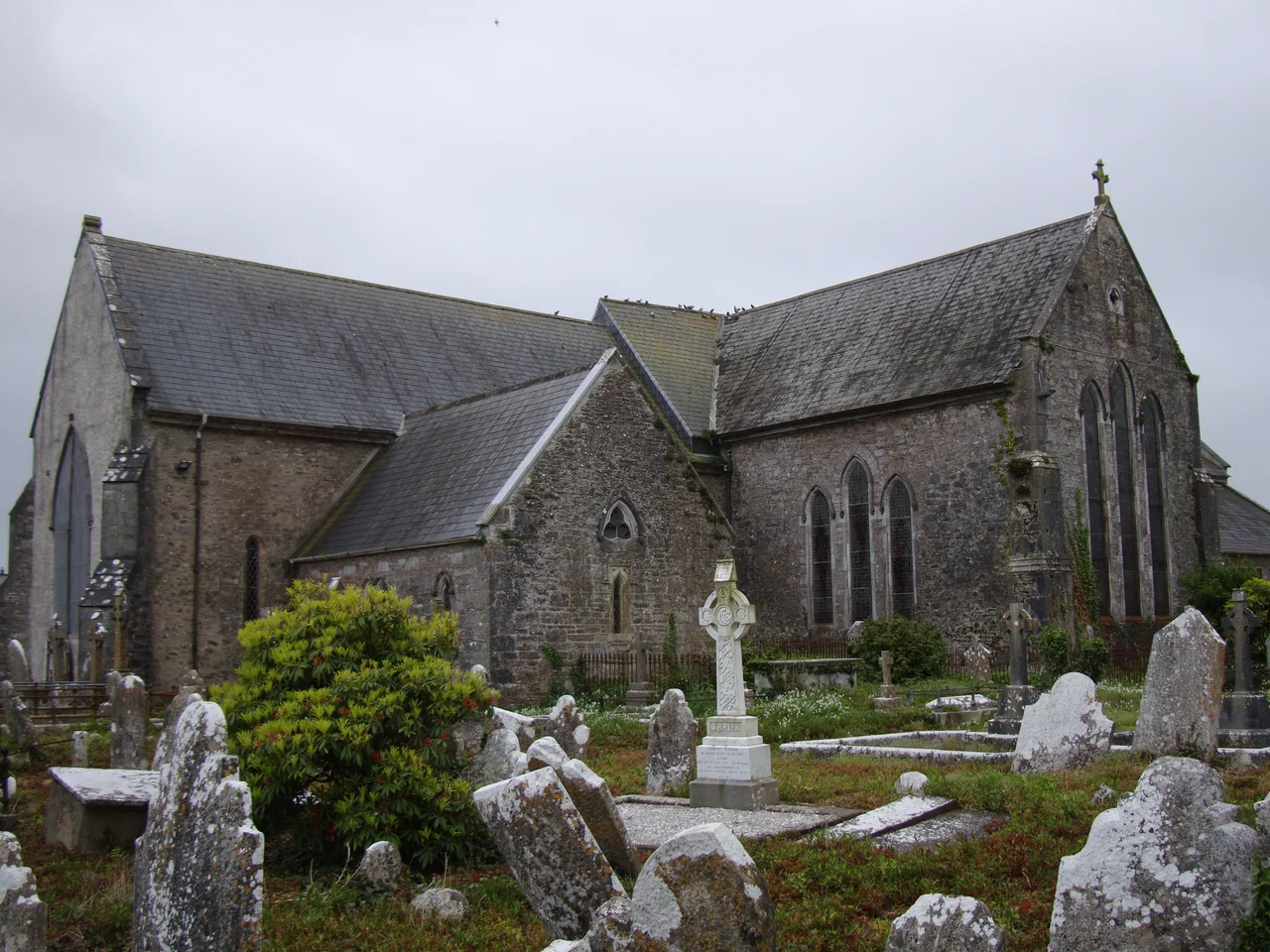

Cloyne Cathedral
Carved into the floor of the nave at Cloyne Cathedral is a horseshoe. It marks the grave of a girl named Mary Smyth, who died in 1675, and the horseshoe is the symbol of her father's trade - a smith, or farrier. But the locals had a different story about that mark on the floor. They called it the devil's footprint, and they said Satan had left it there one black night before fleeing the cathedral. The cathedral itself sits at a crossroads of those kinds of stories: a 6th-century monastic foundation, a 13th-century stone shell, an Irish philosopher who gave his name to a Californian city, and a round tower across the road struck by lightning in 1749.
Colman's Meadow
St Colman of Cloyne founded a monastery here in 560 AD. The land was donated by Coirpre Cromm mac Crimthainn, the King of Munster - the kind of royal grant that anchored the early Irish church to particular places and particular kings. The name Cloyne means 'meadow of the caves,' a reference to the limestone karst that still riddles the ground beneath the town. The monastery and its school became one of the more important religious centres of southern Ireland. A series of churches were built on the same site over the following seven centuries. The present cathedral - the stone bones of what you see today - dates from between 1250 and the 1270s. A small building on the grounds called the Fire House may once have been an oratory, or it may have housed a female religious order tasked with keeping a fire continuously burning, in the older Irish tradition.
The Devil's Footprint
During the 1641 Irish Rebellion, the cathedral was damaged and then repaired the following year. The 17th-century records preserve some unexpectedly human moments. There is Mary Smyth's grave in the nave, marked with the horseshoe that local legend would eventually reassign to the devil. There is the choir, rebuilt and enlarged in the same century. When the cross wall of the choir was removed in 1776, workmen found a row of graves beneath the foundations - brick coffins moulded to the shapes of the bodies inside them, a burial method as practical as it was unsettling to find centuries later. Cloyne kept revealing its earlier selves whenever it was renovated.
A Hurricane on Shrove Tuesday
On Shrove Tuesday 1781, a violent storm struck Cloyne. The north side of the churchyard wall was blown over. Eighty-eight panes of glass shattered in the cathedral. A team of slaters spent eleven days repairing the roof, using 1,200 slates in the process. The numbers come from the records - the kind of granular bookkeeping that only survives when a building is old enough and important enough for someone to write down every slate. Throughout the 18th and 19th centuries, builders worked to make the cathedral look 'more Gothic' than it actually was, removing battlements from the nave walls in 1705 or 1706, taking down the Great Arch at the choir entrance in 1774, and adding new windows in 1856. Major renovations followed in the 1890s under the architect Arthur Hill, paid for by an anonymous donor from India. A new ceiling went in. The gallery on the western wall came out. The organ was moved.
Berkeley and Brinkley
Two of Cloyne's bishops became internationally famous for reasons having nothing to do with church administration. George Berkeley, the Anglo-Irish philosopher whose work on immaterialism shaped Western thought for centuries, served as Bishop of Cloyne from 1734 to 1753. The University of California, Berkeley, and the city of Berkeley, California, are named after him. He arrived in Cloyne, wrote The Querist a year later - a remarkable inquiry into Irish economic and social problems - and remained a working pastor as much as a scholar. John Brinkley, who served as Bishop from 1826 until his death in 1835, was simultaneously Archdeacon of Clogher, Professor of Astronomy at Trinity College Dublin, and President of the Royal Irish Academy. His memorial in the nave shows a globe, a telescope and a Bible - a fair summary of a life lived between the sky and the church.
The Round Tower Across the Road
Outside the cathedral, just across the road, stands Cloyne Round Tower - built in the 10th or 11th century, used as a bell tower for the monks and then again from 1683. In 1749 it was struck by lightning, damage that's still visible in the upper masonry. The combination of cathedral and round tower is one of the most photographed in Ireland - an early medieval defensive bell tower, slim and tapering, next to a 13th-century cathedral, both descended from the same 6th-century monastic foundation. Cloyne stopped being a bishop's seat in 1835 when the see was merged with Cork. Today the cathedral is one of three in the United Dioceses of Cork, Cloyne and Ross, still active, still recognisably the church the medieval masons built.
From the Air
Located at 51.86°N, 8.12°W in the village of Cloyne, East Cork - about 7.6 km south-east of Midleton and inland from the Celtic Sea. From altitude the cathedral and its neighbouring round tower form a distinctive medieval ecclesiastical complex visible amid the village rooftops. Cork Airport (EICK) is about 24 km west; Cork Harbour lies just to the west. Best viewed at lower cruising altitudes; in clear weather the limestone bones of the cathedral catch the light.
Nearby Stories
- St. Declan's Monastery 0.8 km away
- Aghavrin House 2.4 km away
- Mitchelstown Castle 7.4 km away
- Clonakilty 9.5 km away
- Inislounaght Abbey 16 km away
- Walter Siepmann 23 km away
- Newcastle West 33 km away
- SM U-27 110 km away