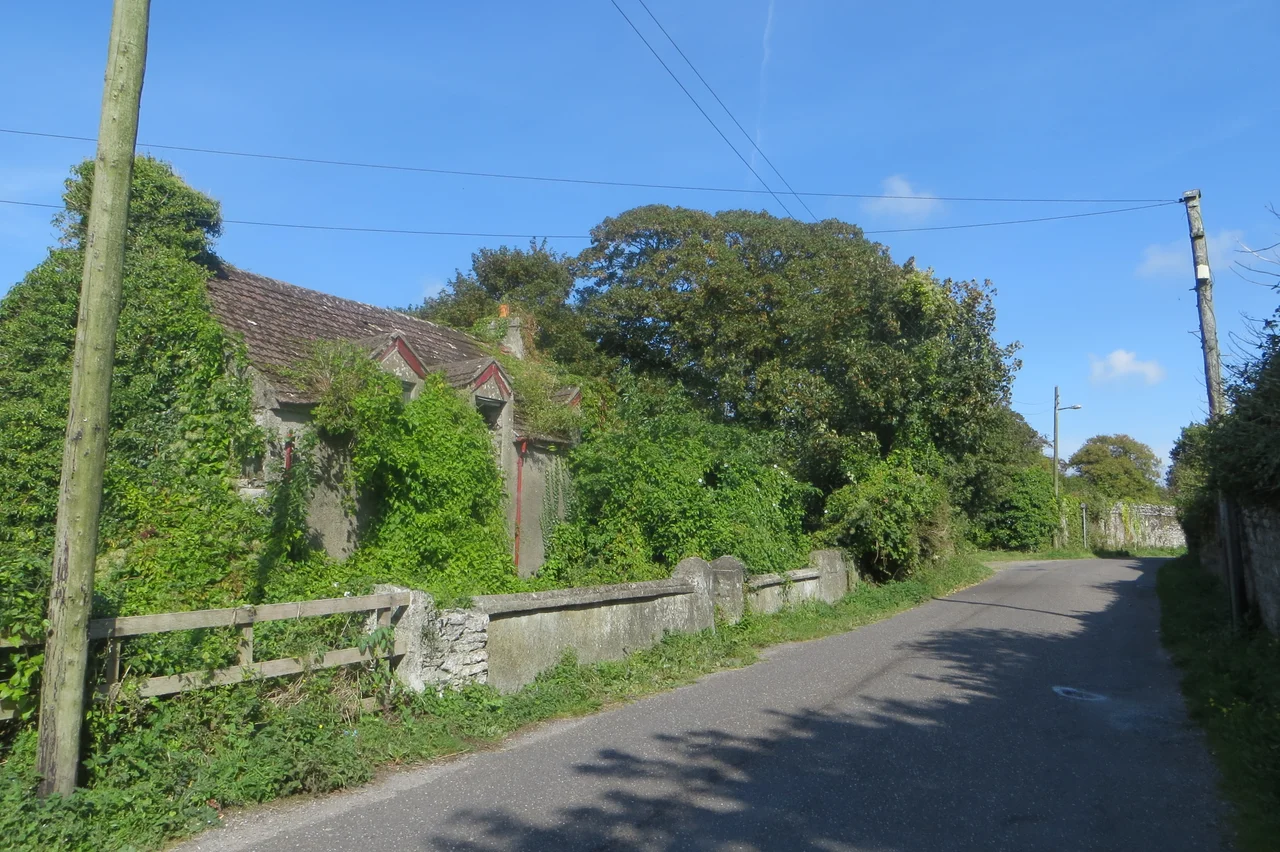

Cloyne
A section of the main street fell into the ground sometime in the 20th century. There was no warning. The limestone beneath the town of Cloyne is honeycombed with caves - the longest cave system in County Cork, estimated at up to seven kilometres - and one day part of the road just collapsed into it. The town has been built on this subterranean network for so long that nobody is exactly sure where every cavity runs. Cloyne Cave is accessible from the grounds of a private house on Rock Street, with the owner's permission. Walk the village and you can feel that the ground beneath your boots is not quite as solid as it looks.
Four Thousand Years of Settlement
West of the town stands a portal dolmen - a Neolithic burial monument roughly 4,000 years old. People were already living here, dying here, and building monuments here before any historical record of Ireland existed. In 560 AD St Colman Mac Lenine founded his monastery and school on the site, donated by Coirpre Cromm mac Crimthainn, King of Munster. The Vikings sacked Cloyne in 822, 824 and 885, killing the abbot and prior on that last raid according to the Annals of the Four Masters. In 978 AD raiders from the kingdom of Ossory plundered the place again. In 1088 Diarmait Ua Briain devastated it. The Synod of Kells recognised Cloyne as a diocese in 1152. Few small towns can lay out a millennium of attack and recovery as cleanly.
The Round Tower and the Cathedral
The Cloyne Round Tower is the town's symbol - a slender stone cylinder dating to the 10th or 11th century, raised several centuries after St Colman founded his monastery. In 1749 a lightning strike damaged its top, and the marks of that strike are still visible in the masonry. On the hill above town stand the ruins of a Norman watchtower, a much later addition. St Colman's Cathedral, the Church of Ireland cathedral, was founded in 1250 AD. The Roman Catholic church, also dedicated to St Colman, was built in 1815 and celebrates Mass every day of the week. Tower, cathedral, and Catholic parish church together form the religious skyline of a town whose first religious foundation predates them all by a thousand years.
The Day the Barracks Burned
Cloyne's most significant moment of the Irish War of Independence came on 4 May 1920. IRA volunteers of the Fourth Battalion attacked the local Royal Irish Constabulary barracks. They failed at first to get inside, but succeeded in setting the building on fire. The garrison surrendered entirely. The volunteers tied the prisoners' hands and ordered them to march the road to Midleton while the flying column escaped in the other direction. By comparison with what would happen ten months later at nearby Clonmult - the IRA's worst single defeat of the war - the Cloyne action was small. But it was the moment Cloyne crossed over from a quiet ecclesiastical town to an active participant in the war that produced the Irish Free State.
Mild Weather, Wet Years
Cloyne sits at the bottom of a valley between hills, less than four kilometres from the open Celtic Sea and only two miles from Cork Harbour. The maritime location gives it a mild climate. Six days of frost in an average year. Snow almost unknown - the exceptions are notable, like Storm Emma in March 2018 or the unusual January of 2010 when air frost was recorded on sixty-two days. The highest temperature on record at Cloyne was 31.1 Celsius on 3 August 1995. The lowest was minus 7.1 Celsius, recorded twice, in January 1979 and January 1987. Annual rainfall averages around 1,041 millimetres. 2009 was the wettest year - 1,433 millimetres. 1975 was the driest, at 584 millimetres. The land itself is rich limestone, good for wheat and barley.
Berkeley, Ring, and Galveston
George Berkeley - the philosopher who became Bishop of Cloyne in 1734 and gave his name to the University of California, Berkeley - was Cloyne's most internationally famous resident. But the list of people who came out of this small town is longer than its population would predict. Christy Ring, born here in 1920, became arguably the greatest hurler in Cork's history - he learned the game on these streets before joining Glen Rovers in the city, and he is buried here, commemorated by a statue. Nicholas Joseph Clayton, born in Cloyne in 1840, emigrated as a child and became Galveston, Texas's most prolific Victorian architect, designing buildings that survived hurricanes and fires. Cynthia Longfield, entomologist and explorer, was born in Cloyne in 1896 and is buried at the cathedral. Sir John Madden, who emigrated to Australia at thirteen, became Chief Justice of Victoria. More recent hurlers - Donal Og Cusack, Diarmuid 'The Rock' O'Sullivan, his brother Paudie O'Sullivan - all came out of Cloyne for Cork senior hurling. A town built over caves keeps surprising you with what it produces.
From the Air
Located at 51.86°N, 8.12°W in East Cork, in a valley between hills 7.6 km south-east of Midleton. From altitude Cloyne reads as a small town with its 11th-century round tower as the dominant vertical landmark. Cork Airport (EICK) is about 24 km west; the Celtic Sea is 5.6 km east, Cork Harbour 3.2 km west. In clear weather the surrounding farmland - limestone-rich, much of it under wheat and barley - shows as a green patchwork around the town centre.
Nearby Stories
- St. Declan's Monastery 0.8 km away
- Aghavrin House 2.4 km away
- Mitchelstown Castle 7.4 km away
- Clonakilty 9.5 km away
- Inislounaght Abbey 16 km away
- Walter Siepmann 23 km away
- Newcastle West 33 km away
- SM U-27 110 km away