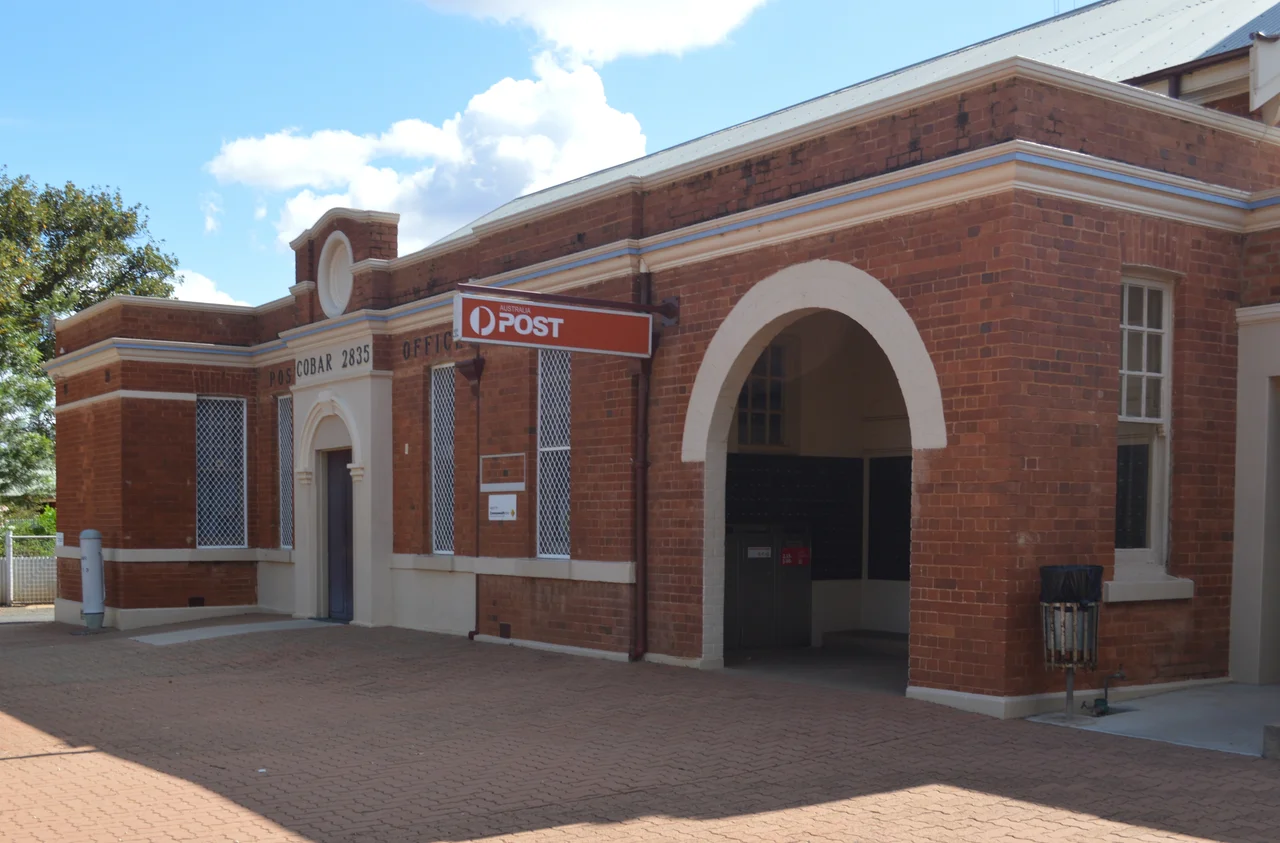

Cobar Post Office
Before there was a building, there was a complaint. In the 1870s the mail for the Cobar mine passed through whatever premises the local postmaster happened to occupy - including, at one point, an inn, which generated grumbling from townsfolk who had to collect their letters at a pub. A copper town that led the nation in production deserved better, and in 1885 it got it: a handsome brick post and telegraph office on Linsley Street, its arched Italianate doorway announcing that the postal service, and the town itself, were here to stay.
A Letter to the Outback
The thread runs back to 1873. That March, a weekly mail service was established between Bourke and the Cobar mine, the first postmaster being Charles Claxton, a storekeeper who ran it out of the mining company's own store. For more than a decade the office wandered from one borrowed building to another. Then, in mid-1881, the Colonial Architect was asked to design something permanent. The tender was let in 1884, and on 15 August 1885 the new brick building opened - at first a post "office" only, a single high-ceilinged room about 26 feet wide, with a porch flanked by two small lobbies where the public could write at sloping boards. A town finally had a proper address.
Barnet's Hand, Vernon's Additions
The original building came from the office of James Barnet, the New South Wales Colonial Architect whose work shaped the colony's public face - the grand General Post Office in Sydney chief among them. Cobar's is a country cousin of that lineage, built of locally made red brick. But the building you see today is not purely Barnet's. Across the following decades it grew under his successor, Walter Vernon: a postmaster's residence added at the rear in 1892, alterations to the facade in 1899, and a substantial reworking around 1907 to 1909 that gave the front its present face. The result is layered - an asymmetrical parapeted screen standing before a tall gabled hall, the whole thing a record of a town's growing needs.
Reading the Facade
Stand on Linsley Street and the details reward a slow look. The unpainted red face brick is banded with crisp white rendered mouldings and dressed stone window sills. Slightly left of centre, the rendered Italianate archway is crowned by a squared pediment with an inset circular panel ringed in egg-and-dart moulding. Tall timber-framed windows fill the flanking bays. And picked out in individual metal letters above the arch is the building's plainest poetry: COBAR 2835 - the name and the postcode - with POST and OFFICE spelled out over the windows to either side. Next door stands the historic council chambers, sharing the post office's materials and scale, the two buildings reading as a single civic statement on the street.
Still Standing, Still Serving
Heritage often means a building frozen as a museum piece. Cobar Post Office is not that. It earned its place on the Australian Commonwealth Heritage List on 22 August 2012 for both its history and its strong streetscape presence - and it remains a working post office, as it has been for the better part of a century and a half. In 2025 the town marked 140 years of service from the building. The quarters at the rear, once the postmaster's home, are now let as a rental. For a structure that began as an answer to a complaint about collecting mail at an inn, it has aged into something close to dignity.
From the Air
Cobar Post Office stands at 47 Linsley Street in central Cobar, at approximately 31.50 degrees S, 145.84 degrees E, one block south of the main highway. From the air it is part of the dense town grid rather than a standalone landmark - look for the civic cluster near the town centre, with the post office and adjoining council chambers sharing a red-brick character. Cobar Airport (ICAO YCBA) lies about 5.6 km southwest with a sealed runway; Bourke (YBKE) and Nyngan (YNYN) are the nearest alternates. The semi-arid climate offers clear skies over 150 days a year and excellent visibility for spotting the township against the surrounding red mulga country.
Nearby Stories
- Mount Drysdale, New South Wales 19 km away
- Nymagee 47 km away
- Louth, New South Wales 87 km away
- Paroo-Darling National Park 123 km away
- Ivanhoe 147 km away
- Roxy Theatre and Peters Greek Cafe Complex 443 km away
- Bingara 454 km away
- Lake Burley Griffin 469 km away