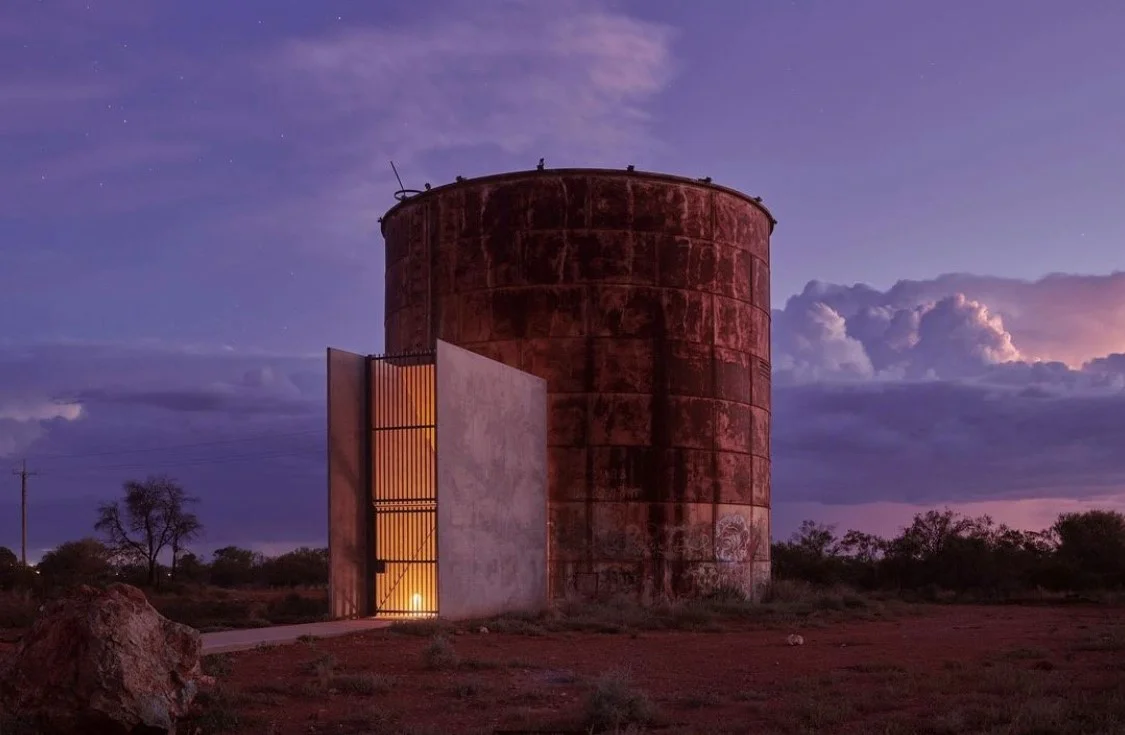

Cobar Sound Chapel
Drive a kilometre and a half west of Cobar, past the slag and the red dirt, and you come to an old steel water tank from 1901 - the kind of derelict thing the outback is full of. Step through its steel gates and the air changes. Inside the rusted shell sits a bare concrete cube, open to the sky through a single round oculus, and from its walls comes music: strings, layered and shifting, that have been playing without pause since the morning of 2 April 2022, and will keep playing, day and night, indefinitely. This is the Cobar Sound Chapel, and it may be the strangest, most beautiful building in the bush.
Twenty Years in the Making
The chapel is the work of two remarkable Australians. The composer and sound artist Georges Lentz dreamed it; the architect Glenn Murcutt - the only Australian to win the Pritzker Prize, architecture's highest honour - gave it form. Their solution was elegant and odd in equal measure: cast a five-metre concrete cube in situ inside the ten-metre disused tank, set loudspeakers into its four walls, cut an oculus in its ceiling to the sky, and frame the entrance with a pair of five-by-five-metre walls. Twenty years passed between conception and completion. The result is neither concert hall nor gallery nor church, yet somehow it is all three - a space built for one purpose, to hold a piece of music and the silence of the desert around it.
The Endless Quartet
The music is Lentz's String Quartet(s), a vast digital, surround-sound composition some 43 hours long, recorded over more than two decades by the Sydney string quartet The Noise. It was inspired by the outback itself - the immense, empty land and, above all, its night skies, where the stars crowd down with a clarity city-dwellers forget exists. The piece does not loop in any ordinary sense; Lentz speaks of the whole chapel as music, a single "digital string quartet," with the very proportions of the building tuned to rhythmic patterns in the sound. Solar power keeps it running. It plays to whoever happens to be standing inside, and to no one at all in the small hours, with equal devotion.
Many Hands, Many Voices
Look closely and the chapel reveals its influences, layered like the music. There are echoes of Aboriginal dot painting in its sensibility, and the visionary art and poetry of William Blake - a Blake inscription is set into one wall. Lentz even left room for the graffiti already scrawled on the old tank, and for passages of AI-generated sound woven into the whole. The chapel's blue corner windows are the work of Sharron Ohlsen, a Cobar Indigenous artist, grounding this global, experimental work firmly in the country where it stands. It is a deeply collaborative thing - a composer, an architect, a quartet, a poet two centuries dead, a local artist, and the desert all speaking at once.
A Chapel With No Religion
Why "chapel"? Because of what the place does to people. Visitors describe stepping inside and falling still, the music rising around them, the disc of sky overhead shifting from blue to black to a scatter of stars. There is no doctrine here, no service, no congregation - only sound, concrete, and light, and the sense that you have entered somewhere set apart. The international press took notice, the New York Times among them, drawn by the unlikely image of a soul-quenching sanctuary built inside an abandoned tank in one of the most remote corners of New South Wales. It is the kind of thing that should not exist this far from anywhere. That it does is the whole point.
From the Air
The Cobar Sound Chapel sits about 1.5 km west of Cobar township, at approximately 31.499 degrees S, 145.842 degrees E. From the air it is modest - a low cylindrical former water tank and its concrete entrance walls, easy to miss against the surrounding scrub; orient instead on Cobar town and its prominent slag dump just to the east. Cobar Airport (ICAO YCBA) lies roughly 5.6 km southwest with a sealed runway; Nyngan (YNYN) and Bourke (YBKE) are the nearest alternates. Skies here are exceptionally clear, with over 150 clear days and 3,200-plus hours of sunshine a year - the same brilliant, star-filled nights that inspired the music within. The chapel is best experienced on the ground, after dark, beneath its open oculus.
Nearby Stories
- Mount Drysdale, New South Wales 19 km away
- Nymagee 47 km away
- Louth, New South Wales 87 km away
- Paroo-Darling National Park 123 km away
- Ivanhoe 147 km away
- Roxy Theatre and Peters Greek Cafe Complex 443 km away
- Bingara 454 km away
- Lake Burley Griffin 469 km away