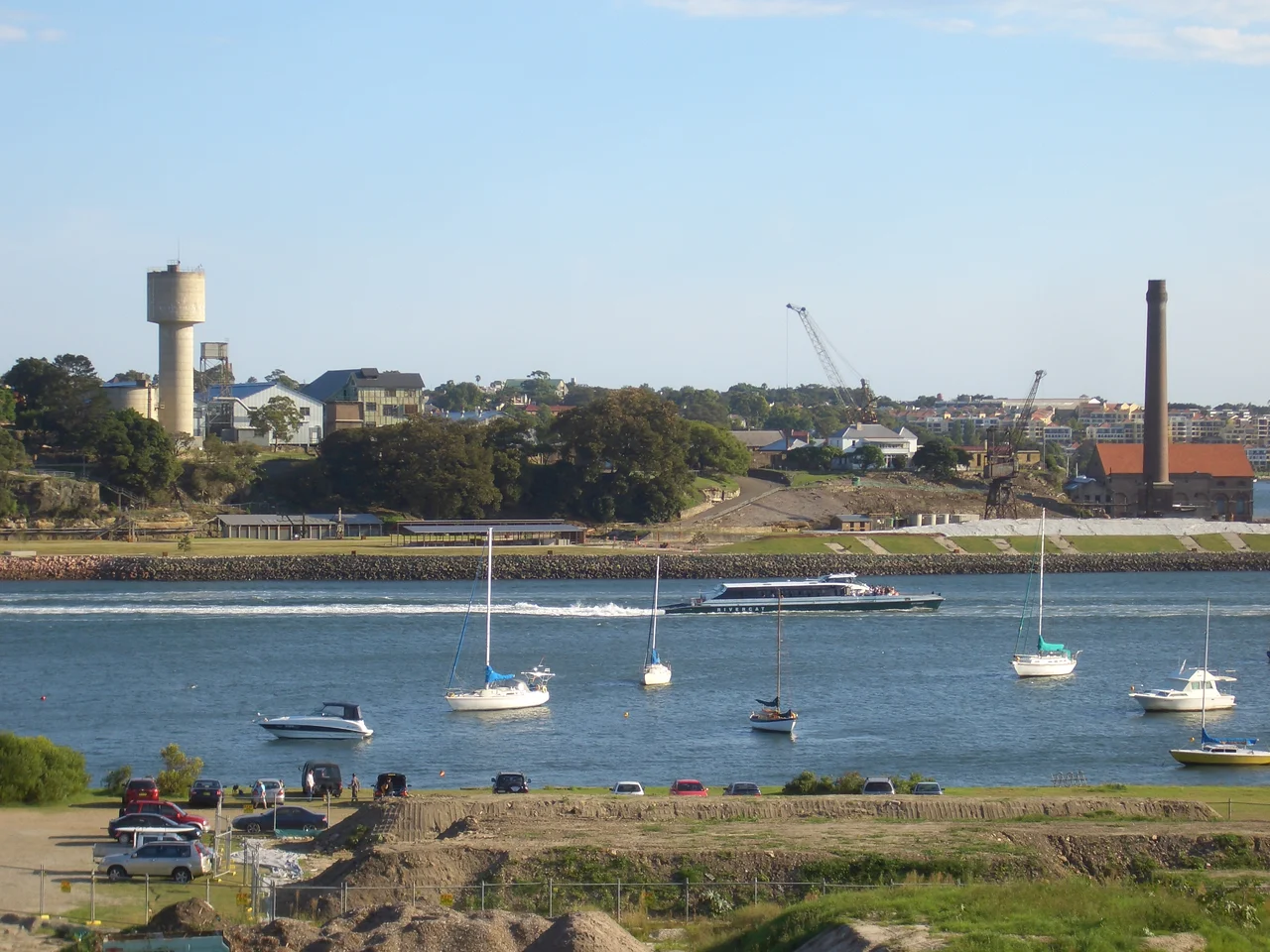

Cockatoo Island
On a small island in the middle of Sydney Harbour, men in chains once cut a hole in solid sandstone large enough to swallow a ship. Cockatoo Island, called Wareamah by the First Nations peoples whose homelands surround this water, is barely thirteen hectares of rock, yet it carries more history than islands many times its size. It served as a brutal convict prison, became the largest shipyard in the country, built and repaired the warships of two world wars, and is now a UNESCO World Heritage Site where you can camp overnight beside the ruins. Few places in Australia compress so much labour, suffering, and ingenuity into so little ground.
Wareamah and the Penal Years
Long before the prison, this was Wareamah, a sandstone knoll connected to the waterways and Country of the Wallumedegal, Wangal, Cammeraygal, and Gadigal peoples, who may have used it as a fishing base. In 1839 Governor Sir George Gipps chose the island as the site of a new penal establishment, and from 1839 to 1869 it held convicts, mostly men sent here as secondary punishment for re-offending in the colony. The first arrivals came from Norfolk Island, and they built their own barracks and cut grain silos into the rock by hand; by 1842 the silos held around 140 tonnes of the colony's grain. These were men twice condemned, made to quarry the very stone that imprisoned them. So heavy was the island's reputation that from 1871 its facilities were often called Biloela rather than Cockatoo Island, an attempt to shed the stain of its convict past. One inmate, the bushranger Captain Thunderbolt, escaped in 1863 and rode into legend, though the romantic tale of his wife swimming tools across the harbour has never been proven.
A Dry Dock Cut by Hand
The island's most astonishing feature was built by the prisoners themselves. Between 1847 and 1857, convict labour excavated some 580,000 cubic feet of sandstone to carve out the Fitzroy Dock, designed by the island's civil engineer Gother Kerr Mann. It was the first large graving dock begun in the southern hemisphere, and it remains the only convict-built dry dock of its kind to survive. The numbers still impress: when finished in 1857 the dock measured 316 feet long and 76 feet wide, with an entrance 60 feet across, later lengthened to 643 feet. Governor FitzRoy laid the foundation stone of its ashlar lining in June 1854, and HMS Herald became the first vessel to float into it in December 1857. The dock would go on working for 134 years. It is worth pausing on what that meant: men with no stake in the result, swinging picks in the heat, shaped a structure so well-made that it outlasted the empire that compelled them to build it.
The Shipyard That Built a Navy
After the convicts came the shipwrights. Shipbuilding began in 1870, and in 1913 the island was handed to the Commonwealth to become the Naval Dockyard of the Royal Australian Navy. The work reached its peak in the First World War, when some four thousand people laboured on this small island, building, repairing, and refitting ships. The yard's first naval launch was a torpedo boat destroyer, built in the United Kingdom, taken apart, shipped out, and reassembled here. For more than a century Cockatoo Island held the nation's most extensive shipbuilding complex, its slipways and cranes and dry docks a working museum of heavy industry. When the yards finally fell silent in the early 1990s, an era ended that had spanned sailing ships and steel-hulled warships alike. Today the island preserves the most varied record of shipbuilding anywhere in Australia, the layered evidence of how a young country learned to build for the sea.
From Ruins to Festival Ground
An island this dense with the past could easily have crumbled into a closed ruin. Instead it was saved and reopened. In 1995 a group called Friends of Cockatoo Island, founded by Jack Clark and his wife Mary Shelley Clark, campaigned to protect the island and other former defence sites, helping prompt the creation of the Sydney Harbour Federation Trust. In 2010, UNESCO inscribed Cockatoo Island, along with ten other Australian Convict Sites, on the World Heritage List as among "the best surviving examples of large-scale convict transportation." Now the island lives a fourth life as a cultural venue. It has hosted the Biennale of Sydney, drawing more than 156,000 visitors in a single season, and a music festival curated by Nick Cave. Parts of X-Men Origins: Wolverine were filmed among its industrial bones. Visitors arrive by ferry to picnic, wander, and pitch tents at a campsite that fills to capacity to watch the New Year's Eve fireworks, sleeping above the cells where the colony once sent its most desperate men.
From the Air
Cockatoo Island lies at 33.847°S, 151.172°E, at the meeting of the Parramatta and Lane Cove Rivers in Sydney Harbour, west of the Harbour Bridge. From the air it is a clear, distinctive landmass: an oval island ringed by water with the rectangular scars of its dry docks and slipways visible on its lower terraces and the wooded plateau rising in the centre. It makes an excellent visual waypoint for harbour navigation. View on a harbour circuit at 1,500 to 2,500 feet, with the Gladesville Bridge to the west and the CBD towers to the east. Sydney Airport (YSSY / Kingsford Smith) lies roughly 12 km southeast; Bankstown (YSBK) serves general aviation to the southwest. Harbour airspace is controlled and busy with seaplanes and scenic traffic, so coordinate with ATC; clear conditions reveal the dock outlines best.
Nearby Stories
- Royal National Park 28 km away
- Jervis Bay 107 km away
- Hive shipwreck 149 km away
- Apsley Falls 283 km away
- Smoky Cape Lighthouse 316 km away
- South West Rocks Pilot Station Complex 346 km away
- Roxy Theatre and Peters Greek Cafe Complex 413 km away
- 2003 Fiordland Earthquake 1774 km away