.jpg)
Cockington Court
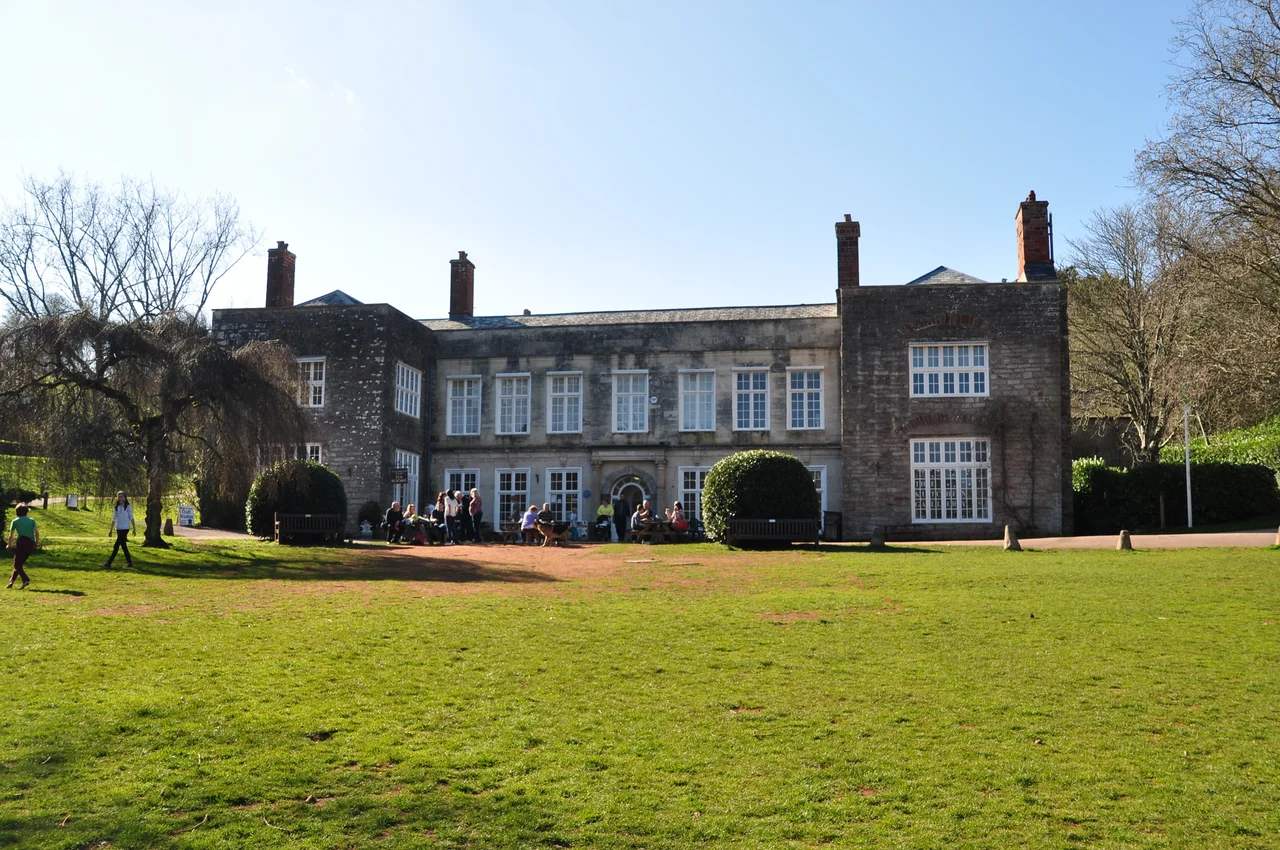
Before she invented Hercule Poirot, before she became the bestselling novelist in history, Agatha Christie was Sister Anne in a homemade burlesque of Bluebeard. The year was around 1912. The setting was the terrace of Cockington Court, a 16th-century manor outside Torquay where her friends the Mallocks lived. In the photographs that survive, Agatha is in voluminous harem trousers. Her hostess plays Scheherazade. The men sport magnificent whiskers and turbans. The first act of the play, the programme promises, is titled "Why Did They Bag-Dad?" It is impossible, looking at those laughing young people on the lawn, to imagine the war that was about to take all of it away.
Saxon Bones, Tudor Walls
The manor at Cockington is old enough to appear in the Domesday Book of 1086, but the bones beneath it are older still. The Cary family raised the present house in the 16th century, a Tudor pile of stone and slate set in a fold of the Devon hills two miles from the sea. Sir George Cary, an Elizabethan worthy, sat at its head until his death; the place passed to younger brothers, then nephews, then finally to Sir Henry Cary, a Major in the Royalist Army. The Civil War ruined him. To pay his debts he sold Cockington in the 1650s to Roger Mallock, the head of a wealthy Exeter silversmithing family. The Mallocks would hold it for nearly three centuries, remaking the interiors and gardens to suit successive generations, until the estate finally passed to the Torbay Council in the 1930s. The English Heritage Register lists it Grade II*.
The Bluebeard of Unhappiness
Margaret Mallock loved theatricals. She and her husband Charles Herbert Mallock were friends of Agatha Christie's mother and would invite Agatha across the valley for weekends of cricket, picnics, and amateur dramatics. In her autobiography Agatha remembered "a musical play got up by friends in Torquay, a version of Bluebeard, with topical words, written by themselves. I was Sister Anne, and the object of my affections later became an Air Vice-Marshal." The biographer Janet Morgan describes one set of photographs from around 1912: a dozen friends "larking about," the women in beads and veils, performing "The Blue Beard of Unhappiness" on the Cockington terrace. Mrs. Mallock played Scheherazade. The programme was printed on blue paper, of course. Agatha was in her twenties, shy enough that performing required real courage, and entirely uninterested in being a famous writer. That was all still ahead of her.
The Telegram
What came next was the war that ended everything. Charles Mallock joined up. In 1917 he was killed in action. His wife Margaret was pregnant with twins and was out on the road when the telegram reached her. Margaret's sister Joan Millyard remembered the shock: "the baby girl lived, the boy died." Agatha was twenty-seven, newly married, and grieving her own losses. She rode the train down from Torquay again and again that year and the next, to sit with Margaret and the surviving daughter. "Agatha was very understanding and kind to her in that period," Joan recalled. The friendship outlasted the grief. In 1934, when Agatha published "Why Didn't They Ask Evans?", she dedicated it to Margaret's son Christopher. Four years later, "Appointment with Death" was dedicated to his older brother Richard and his wife Myra, "to remind them of their journey to Petra."
A Craft Centre, A Living Room
The Mallocks announced the sale of the Cockington Estate in 1932. The Torbay Council bought the lot, and what had been a private demesne became a public possession. Today the Tudor house operates as a craft centre and event venue, the kind of working heritage site where you can buy a hand-thrown bowl in what used to be a drawing room and get married in the gardens where amateur Bluebeards once strutted. The thatched cottages of Cockington village press around it, and the lanes are still narrow enough to discourage cars. If you walk the terrace where Agatha posed in her harem trousers, you can squint and almost see the photograph being taken, the long Edwardian afternoon stretching on, oblivious to the century that was about to begin.
From the Air
Cockington Court sits at 50.4639 N, 3.5642 W, about two miles inland from Torquay harbour on the South Devon coast. View from 2,000 to 3,000 feet for the best appreciation of the wooded combe, the cricket pitch, and the village clustered around the manor. Nearest airport is Exeter (EGTE), roughly 18 nautical miles to the north-east. Tor Bay opens to the south; the red sandstone cliffs of the English Riviera are unmistakable from the air. Spring through autumn the gardens are at their most photogenic; winter mists pool in the combe at dawn.
Nearby Stories
- Torcross 2.8 km away
- Cotehele 4.6 km away
- HMS Formidable (1898) 9.1 km away
- Holsworthy 9.4 km away
- Eddystone Lighthouse 11 km away
- Tiverton Castle 18 km away
- 1890 Norton Fitzwarren Rail Crash 24 km away
- Lyme Bay Canoeing Disaster 26 km away